What is a learning-rate schedule in the context of training a neural network?
Select an answer to reveal the explanation.
Short Explanation and Infographic
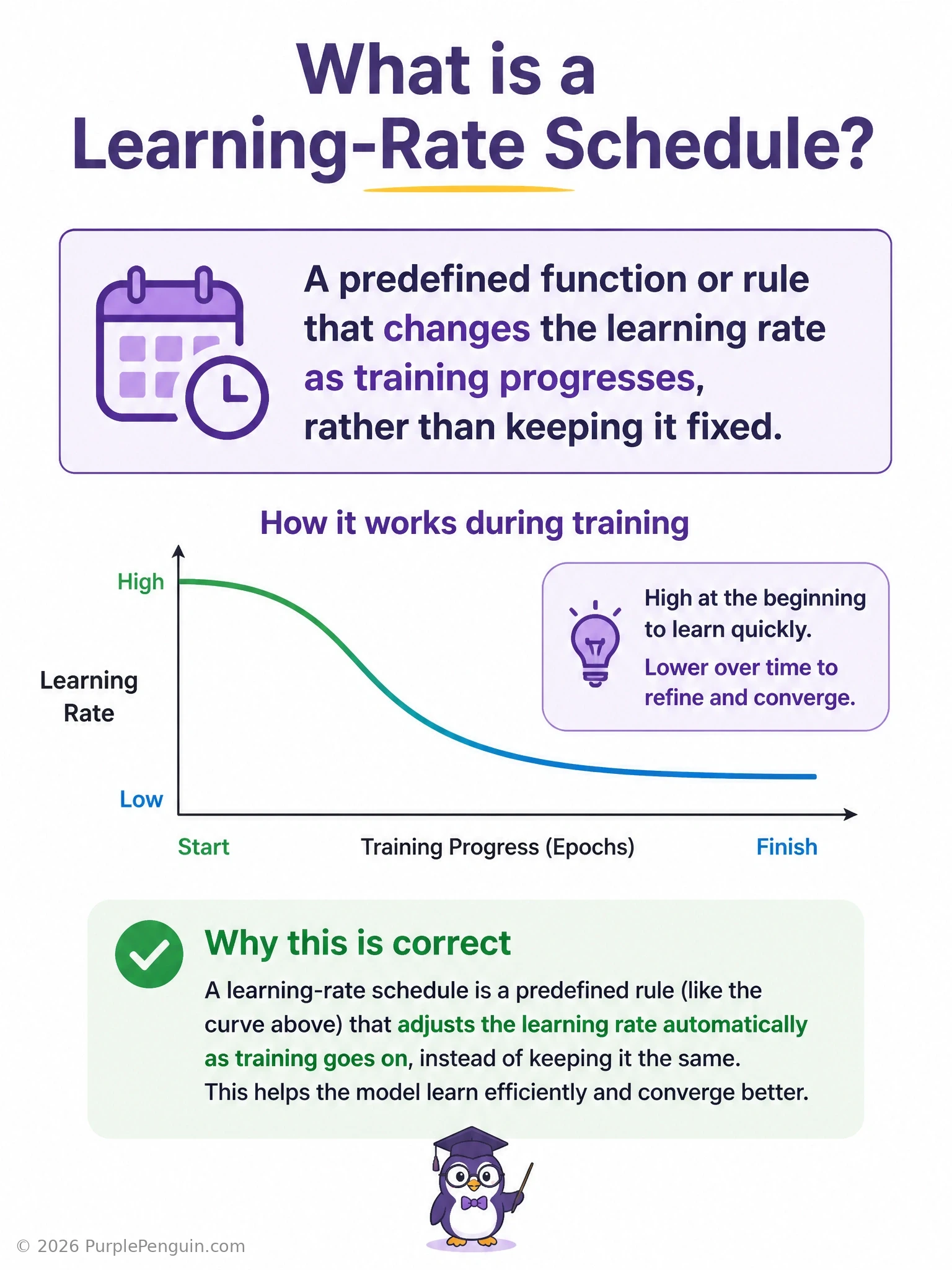
Picture the learning rate as how big a step your optimizer takes toward a better solution. Early in training you often want big steps to make fast progress, and later you want smaller steps so you don't overshoot the minimum you're trying to settle into. A learning-rate schedule is just the rule that adjusts that step size over time instead of leaving it stuck at one value — that's the first option, and it's correct. It's not about assigning batches to GPUs, which is a hardware/data-parallelism concern, and it's not just a training log of epoch counts either — that's bookkeeping, not something that changes how the model learns. It's also not about shuffling sample order; that's part of how mini-batches are constructed, completely separate from step-size control.
Full explanation below image
Full Explanation
A learning-rate schedule is a predefined strategy for varying the learning rate hyperparameter over the course of training rather than holding it constant. Common schedules include step decay (dropping the rate by a fixed factor every N epochs), exponential decay, cosine annealing (smoothly decreasing the rate following a cosine curve), and warmup schedules (starting with a small rate and ramping up before decaying), each designed to balance fast early convergence against stable fine-tuning later in training. This makes the first option correct: a schedule is fundamentally a rule or function of training progress (epoch or step count) that outputs the learning rate to use at that point. The second option, describing a schedule as a table assigning mini-batches to GPUs, actually describes a data-parallelism or device-placement strategy used in distributed training, which is an infrastructure concern entirely separate from the optimization hyperparameter being adjusted. The third option, describing it as merely a log of completed epochs for reporting purposes, confuses a schedule with training telemetry; a schedule actively changes model behavior by altering the step size used in gradient descent updates, it doesn't just record history. The fourth option, describing it as a rule for shuffling training samples each epoch, describes data loading and sampling strategy, which affects what order the model sees examples in but has no direct bearing on the magnitude of the parameter updates. Learning-rate schedules matter because a rate that's too high throughout training can cause the loss to oscillate or diverge, while a rate that's too low throughout can make convergence painfully slow or get the model stuck in a poor local region; scheduling lets a model start with large, exploratory updates and finish with small, precise ones. A useful memory aid is to think of the learning rate like a car's speed when parking: you drive fast to get close to the spot, then slow down as you get near so you don't crash into the curb — the schedule is what tells you when to ease off the gas.