Which of the following is a classic example of a supervised learning task?
Select an answer to reveal the explanation.
Short Explanation and Infographic
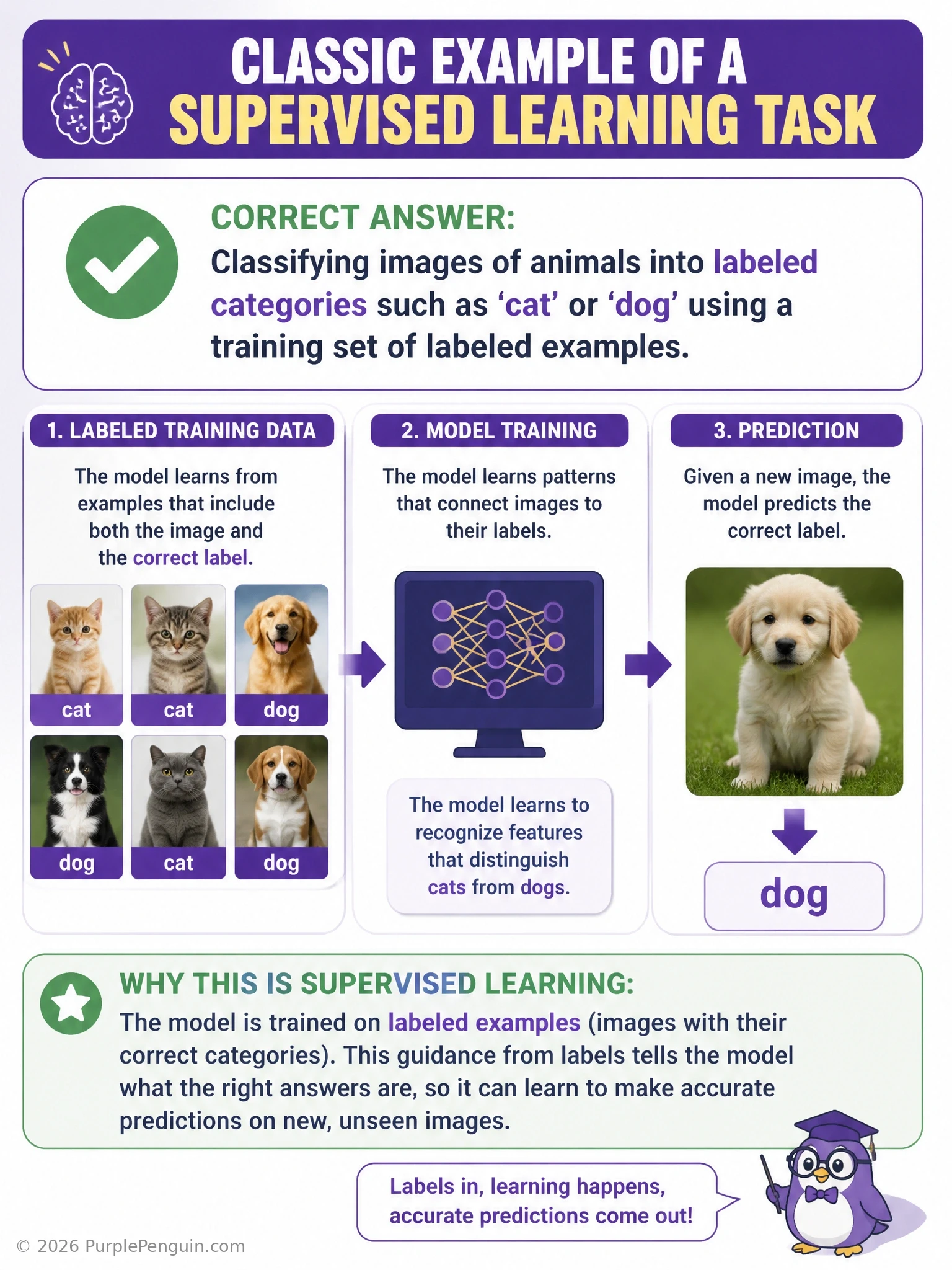
Supervised learning is exactly what it sounds like: you 'supervise' the model by showing it examples where you already know the right answer. Image classification is the textbook case here — you feed the network thousands of pictures already labeled 'cat' or 'dog,' and it learns to map pixels to the correct label. That's why the third option is correct. Clustering unlabeled transactions doesn't count because there's no ground-truth label to learn from — that's unsupervised learning. Training an agent through trial-and-error rewards is reinforcement learning, a different paradigm entirely, driven by reward signals instead of labeled input-output pairs. And dimensionality reduction on unlabeled data, like compressing features for visualization, is also unsupervised — no labels means no supervision.
Full explanation below image
Full Explanation
Supervised learning is defined by training on a dataset of labeled examples, where each input is paired with a known correct output, and the model learns a mapping from inputs to outputs by minimizing the error between its predictions and those ground-truth labels. Image classification into categories like 'cat' or 'dog' is a canonical supervised task because every training image comes with a human-assigned label, and the network's loss function directly compares its predicted class against that label during training. This makes the third option correct. The first option, clustering unlabeled customer transactions into spending groups, is unsupervised learning: the algorithm (e.g., k-means) groups data based on similarity alone, with no predefined labels to guide it, and the resulting clusters are discovered rather than predicted against a known answer. The second option, training an agent to play a game by maximizing a reward signal through trial and error, describes reinforcement learning, a distinct paradigm where an agent learns a policy by interacting with an environment and receiving delayed or immediate rewards, rather than learning from a fixed set of labeled input-output pairs. The fourth option, reducing the dimensionality of an unlabeled dataset for visualization (as with PCA or t-SNE), is also unsupervised, since it only uses the structure of the input features themselves without any target labels to predict. The unifying test for supervised learning is simple: ask whether each training example has a known correct answer that the model is explicitly trained to reproduce. If yes, it's supervised, as with image classification; if the data has no labels and the goal is finding structure (clustering, dimensionality reduction) or the training signal comes from rewards over time (reinforcement learning), it falls into a different learning paradigm. Remembering this label-versus-no-label, reward-versus-no-reward distinction is the fastest way to sort learning tasks into the right bucket on an exam.