A colleague asks you to explain the difference between a shallow neural network and a deep neural network. What is the key distinction?
Select an answer to reveal the explanation.
Short Explanation and Infographic
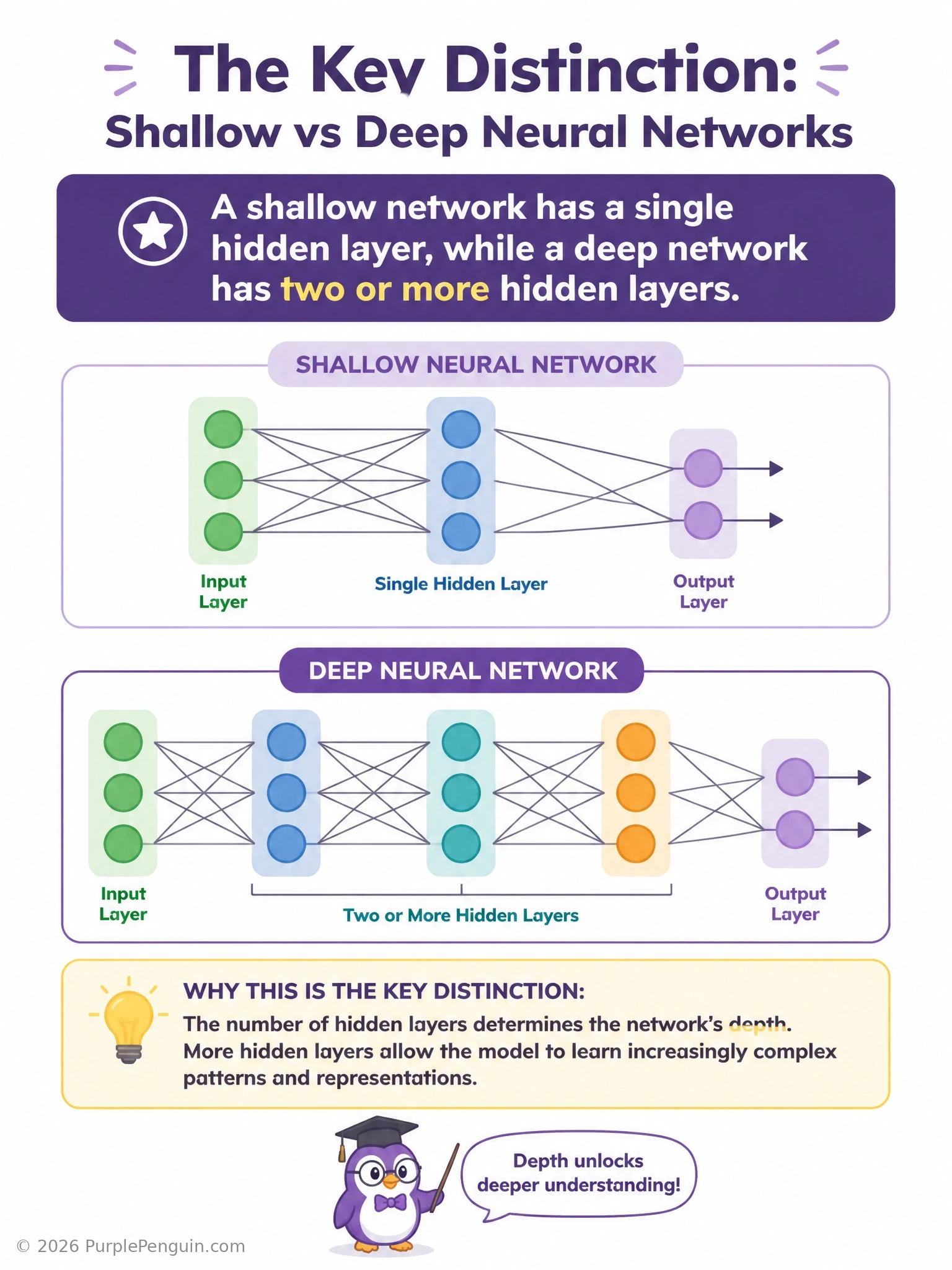
Here's the deal: 'shallow' versus 'deep' is just about how many hidden layers are stacked between input and output. A shallow network stops at one hidden layer, while a deep network keeps stacking two, ten, or a hundred more, letting each layer build on the features the last one learned. That's why the second option is correct. The layer-type option is a trap — both shallow and deep networks can use dense, convolutional, or recurrent layers; depth is about layer count, not layer type. More neurons per layer doesn't make a shallow network train faster than a deep one either — width and depth are independent knobs, and depth actually tends to add training time, not remove it. And activation functions show up in both — deep networks absolutely need them between layers, or all those extra layers would collapse into one linear transform.
Full explanation below image
Full Explanation
The distinction between shallow and deep neural networks comes down strictly to depth: how many hidden layers sit between the input layer and the output layer. A shallow network contains exactly one hidden layer, which — per the universal approximation theorem — can in principle approximate any continuous function given enough neurons, but in practice often needs an impractically large layer to do so. A deep network stacks two or more hidden layers, allowing the model to learn hierarchical representations, where early layers capture simple, low-level features and later layers combine them into increasingly abstract, task-specific representations. This is why the second option is correct: it correctly ties 'shallow' and 'deep' to hidden-layer count rather than to any other architectural property. The option claiming shallow networks use only convolutional layers and deep networks use only recurrent layers is incorrect because layer type (dense, convolutional, recurrent, attention-based) is an orthogonal design choice — you can build a shallow CNN or a deep MLP just as easily as a deep CNN or a deep RNN. The option claiming shallow networks train faster because they have more neurons per layer is incorrect on two counts: first, having more neurons per layer describes width, not shallowness, and a shallow network is not defined by having more neurons; second, training speed depends on total parameter count and computational graph size, not depth alone, so this reasoning conflates unrelated concepts. The option claiming deep networks never use activation functions is incorrect because nonlinear activation functions between layers are precisely what allow depth to matter — without them, stacking any number of linear layers is mathematically equivalent to a single linear layer, erasing the benefit of depth entirely. A useful memory aid: depth counts hidden layers like counting floors in a building — one floor is shallow, multiple floors is deep, regardless of how wide each floor is or what furniture (layer type) fills it.