What does the learning rate hyperparameter primarily control during neural network training?
Select an answer to reveal the explanation.
Short Explanation and Infographic
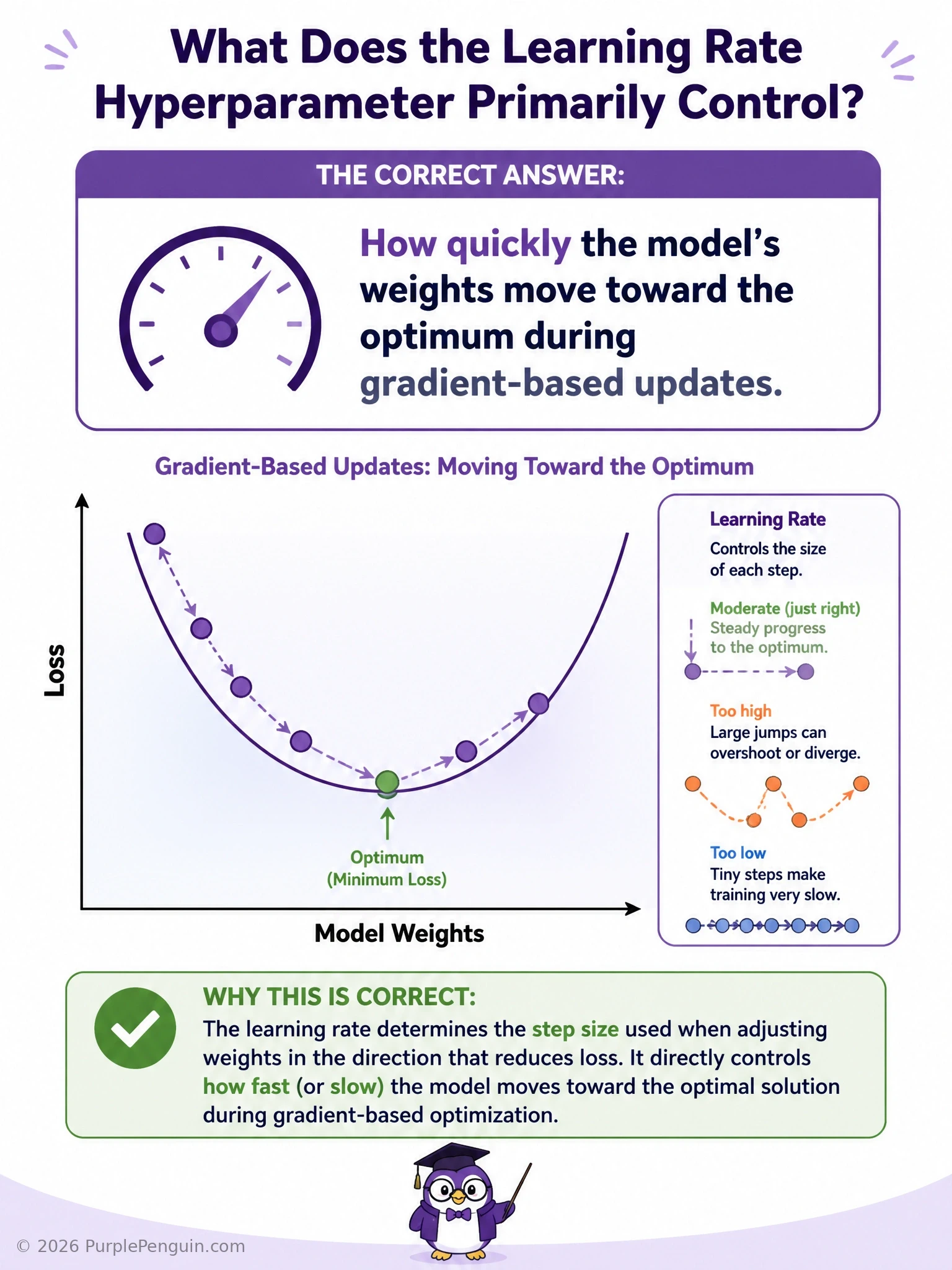
Think of the learning rate as the size of the step you take when you're walking downhill toward the lowest point of the loss landscape. A big learning rate means big steps — you might reach the bottom fast, but you also risk overshooting it or bouncing around wildly. A tiny learning rate means small, cautious steps — safer, but training crawls along and might take forever, or get stuck in a shallow dip along the way. That's answer D, and it's one of the most important knobs you'll tune in deep learning. It's not about how many layers you add, that's architecture design done beforehand. It's not dropout's job of zeroing out neurons, that's a separate regularization technique. And it's not batch size either, which controls how many examples you average a gradient over before updating. Learning rate is purely about step size on each update.
Full explanation below image
Full Explanation
The learning rate is a hyperparameter that scales the size of the update applied to a model's weights during each optimization step. After backpropagation computes the gradient of the loss with respect to each weight, the optimizer multiplies that gradient by the learning rate before subtracting it from the current weight value (in the simplest gradient descent case). A learning rate that is too high can cause the optimizer to overshoot minima, oscillate, or even diverge, with the loss increasing rather than decreasing over time. A learning rate that is too low results in very slow convergence, potentially requiring an impractical number of training iterations, and can also increase the risk of getting stuck in poor local minima or saddle points. Because of this sensitivity, practitioners often use learning rate schedules (which decrease the rate over time) or adaptive optimizers like Adam, which adjust effective step sizes per parameter based on historical gradient information.
The first distractor describes an architectural decision, namely how many layers a network has, which is chosen (or searched for) before training and remains fixed during a given training run; it is unrelated to the size of weight updates during optimization. The second distractor describes dropout, a regularization hyperparameter that specifies the fraction of neurons to randomly deactivate during training in order to reduce overfitting; this is a structural training technique, not a control over step size in gradient descent. The third distractor describes batch size, which determines how many training examples are used to compute each gradient estimate before an update is applied; while batch size can indirectly interact with how learning rate should be tuned, it controls the sample count per step rather than the magnitude of the weight update itself.
A useful memory aid: if gradient descent is a hike down a hill toward the loss minimum, the learning rate is your stride length — too long and you might stumble past the valley floor or fall off a cliff, too short and you'll be hiking long after everyone else has gone home.