A team is choosing between a CNN and an RNN for two different projects: one involves classifying photographs, and the other involves predicting the next word in a sentence. Which statement correctly matches architecture to task?
Select an answer to reveal the explanation.
Short Explanation and Infographic
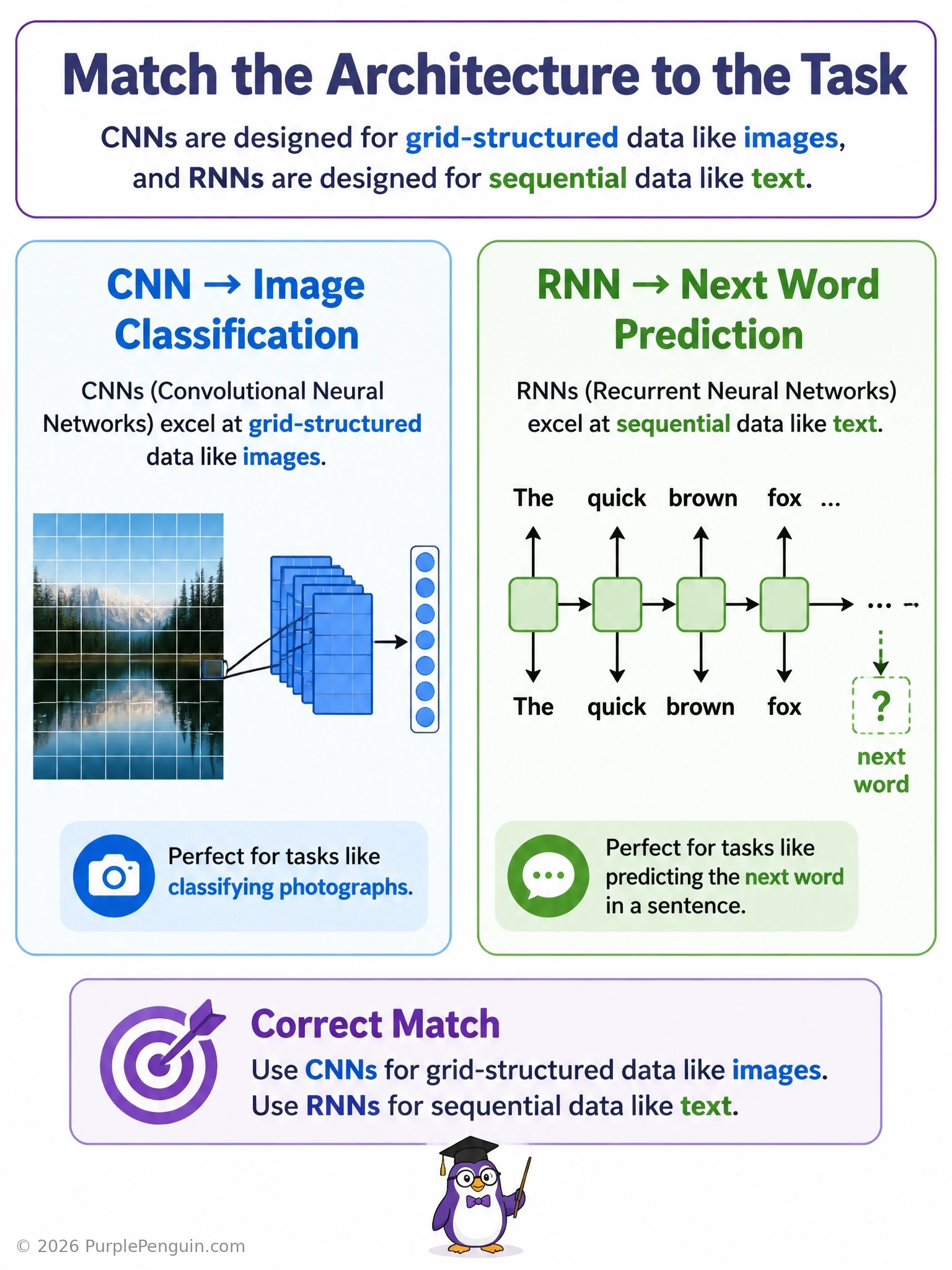
This one comes down to matching the tool to the data's shape. Photographs are grid-structured — rows and columns of pixels where nearby pixels are related in two dimensions — and that's exactly what CNNs were built to exploit with their sliding filters. Sentences, on the other hand, are sequential — order matters, and each word's meaning depends on what came before it — and that's exactly the kind of temporal dependency an RNN's feedback loop and hidden state are designed to capture. So for photo classification you reach for a CNN, and for next-word prediction you reach for an RNN (or these days, often a Transformer, but between just these two options, RNN wins). That's answer C. Don't get it backwards, and don't fall for 'they're interchangeable' or 'they're the same thing' — they're genuinely different architectures built for genuinely different data structures.
Full explanation below image
Full Explanation
Convolutional neural networks and recurrent neural networks are each architecturally specialized for a different type of data structure. CNNs use filters that slide across two (or more) spatial dimensions, exploiting local correlations and translation invariance, which makes them highly effective for grid-structured data such as images, where nearby pixels are meaningfully related regardless of their absolute position. RNNs, by contrast, maintain a hidden state that is updated and passed forward at each time step, allowing them to model dependencies that unfold over an ordered sequence, such as the words in a sentence, where each element's meaning is influenced by what came before it. Matching the architecture to the data structure is a foundational modeling decision: image classification tasks are the classic use case for CNNs, while tasks like language modeling, next-word prediction, or time-series forecasting are the classic use case for RNNs (and their more advanced descendants like LSTMs and GRUs, or increasingly Transformers).
The first distractor reverses the correct mapping, incorrectly assigning grid-structured data to RNNs and sequential data to CNNs; RNNs lack any inherent mechanism for exploiting two-dimensional spatial locality the way convolutional filters do, and CNNs lack the temporal recurrence needed to naturally model arbitrary-length sequential dependencies. The second distractor is incorrect because architecture choice meaningfully affects both performance and efficiency; using a plain CNN for a sequence task discards ordering information unless heavily adapted, and using a plain RNN for image data discards two-dimensional spatial structure and is computationally far less efficient than convolution for that purpose. The third distractor is incorrect because CNNs and RNNs are fundamentally different architectures with different core computations (sliding shared filters versus a recurrent hidden state), not alternate names for the same design.
A helpful memory aid: 'C' for CNN pairs naturally with 'canvas' (a 2D grid like an image), while 'R' for RNN pairs naturally with 'reading' (processing information in a sequential order, one step at a time).