What is a key distinction between deep learning and traditional machine learning approaches?
Select an answer to reveal the explanation.
Short Explanation and Infographic
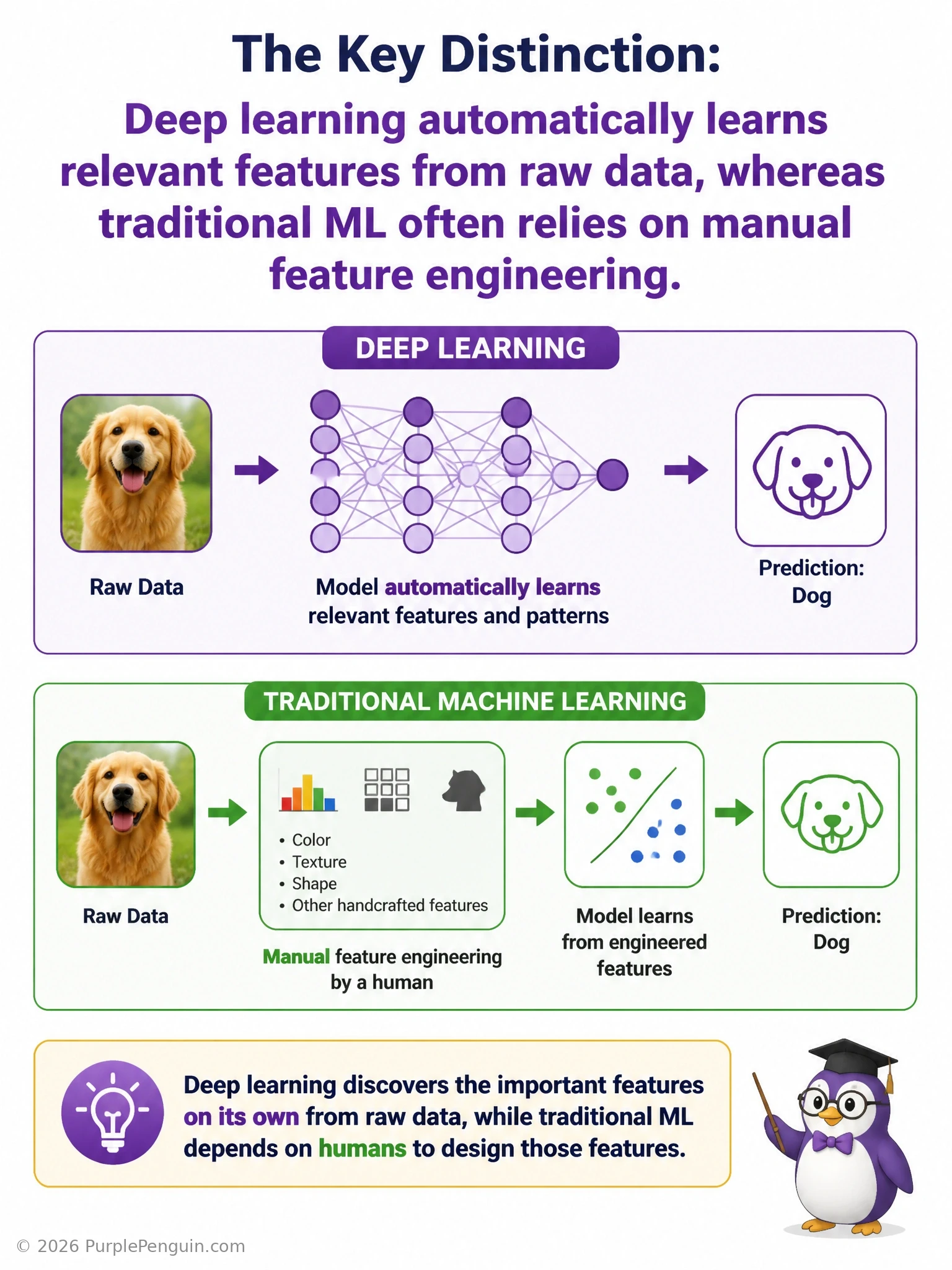
Here's the classic distinction between old-school ML and deep learning: with traditional ML, a human expert usually has to sit down and hand-craft the features — deciding, say, which pixel statistics or edge counts might help a model tell cats from dogs. Deep learning flips that on its head. Feed it raw pixels, and the network itself learns which features matter, layer by layer, with zero hand-holding on what to look for. That's answer B, and it's arguably the single biggest reason deep learning took off. Traditional ML absolutely still involves preprocessing, often a lot of it, so that first option is just wrong. Deep learning is used constantly for classification, it's one of its bread-and-butter applications, so ignore that one too. And traditional ML doesn't always beat deep learning — it actually tends to do better mainly on small, simple, tabular datasets, while deep learning shines with more data and more complex, unstructured inputs like images or text.
Full explanation below image
Full Explanation
A defining distinction between deep learning and traditional machine learning lies in how features are obtained. Traditional machine learning pipelines typically require domain experts to manually design and select features (feature engineering) that are believed to be predictive for a given task, and these hand-crafted features are then fed into algorithms such as logistic regression, support vector machines, or decision trees. Deep learning, by contrast, uses multi-layer neural networks that automatically learn a hierarchy of increasingly abstract features directly from raw or minimally processed data (such as pixel values or raw text tokens), removing much of the need for manual feature design and often discovering feature representations that outperform hand-engineered ones, particularly on complex, high-dimensional, unstructured data.
The first distractor is incorrect because traditional machine learning pipelines commonly involve substantial preprocessing, such as normalization, handling missing values, encoding categorical variables, and the manual feature engineering step itself; claiming no preprocessing is required misrepresents how these pipelines typically work. The second distractor is incorrect because deep learning models, including CNNs and fully connected networks, are widely and successfully used for classification tasks such as image recognition, spam detection, and sentiment analysis; classification is one of the most common applications of deep learning, not something it is incapable of. The third distractor is incorrect because performance depends heavily on the dataset's size, structure, and complexity; traditional ML methods often perform comparably or better on small or structured tabular datasets where hand-crafted features are effective and abundant data isn't available, while deep learning tends to have an advantage on large-scale, unstructured data such as images, audio, and text, meaning neither approach universally dominates the other.
A helpful memory aid: traditional ML says 'tell me what to look for,' while deep learning says 'let me figure out what's worth looking for myself,' which is precisely the automatic feature learning that distinguishes the two paradigms.