How does a dense (fully connected) layer differ structurally from a convolutional layer?
Select an answer to reveal the explanation.
Short Explanation and Infographic
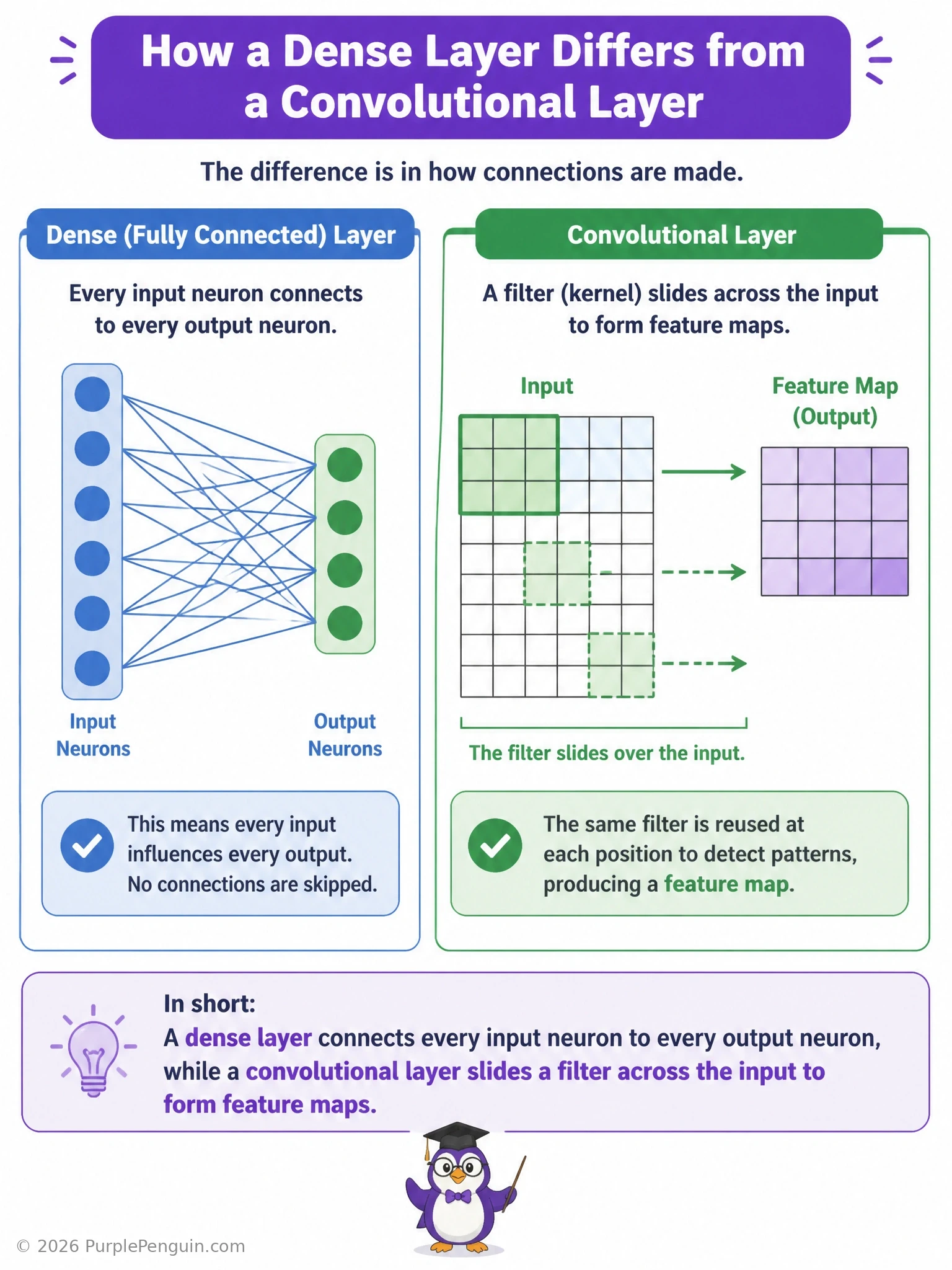
Here's the structural difference in plain terms: a dense layer wires up every input neuron to every output neuron, each connection with its own weight — full connectivity, no exceptions. A convolutional layer does something different: it takes one small filter and slides it across the input, reusing those weights at every position to build a feature map. That's answer A. It's not that dense layers only handle images and conv layers only handle text — that's backwards, since conv layers are famous for image data, and dense layers are general-purpose. It's also false that dense layers need no learnable weights; they're packed with weights, one per connection. And there's no rule that dense layers always come after the output or conv layers always precede the input — layer ordering is a design choice, not a fixed law. Full connectivity versus shared sliding filters is the real distinction.
Full explanation below image
Full Explanation
The structural distinction between a dense (fully connected) layer and a convolutional layer lies in how their neurons connect to the previous layer's outputs. In a dense layer, every neuron is connected to every neuron in the preceding layer, each connection having its own independently learned weight; this gives the layer maximum flexibility to combine information from anywhere in its input but results in a very large number of parameters, especially when the input is large (such as a flattened image). In a convolutional layer, by contrast, a small filter (kernel) is applied via a sliding-window operation across the spatial extent of the input, with the same set of weights reused at every position (parameter sharing). This local, shared-weight structure captures spatial locality and dramatically reduces the parameter count relative to a dense layer operating on the same input size.
The first distractor is incorrect and in fact inverted relative to common usage: convolutional layers are especially well suited to image (grid-structured) data due to their ability to exploit spatial locality and translation invariance, while dense layers are general-purpose and can be applied to any flattened input regardless of modality, including the final stages of both image and text pipelines. The second distractor is incorrect because dense layers are actually characterized by having a very large number of learnable weights — one per connection between input and output neurons — while convolutional layers, though they do have learnable weights (the filter values), typically have far fewer parameters due to weight sharing; neither layer type lacks learnable weights entirely. The third distractor is incorrect because there is no universal architectural rule dictating layer order in this way; convolutional layers are commonly placed early in a network to extract spatial features, with dense layers typically appearing later to perform classification, but this is a common design pattern rather than an inviolable rule, and many valid architectures deviate from it.
A useful memory aid: 'dense' means every-to-every connectivity with independent weights, while 'convolutional' means a small, shared filter slides across the input, trading some flexibility for spatial awareness and parameter efficiency.