What specific architectural property allows a CNN to efficiently capture local spatial features in an image?
Select an answer to reveal the explanation.
Short Explanation and Infographic
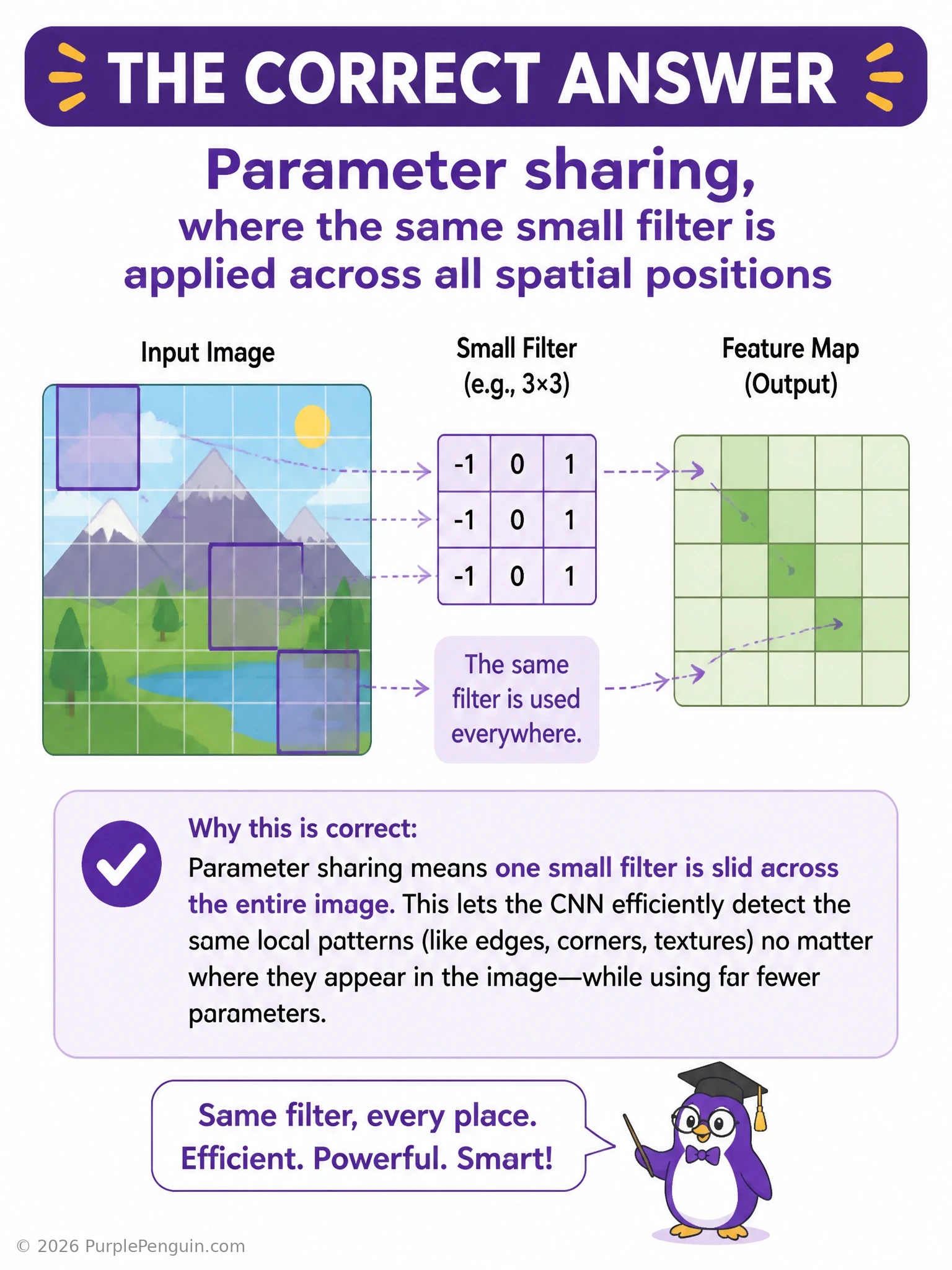
The magic behind CNNs capturing local features efficiently comes down to parameter sharing. Instead of learning a brand-new set of weights for every position in the image, a CNN reuses the exact same small filter as it slides across the whole input. That filter learns one specific local pattern — say, a vertical edge — and because it's shared everywhere, it can spot that edge whether it shows up in the corner or dead center, without ballooning the parameter count. That's answer D. Full connectivity between every neuron is the opposite approach, and it's what makes plain fully connected networks so parameter-heavy and blind to spatial locality. A recurrent hidden state passing info row to row describes an RNN-like mechanism, not standard convolution. And randomly reinitializing weights before every forward pass would destroy any learning that happened — not a real technique at all. Parameter sharing is the efficiency trick that makes CNNs work.
Full explanation below image
Full Explanation
The key architectural property enabling CNNs to efficiently capture local spatial features is parameter sharing combined with local connectivity. Each convolutional filter is a small matrix of learnable weights that is applied repeatedly across every spatial position of the input via a sliding-window operation, rather than each spatial location having its own independent set of weights. This means the network only needs to learn one set of parameters per filter to detect a given pattern (such as an edge or texture) anywhere in the input, dramatically reducing the total parameter count compared to a fully connected alternative and allowing the same feature detector to generalize across spatial position. Additionally, since each filter only looks at a small local neighborhood of the input at a time (its receptive field), the network naturally captures local spatial correlations, which is well matched to the structure of natural images where nearby pixels are typically highly correlated.
The first distractor describes full connectivity, characteristic of fully connected (dense) layers, where every neuron connects to every neuron in the previous layer with its own independent weight; this approach discards spatial locality entirely (treating all inputs as an unordered flat vector) and requires vastly more parameters, making it inefficient and less effective for capturing local spatial patterns in images. The second distractor describes a recurrent connection carrying state across a sequence, which is the defining mechanism of RNNs used for sequential data, not the mechanism used by standard convolutional layers to process spatial grids like images. The third distractor, random reinitialization before every forward pass, is not a real or useful technique; it would discard all previously learned information at every step and prevent any convergence during training — weight initialization happens once, before training begins, not repeatedly during it.
A helpful memory aid: parameter sharing is what lets a CNN use one small, reusable 'stencil' to hunt for the same pattern everywhere in the image, which is both what makes CNNs parameter-efficient and what makes them naturally sensitive to local spatial structure.