A team training a generative adversarial network (GAN) notices that the generator keeps producing only a handful of nearly identical outputs, no matter how long training continues. What is this well-known GAN training problem called?
Select an answer to reveal the explanation.
Short Explanation and Infographic
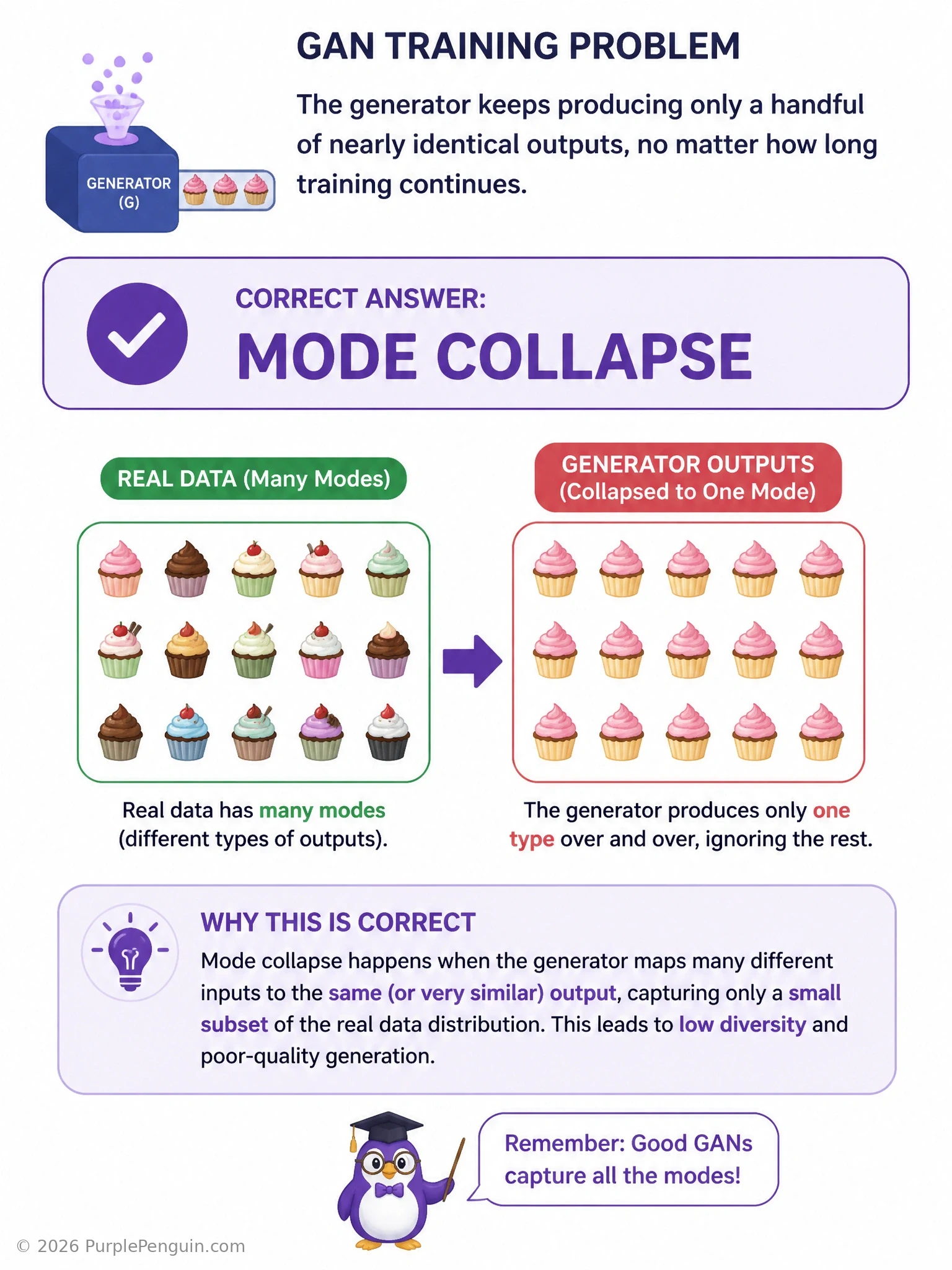
This is a classic GAN headache called mode collapse, and it's answer C. What's happening is the generator finds a small handful of outputs that reliably fool the discriminator, so instead of exploring the whole range of possible outputs it just keeps cranking out those same few 'safe bets' over and over. You lose diversity even though the individual samples might look fine. It's not vanishing gradient — that's a general deep-network training issue about gradients shrinking to near-zero across many layers, not about limited output variety. It's not classic overfitting either, since overfitting is about memorizing training data rather than generalizing, which is a different failure mode than producing repetitive outputs. And 'batch normalization failure' isn't even a standard named problem — normalization issues can contribute to instability, but the specific symptom of a narrow, repetitive output distribution has its own name: mode collapse.
Full explanation below image
Full Explanation
Mode collapse is one of the most well-documented failure modes in GAN training. It occurs when the generator discovers that producing a limited set of outputs (or even a single output) is sufficient to reliably fool the current discriminator, and as a result it stops exploring the full diversity of the target data distribution. Because the generator's only training signal comes from trying to defeat the discriminator, and the discriminator provides no explicit reward for output diversity, the adversarial game can settle into an equilibrium where the generator repeatedly exploits a narrow set of 'safe' outputs rather than modeling the true breadth of the underlying data distribution. This is a direct consequence of the minimax game dynamics between the generator and discriminator rather than a bug in implementation, and mitigating it often requires specialized techniques such as minibatch discrimination, unrolled GANs, or alternative loss formulations like Wasserstein loss.
The first distractor, vanishing gradient, refers to a general problem in deep network training where gradients shrink to near-zero magnitude as they propagate backward through many layers, effectively halting learning in earlier layers; while vanishing gradients can occur in GANs (particularly when the discriminator becomes too strong too quickly), the specific symptom described — a narrow, repetitive set of generator outputs — is the signature of mode collapse, not vanishing gradients. The second distractor, overfitting, describes a model that has memorized its training data at the expense of generalizing to new data; this is a distinct failure mode focused on generalization performance, not on the diversity of a generator's outputs. The third distractor, 'batch normalization failure,' is not a standard named training pathology in the GAN literature; while poor normalization choices can contribute to general training instability, it does not specifically describe the repetitive, low-diversity output behavior at hand.
A useful memory aid: mode collapse means the generator has found a small number of 'winning tickets' that fool the discriminator and stopped exploring further, so the fix generally involves techniques that explicitly encourage or reward diversity in the generator's outputs.