Why is a convolutional neural network generally preferred over a fully connected network for image classification tasks?
Select an answer to reveal the explanation.
Short Explanation and Infographic
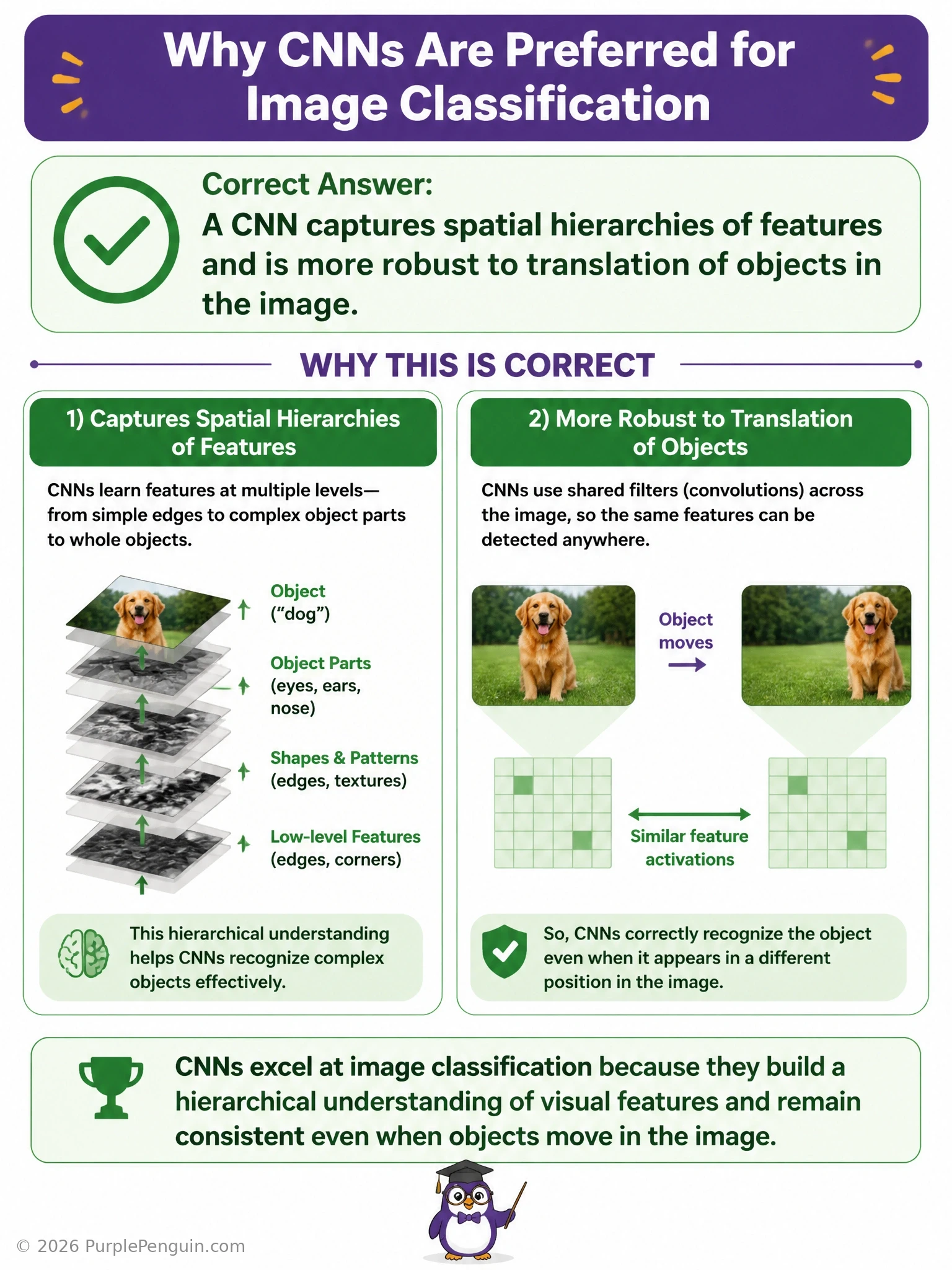
Imagine recognizing a cat no matter where it sits in the photo — corner or dead center, doesn't matter. A CNN handles that naturally because its filters slide across the whole image looking for the same pattern everywhere, so a cat's ear looks like a cat's ear whether it's in the corner or the middle. Stack these layers and you build a hierarchy from edges to shapes to whole objects. That's answer A, and it's why CNNs dominate vision tasks over fully connected networks, which need a separate weight for every pixel position and have no sense that nearby pixels are related. CNNs don't remove the need for labels — that's a training-paradigm question, not an architecture one. They don't guarantee zero overfitting; you still need dropout, augmentation, and good data. And 'always faster on any hardware' is too absolute a claim. Spatial hierarchy and translation robustness are the real wins.
Full explanation below image
Full Explanation
Convolutional neural networks are preferred for image tasks primarily because their architecture is specifically designed to exploit the spatial structure of image data. By using small filters that slide across the entire input with shared weights (parameter sharing), CNNs learn to detect a given feature (such as an edge or texture) regardless of where it appears in the image, granting a useful degree of translation invariance. Stacking multiple convolutional layers additionally builds a spatial hierarchy of representations: early layers detect low-level features like edges and corners, middle layers combine these into parts and textures, and deeper layers assemble increasingly abstract, object-level concepts. A fully connected network, by contrast, treats every pixel as an independent input with its own unique weight per neuron, which both discards the spatial relationships between neighboring pixels and requires a dramatically larger number of parameters, making it far less efficient and less effective for image data.
The first distractor is incorrect because whether labeled data is required depends on the learning paradigm (supervised, unsupervised, or self-supervised), not on whether the architecture is convolutional or fully connected; CNNs are commonly trained in a supervised fashion using labeled datasets just like fully connected networks. The second distractor is incorrect because no architecture inherently guarantees zero overfitting; CNNs can and do overfit, particularly on small datasets, and still require techniques such as dropout, data augmentation, weight decay, or early stopping to control it. The third distractor is incorrect because training speed depends heavily on factors like model size, hardware, batch size, and implementation efficiency; while CNNs are often more parameter-efficient for image tasks than an equivalently capable fully connected network, this does not translate into an unconditional guarantee of faster training on every possible hardware configuration.
A helpful memory aid: CNNs 'see' images the way a sliding stencil would, reusing the same pattern-detector across the whole picture and building understanding layer by layer, while a fully connected network is more like memorizing every individual pixel's position without appreciating that neighboring pixels usually belong together.