Which statement best describes backpropagation in a neural network?
Select an answer to reveal the explanation.
Short Explanation and Infographic
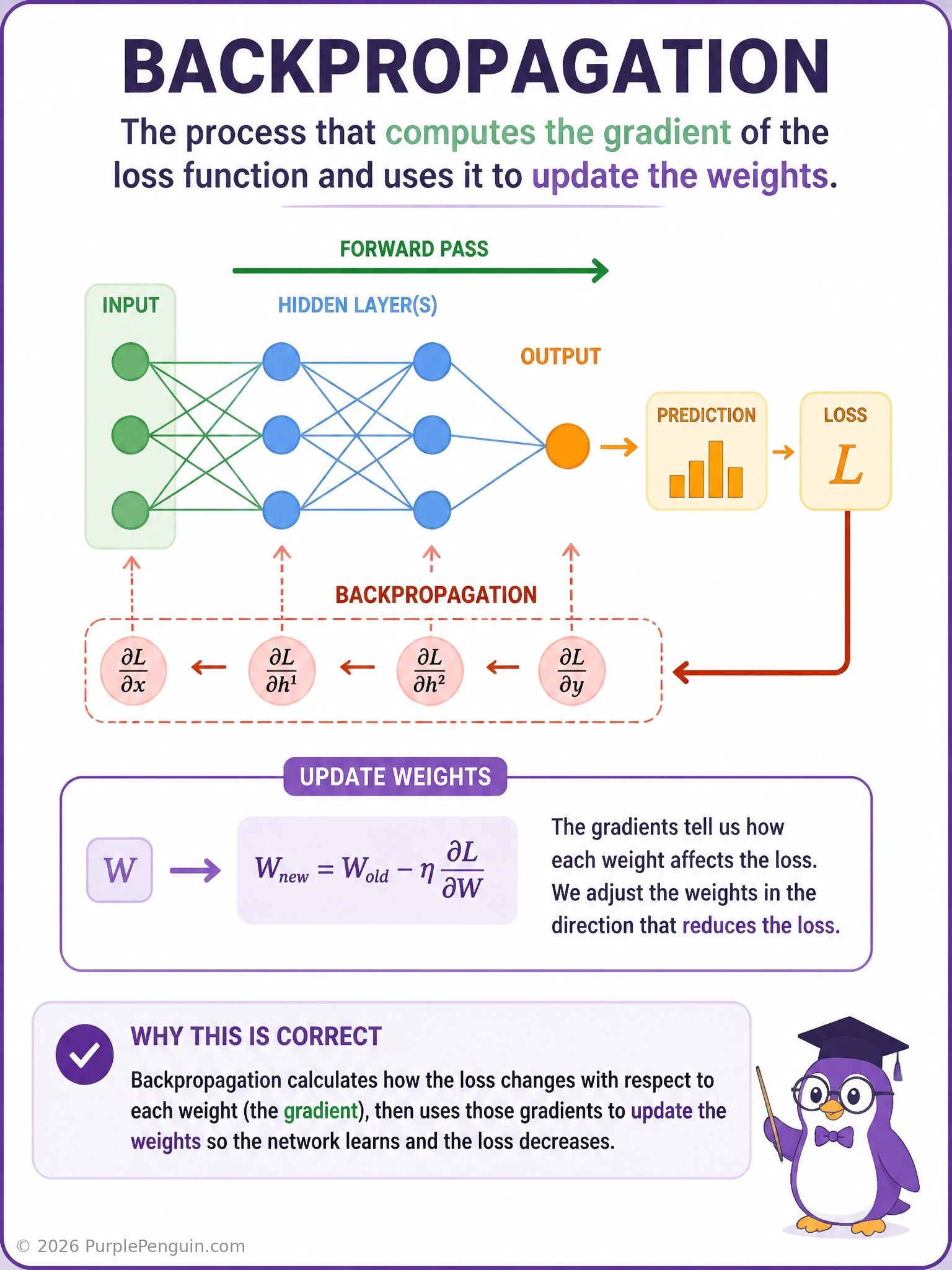
Backpropagation is just the network's way of learning from its mistakes. After a forward pass produces a prediction, you compare it to the actual answer with a loss function, and then backprop works backward through the network, layer by layer, computing how much each weight contributed to that error — that's the gradient. Then those gradients get used to nudge every weight in the direction that reduces the error. That's answer A, plain and simple. It's not about picking how many hidden layers to use, that's an architecture decision made beforehand. It's not weight initialization, which happens before training even begins. And it's definitely not data augmentation, which is about creating more training examples, not adjusting weights. Backprop is the engine that turns 'the model was wrong' into 'here's exactly how to fix it.'
Full explanation below image
Full Explanation
Backpropagation is the core algorithm used to train neural networks via gradient-based optimization. After a forward pass produces an output, a loss function quantifies the discrepancy between the predicted and actual values. Backpropagation then applies the chain rule of calculus to efficiently compute the gradient of that loss with respect to every weight in the network, working backward from the output layer toward the input layer. These gradients indicate the direction and magnitude by which each weight should change to reduce the loss, and an optimizer (such as SGD or Adam) uses them to actually update the weights, typically scaled by a learning rate. This forward-pass/backward-pass/update cycle repeats over many iterations until the model converges.
The first distractor describes architecture search or hyperparameter selection (deciding network depth and width), which is typically done before training via manual design, grid search, or automated neural architecture search — it is a separate concern from how gradients are computed once an architecture is fixed. The second distractor describes weight initialization schemes (such as Xavier or He initialization), which set the starting values of weights before any training data is processed; initialization happens once, prior to the first forward pass, and is unrelated to the iterative gradient computation that backpropagation performs. The third distractor describes data augmentation, a technique for artificially expanding a training set (through transformations like rotation or cropping) to improve generalization; it operates on the input data, not on the internal computation of gradients or weight updates.
A common memory aid is that backpropagation answers the question 'who is to blame for the error, and by how much?' — it distributes credit and blame for the loss backward through the network so that every weight knows precisely how to adjust.