A CNN has already extracted features through several convolutional and pooling layers. What does the fully connected layer near the end of the network typically do?
Select an answer to reveal the explanation.
Short Explanation and Infographic
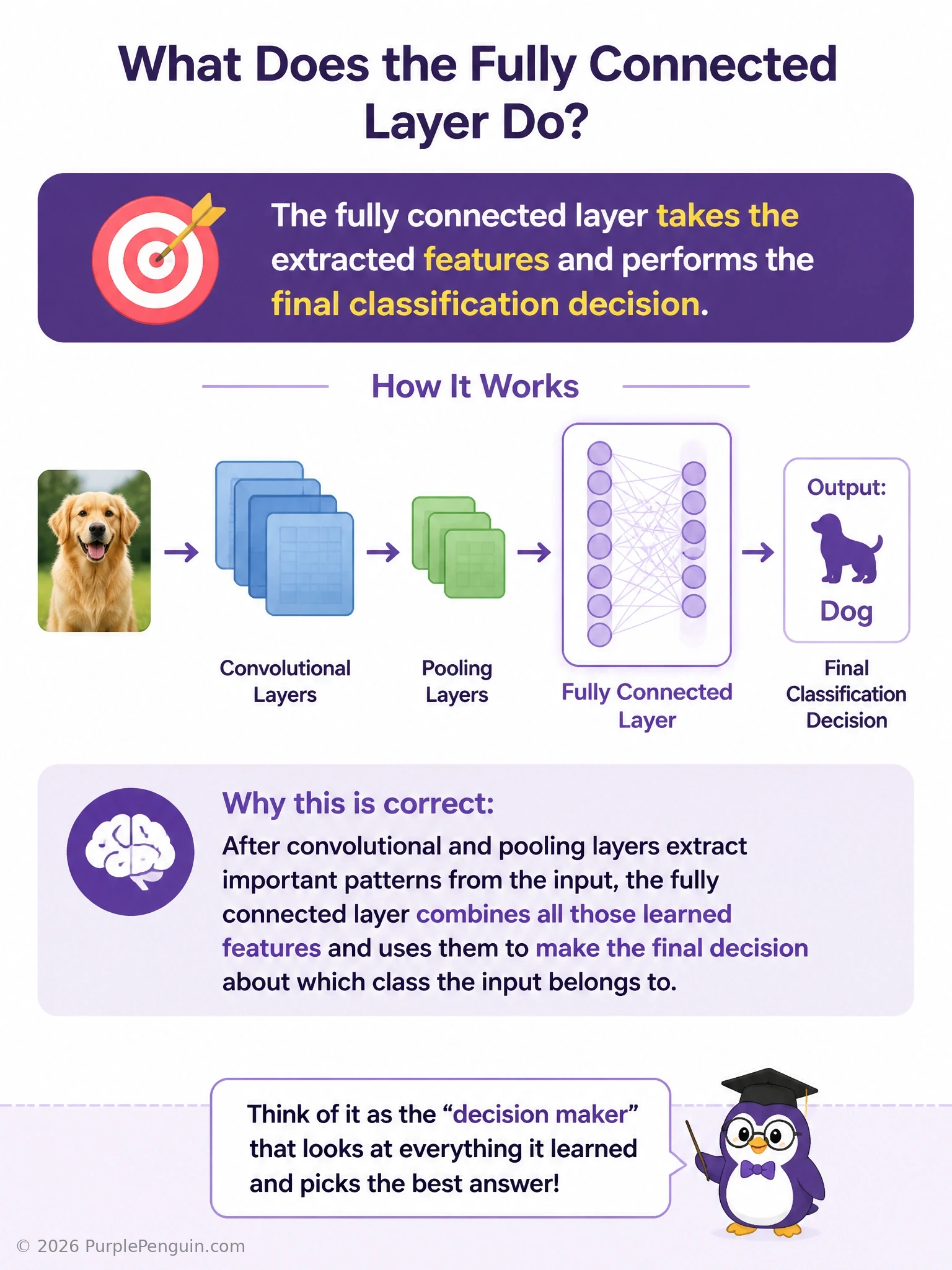
By the time your data reaches the fully connected layer, the heavy lifting is done — the conv and pooling layers have already pulled out all the edges, textures, and shapes that matter. The fully connected layer's job is to take that flattened bag of features and connect every one of them to every output neuron so it can make the actual classification call, like 'cat' versus 'dog.' That's answer B. Sliding a kernel to extract more patterns is what convolution does, not what happens here. Shrinking spatial resolution is pooling's job. And applying a nonlinear activation to introduce sparsity is describing something like ReLU, which is a building block used throughout the network, not the defining role of the FC layer. Think of FC as the decision-maker sitting at the very end of the pipeline.
Full explanation below image
Full Explanation
In a typical CNN architecture, convolutional layers (often interleaved with pooling layers) act as automatic feature extractors, progressively learning low-level patterns like edges in early layers and increasingly abstract, task-relevant patterns in deeper layers. Once this feature-extraction pipeline is complete, the resulting feature maps are flattened into a vector and passed into one or more fully connected (dense) layers, where every input neuron is connected to every output neuron. This dense structure allows the network to combine information from across all extracted features and produce the final output, such as class scores that are then typically passed through a softmax function for classification.
The first distractor describes convolution itself — sliding a kernel to detect patterns — which is the opposite stage of the pipeline from the fully connected layer; convolutional layers extract features, they do not consume already-extracted ones for a final decision. The second distractor describes pooling (e.g., max pooling or average pooling), which down-samples feature maps to reduce spatial dimensions and computational cost while retaining the most salient information; pooling is a dimensionality-reduction step, not a classification step. The third distractor describes the effect of an activation function like ReLU, which introduces nonlinearity and sparsity throughout the network but is not unique to, or descriptive of, the fully connected layer's role.
A helpful way to remember the CNN pipeline: convolution and pooling layers act as the 'eyes' that see and summarize patterns, while the fully connected layer acts as the 'brain' that weighs all that evidence together and commits to a final classification decision.