What is the main objective behind using a deep neural network rather than a shallow one?
Select an answer to reveal the explanation.
Short Explanation and Infographic
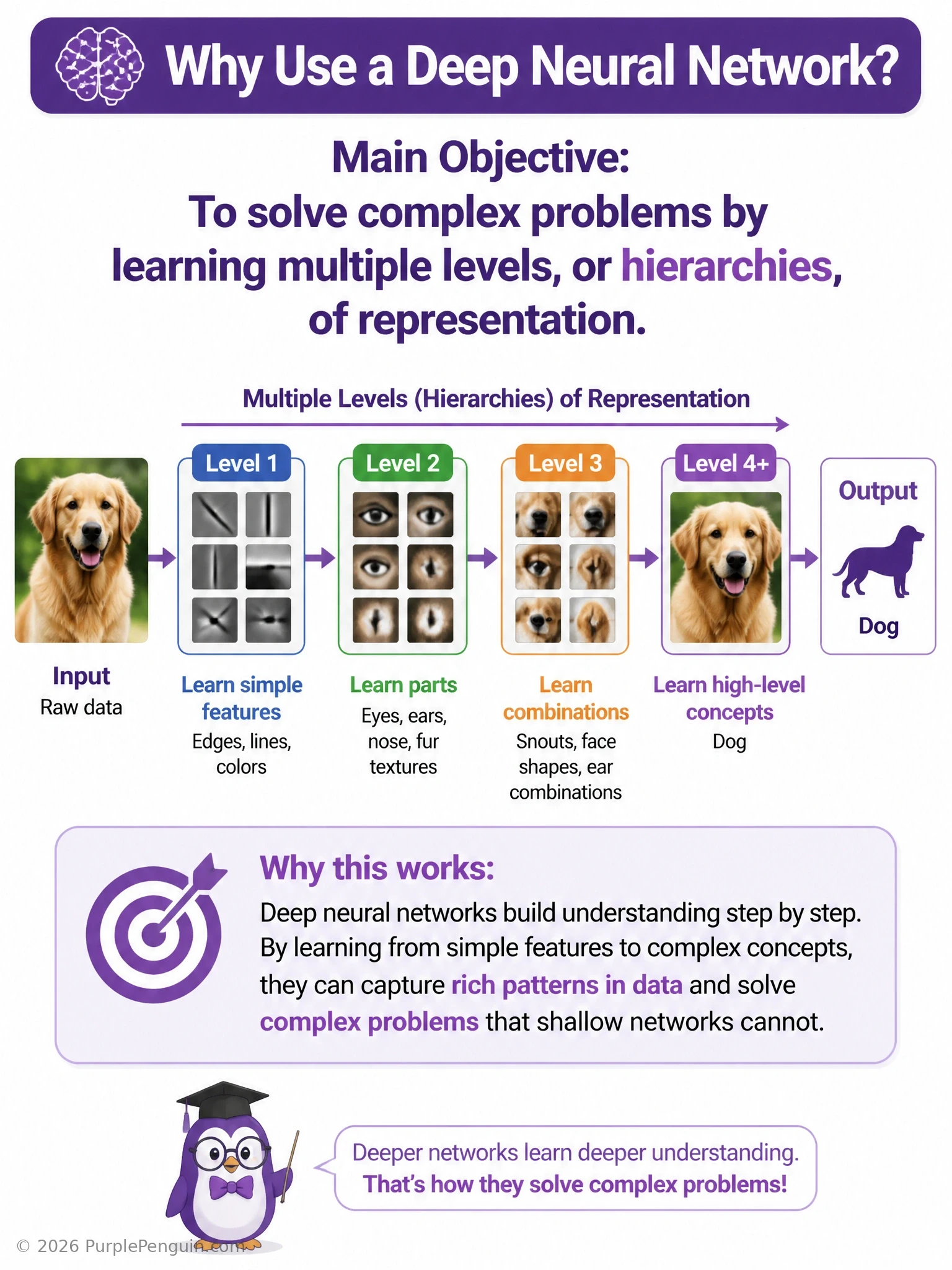
Here's why we go 'deep' in the first place. Stacking many layers lets a network build a hierarchy of representations — early layers pick up simple stuff like edges, middle layers combine those into shapes or textures, and later layers combine those into high-level concepts like 'this is a face.' That layered abstraction is what lets deep networks crack genuinely complex problems that shallow models can't touch. That's answer D. It's not about training faster on weak hardware — depth usually costs you more compute, not less. It's not about ditching labeled data; that's more the territory of unsupervised or self-supervised learning, a separate topic. And depth doesn't inherently mean fewer parameters — often the opposite. The whole point of depth is representational power through hierarchy, not efficiency shortcuts.
Full explanation below image
Full Explanation
The central motivation for deep neural networks is representational hierarchy: by stacking many layers, the network can learn increasingly abstract features at each successive layer. In an image classification context, for example, the earliest layers might learn to detect edges and simple textures, middle layers combine these into parts or shapes, and the deepest layers assemble those parts into high-level, task-relevant concepts such as object identities. This compositional structure allows deep networks to model highly complex, nonlinear relationships in data that shallow architectures (with only one or two hidden layers) generally cannot capture efficiently, since a shallow network would need an impractically large number of neurons to approximate the same function.
The first distractor is incorrect because depth generally increases computational cost and training time rather than decreasing it; deep networks require more matrix multiplications and more memory for activations and gradients during backpropagation, and often need specialized hardware (GPUs/TPUs) to train in reasonable time. The second distractor confuses depth with learning paradigm; the need for labeled data is determined by whether training is supervised, unsupervised, or self-supervised, not by network depth — a deep network can be trained in any of these paradigms and still requires appropriately structured training signals. The third distractor is incorrect because deep networks frequently have more total parameters than shallow ones, not fewer, although depth can sometimes achieve better parameter efficiency per unit of representational power than an extremely wide shallow network.
A useful way to frame this: depth is not primarily a hardware or efficiency choice, it is a modeling choice that trades additional computation for the ability to learn a hierarchy of representations, which is precisely what enables deep learning to outperform traditional approaches on complex tasks like vision and language.