In a very deep neural network, what problem does a residual (skip) connection primarily address?
Select an answer to reveal the explanation.
Short Explanation and Infographic
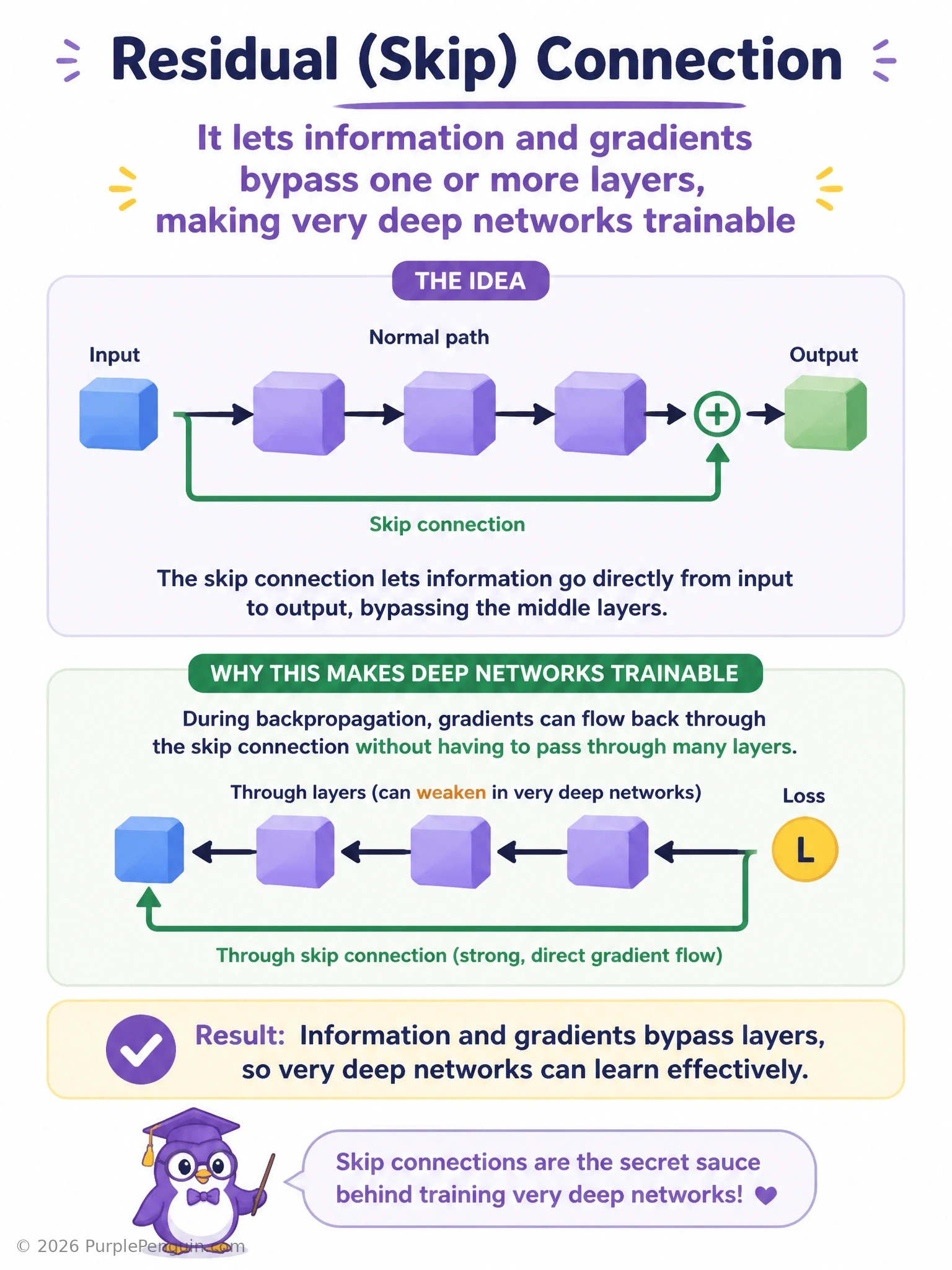
Let's talk about why ResNets exist at all. Stack enough plain layers and the gradient signal going backward gets weaker and weaker until early layers barely learn anything — that's the vanishing gradient problem showing up as a training issue, not just a theory footnote. A skip connection routes the input around a block and adds it back to the output, so there's always a direct path for gradients to flow. That's answer C, and it's the reason you can train networks with over a hundred layers without them falling apart. It's not about sharing weights to cut parameters — that's a different trick entirely. It's not softmax's job of turning outputs into probabilities. And it's not pooling or strided convolution, which is what actually shrinks spatial dimensions. Skip connections are strictly about keeping the gradient highway open.
Full explanation below image
Full Explanation
A residual or skip connection adds the input of a block directly to its output, so the block only needs to learn a residual function (the difference between input and desired output) rather than the full transformation from scratch. This has two major benefits in very deep networks: it gives gradients a direct, largely unimpeded path back to earlier layers during backpropagation, which substantially mitigates the vanishing gradient problem, and it means adding more layers can never make representational capacity worse, since a block can simply learn to pass its input through unchanged (approximating an identity mapping) if additional transformation isn't helpful. This is what allowed architectures like ResNet to scale to over a hundred layers while still training reliably.
The first distractor describes weight sharing, a separate concept used in convolutional layers (and some recurrent architectures) to reduce parameter count and encourage translation invariance — it is unrelated to how residual connections work. The second distractor describes the softmax function, which converts raw output logits into a probability distribution over classes; that happens at the output layer, not inside intermediate residual blocks. The third distractor describes pooling or strided convolutions, operations that intentionally reduce the spatial resolution of feature maps; skip connections do not change spatial dimensions and in fact typically require the input and output of a block to match in shape so they can be added element-wise.
Memory aid: think of a skip connection as an 'information shortcut' or express lane that lets both the forward signal and the backward gradient skip past layers that might otherwise degrade or shrink them, which is precisely what makes ultra-deep architectures trainable.