What is the primary function of a convolutional layer in a CNN?
Select an answer to reveal the explanation.
Short Explanation and Infographic
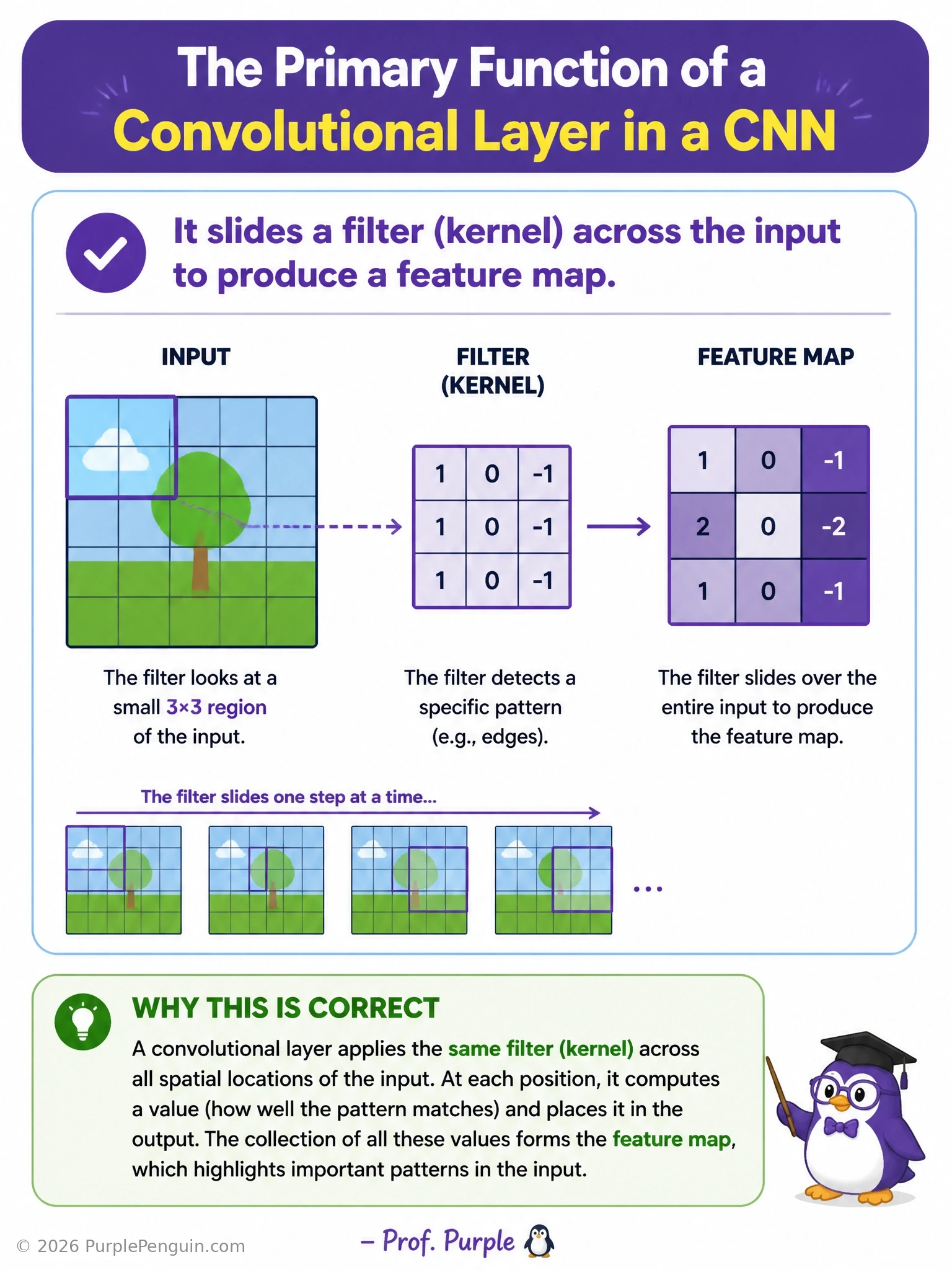
Here's the deal: a convolutional layer's whole job is to slide a small filter across your input and produce a feature map. That filter is looking for a specific pattern — an edge, a curve, a texture — and everywhere it finds a strong match, the feature map lights up. That's answer B. Dropping neurons is dropout, a totally different tool for fighting overfitting. Flattening is what you do right before a dense layer, not what convolution does. And normalizing activations to zero mean and unit variance is batch normalization's job. Convolution is about detecting local patterns with a shared filter, not about regularizing or reshaping data. Keep that distinction straight and this kind of question becomes free points on the exam.
Full explanation below image
Full Explanation
A convolutional layer performs a sliding-window operation: a small learnable filter (kernel) moves across the width and height of the input, computing a dot product at each position. The output of this operation is a feature map, where each value indicates how strongly the pattern encoded in the filter is present at that spatial location. Because the same filter is reused across the entire input (parameter sharing), the layer can detect a feature such as an edge or texture regardless of where it appears in the image, which also keeps the parameter count far lower than a fully connected alternative operating on the same input size. Stacking multiple convolutional layers allows the network to build progressively more abstract feature maps, starting from simple edges and textures in early layers and combining them into shapes and object parts in deeper layers.
The first distractor describes dropout, a regularization technique that randomly deactivates neurons during training to reduce co-adaptation and overfitting — it has nothing to do with filtering or feature extraction, and it is typically applied to fully connected layers rather than being the defining operation of a convolutional one. The second distractor describes flattening, a reshaping operation typically applied after the convolutional/pooling stack to convert a multi-dimensional feature map into a one-dimensional vector before it is passed to fully connected layers; flattening does not extract features, it only changes the tensor's shape without altering its content. The third distractor describes batch normalization, which rescales layer activations to have controlled statistics in order to stabilize and speed up training, but it does not itself detect spatial patterns or produce a feature map the way a convolutional filter does.
A useful memory aid: convolution = detection, pooling = down-sampling/summarizing, dense = classification/decision, and normalization/dropout = training stabilizers. Recognizing which category a described operation falls into is the fastest way to eliminate wrong answers on CNN architecture questions.