
Once the safety-review summarizer's Model Serving endpoint is live, the governance team wants a durable, queryable record of every request and response the endpoint has served, so they can later audit for PII leakage or unexpected output patterns. What Databricks feature should the endpoint be configured to use?
Select an answer to reveal the explanation.
Short Explanation
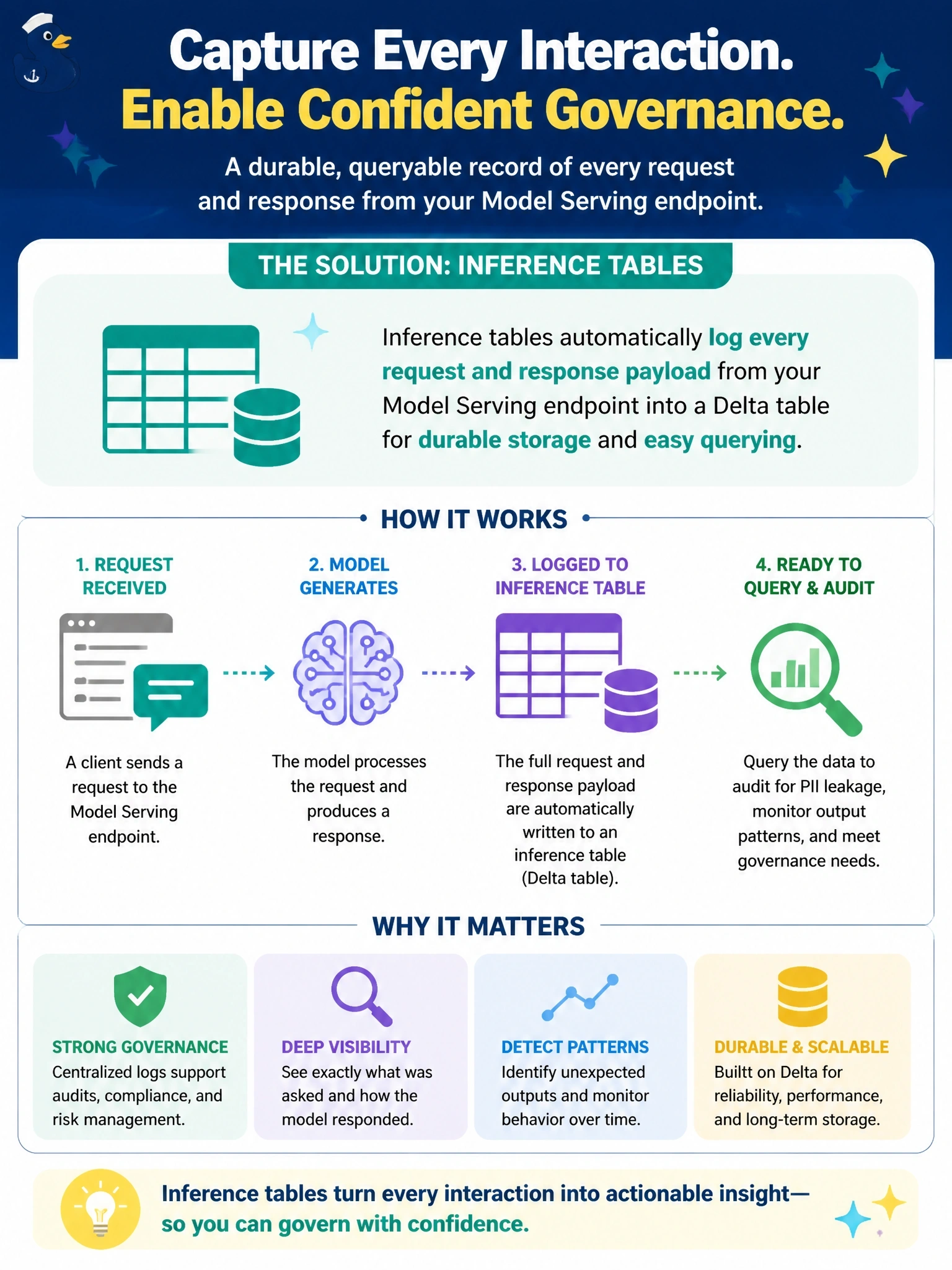
Inference tables are the endpoint's own black-box recorder: turn the feature on and every request and response gets written to a Delta table you can query like any other data, which is exactly what an auditor needs when they want to go back and check for PII leakage after the fact.
Full Explanation
Inference tables, when enabled on a Model Serving endpoint, automatically capture every incoming request and outgoing response payload and write them to a Delta table in Unity Catalog, giving the governance team a durable, SQL-queryable audit trail they can scan for PII leakage, unexpected outputs, or usage patterns without adding custom logging code to the application. That is precisely the requirement stated. Unity Catalog volumes are a storage location for files such as source documents that the model or an application reads, not a mechanism for capturing live request and response traffic from a serving endpoint. AI Gateway rate limiting controls how much traffic a caller is permitted to send in a time window, which protects the endpoint from overload and controls cost, but it does not create a record of the payloads themselves, so it does not satisfy an audit requirement. A Vector Search sync schedule governs how often the retrieval index refreshes from its Delta source, an operational detail about the index, unrelated to logging what the endpoint served to end users. Inference tables are the specific, purpose-built answer for post-hoc auditing of production traffic, and they are also the raw data source many teams query to build ongoing monitoring dashboards and drift checks.