
Terminal planners report that the port-operations copilot is slow to respond during the morning shift-change rush, and the ops team wants to confirm whether the Model Serving endpoint itself is the bottleneck before investigating the application code. Which built-in signal should they check first?
Select an answer to reveal the explanation.
Short Explanation
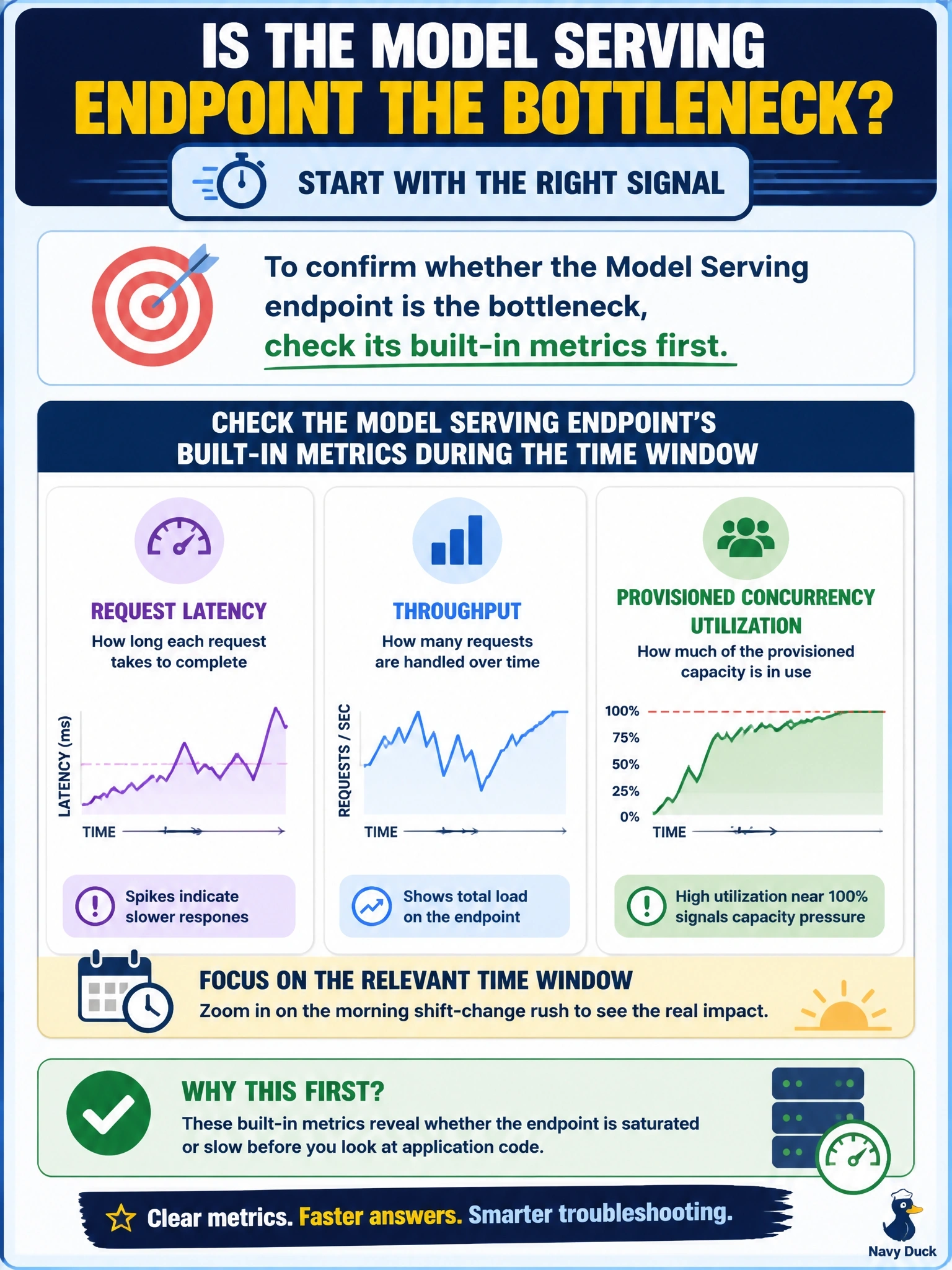
Before you go chasing bugs in application code, check the endpoint's own dashboard first, because Model Serving already tracks latency, throughput, and how much of its provisioned capacity is actually in use, and that single view tells you immediately whether the bottleneck lives at the endpoint.
Full Explanation
Model Serving endpoints expose built-in operational metrics, including request latency, throughput, and provisioned concurrency utilization, and checking these for the specific time window in question is the direct way to confirm or rule out the endpoint as the bottleneck, for example by revealing that concurrency was saturated during the shift-change rush and requests were queuing. This is the correct first step precisely because it is fast, requires no code changes, and directly answers the question asked. The Vector Search sync schedule shows when the index content was last refreshed from its Delta source, which speaks to data freshness, not to response latency or throughput during a traffic spike. The Unity Catalog lineage graph shows which jobs and tables feed which downstream assets, a governance and impact-analysis tool, not a real-time performance signal. The MLflow training run history describes how the model was built and evaluated during development, which has no bearing on live-traffic response time in production. The closest-looking trap is the Vector Search sync schedule, since a stale index sounds vaguely related to slowness, but sync freshness and response latency are unrelated concerns; a fully synced index can still sit behind a saturated, slow endpoint. Checking endpoint metrics first is also consistent with the general practice of isolating the serving layer before debugging application-level orchestration code.