
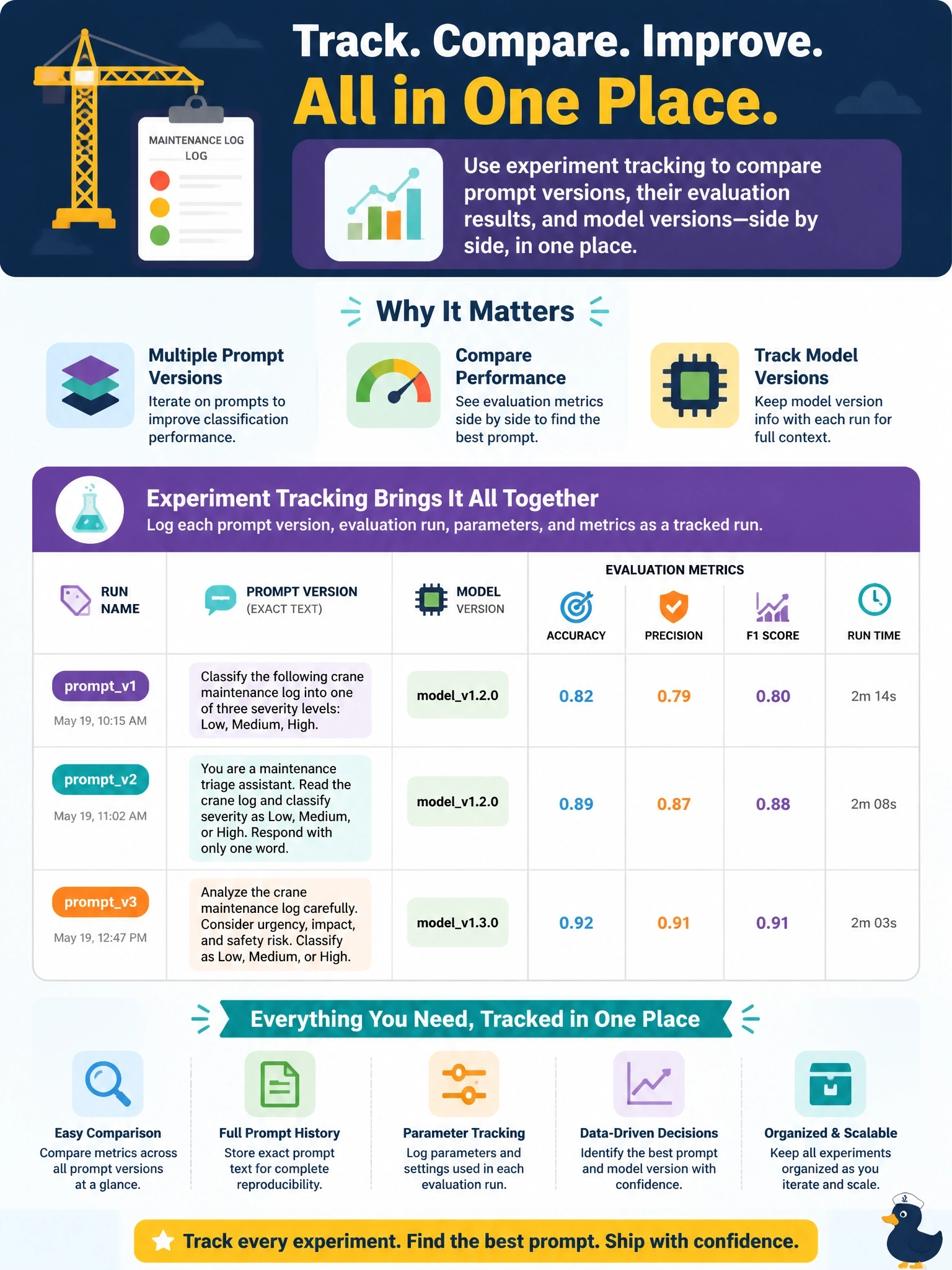
The maintenance-triage agent team is iterating on several prompt versions for classifying crane maintenance log severity, and wants to compare each version's evaluation scores, exact prompt text, and model version side by side without maintaining a separate spreadsheet. What should they use?
Select an answer to reveal the explanation.
Short Explanation
This is exactly what MLflow experiment tracking is for: log each prompt version as its own run, attach its evaluation scores and parameters, and the tracking UI gives you the side-by-side comparison for free, no spreadsheet required. Lineage tools and inference tables record different things entirely, so reaching for either here just adds a workaround for a problem MLflow already solves.
Full Explanation
MLflow experiment tracking is designed precisely for this workflow: each prompt-version iteration is logged as a run, with parameters such as the prompt text and model version, and metrics from the evaluation, and the MLflow UI supports comparing runs side by side across those fields. This replaces the ad hoc spreadsheet the team is trying to avoid maintaining. Unity Catalog table lineage tracks which jobs, notebooks, or pipelines read and wrote which tables, which is useful for governance and impact analysis on data assets, but it does not capture prompt text, evaluation scores, or model parameters at the granularity an iteration workflow needs. A Vector Search index sync log records when a Delta Sync index last refreshed from its source table, which is an operational detail about the retrieval index, not about comparing prompt or model iterations. An inference table logs production request and response payloads for a live serving endpoint, which is valuable for monitoring what already-deployed traffic looked like, but it is not built for comparing development-time experiments before anything is deployed, and it does not structure data by prompt version or attach evaluation metrics the way an MLflow run does. Using MLflow tracking during development, then promoting the winning version to Model Serving, is the standard Databricks GenAI development loop.