
Deck and engine-room crew on Meridian vessels file reports in English, Tagalog, and Mandarin. The port-ops copilot needs to summarize a batch of mixed-language reports for a monolingual English-speaking shift supervisor. In what order should translation and summarization be applied?
Select an answer to reveal the explanation.
Short Explanation
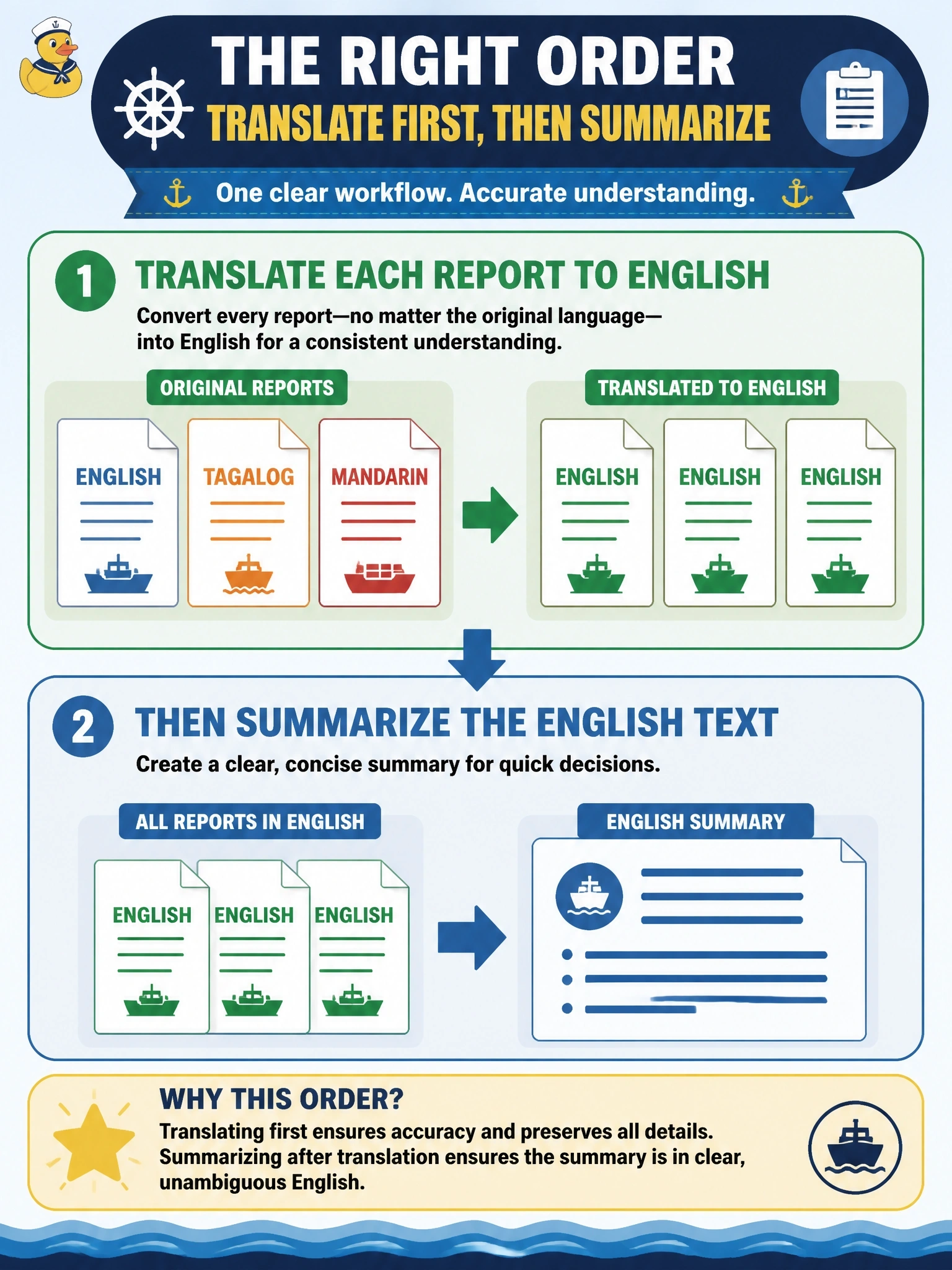
Get everything into one language the supervisor can actually read first, then summarize it - trying to summarize text you can't understand yet, or worse, throwing away two-thirds of the reports, both leave the supervisor with a worse picture than they should have.
Full Explanation
Translating first and summarizing second is the more reliable order because it produces a single, consistent-language corpus before the model attempts to compress and prioritize information across it, reducing the risk of losing nuance or mixing terminology conventions between languages during the harder summarization step. Summarizing first in each original language and translating the summaries afterward is riskier because summarization already discards detail, and translating a compressed, potentially idiomatic summary can compound small errors or ambiguities that would have been resolvable in the fuller original text. The claim that order doesn't matter is incorrect - these are sequential transformations, and pipeline order changes what information survives to the final output, which is precisely why 'define and order tools/stages' is a named exam objective rather than an afterthought. Discarding the non-English reports is the worst option: it silently drops real safety-relevant content from two of the three source languages, which directly undermines the supervisor's situational awareness rather than merely producing a slightly different summary. Choosing and sequencing model tasks correctly, rather than assuming any order is equivalent, is the skill under test.