
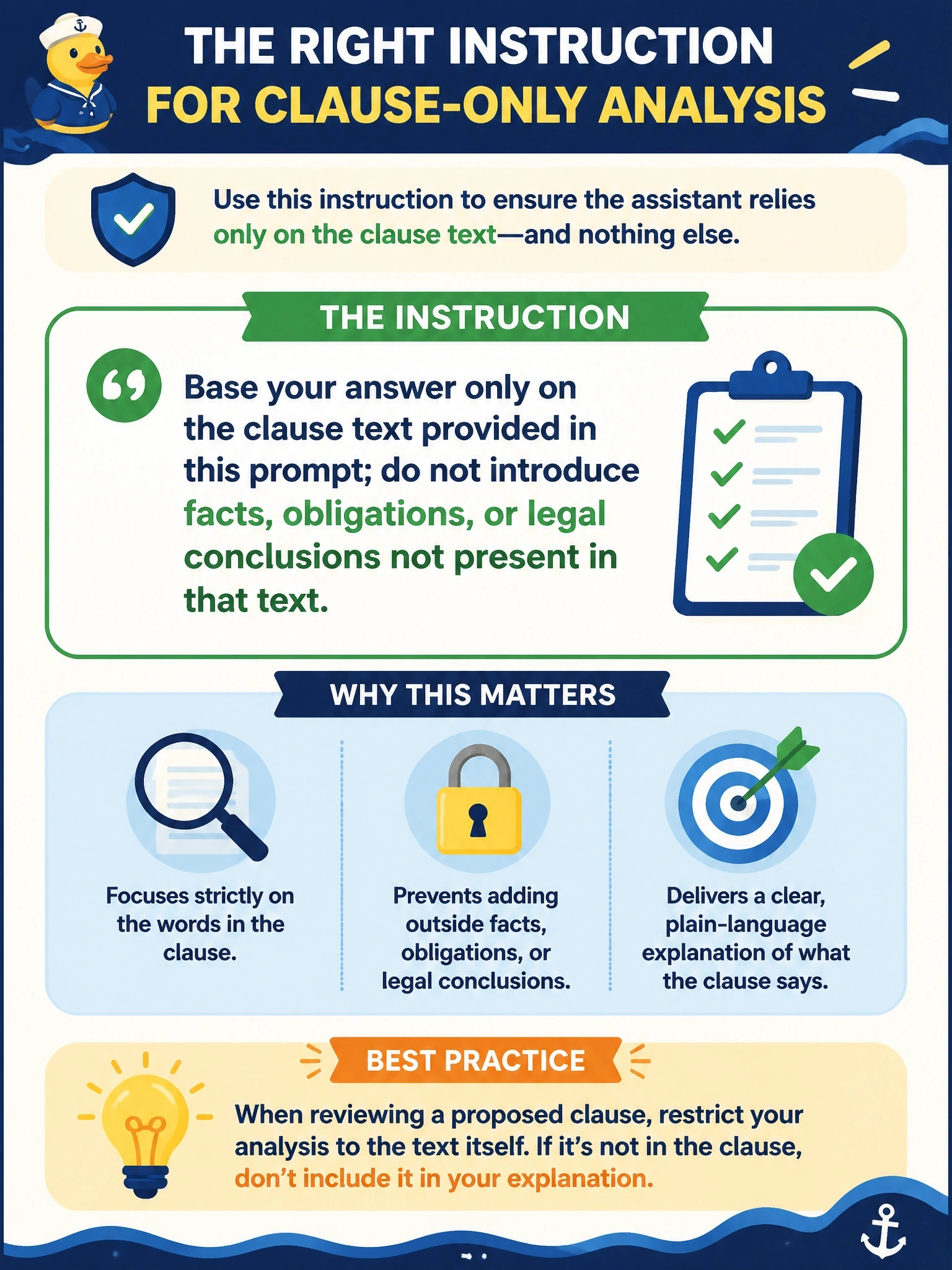
Meridian's legal team asks for an assistant that reviews a proposed charter clause and explains, in plain language, what obligation it creates for the shipowner - drawing only on the actual clause text supplied, never on the model's general knowledge of maritime law. Which instruction belongs in the prompt to enforce this constraint?
Select an answer to reveal the explanation.
Short Explanation
Legal wants the model reading only the paper in front of it, not freelancing from whatever it picked up in training - so the instruction has to explicitly say 'stick to this text,' the same way you'd tell a witness to testify only to what they saw.
Full Explanation
An explicit 'answer only from the supplied clause text, do not introduce outside facts or conclusions' instruction is correct because it is the only option that directly implements the stated constraint - grounding the answer strictly in the provided text rather than the model's general parametric knowledge, which matters enormously in a legal-adjacent context where an unsupported claim could be read as advice. Telling the model to use its full training knowledge of maritime law does the opposite of what was asked - it explicitly invites exactly the ungrounded, parametric-knowledge answers the legal team wants to avoid. A brevity constraint ('five words or fewer') addresses length, not grounding, and does nothing to prevent the model from inventing an obligation not actually in the clause; a five-word ungrounded guess is not safer than a longer ungrounded guess. Instructing the model to guess rather than admit uncertainty is actively harmful in this setting - it encourages confident fabrication precisely where the legal team needs the opposite, an admission that the clause doesn't say something rather than an invented answer. Recognizing which instruction actually implements a stated grounding constraint, versus a superficially plausible but off-target instruction, is the core skill tested here.