
A marine-insurance underwriter partnering with Meridian wants a tool that reads incoming casualty claim narratives and returns exactly three bullet points: cause, estimated exposure, and recommended next action - nothing else, in that fixed order, every time. What prompt-design technique most directly enforces this?
Select an answer to reveal the explanation.
Short Explanation
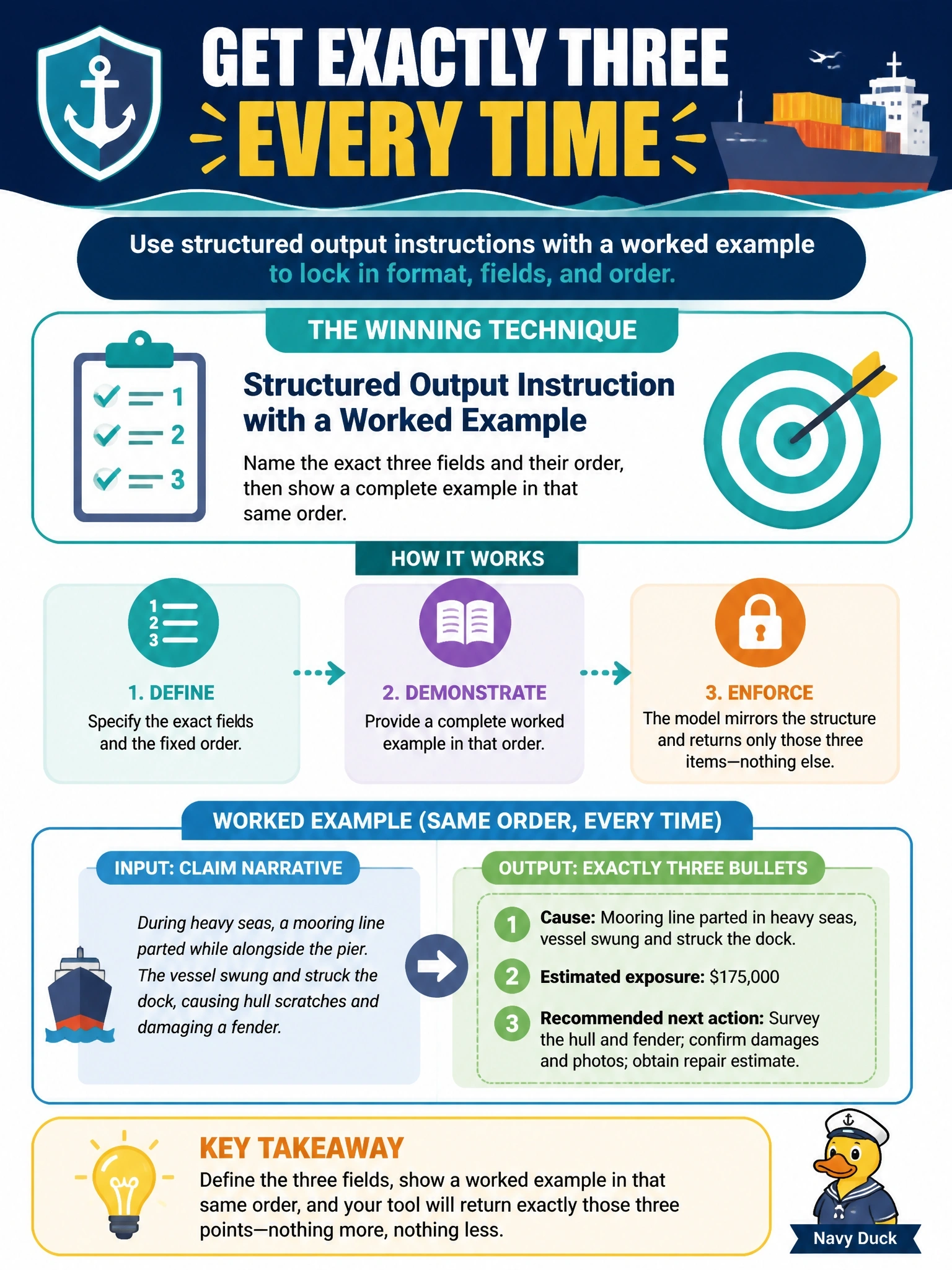
Naming the three fields and showing exactly one filled-in example in that order is what actually locks the output into that shape every time - a vague 'summarize it' leaves the model free to wander, and creativity settings work against consistency, not for it.
Full Explanation
A structured output instruction that names the required fields (cause, estimated exposure, recommended next action) and specifies their fixed order, backed by one worked example in that exact sequence, is the most direct way to force a specifically formatted response, because it removes ambiguity about both content and ordering. Increasing temperature works directly against the stated goal - it increases variability in phrasing and structure, which is the opposite of 'exactly three bullets, same order, every time.' A bare instruction to 'summarize the claim' is too generic; it does not specify the three required fields or their order, so the model is free to produce a paragraph, a different number of bullets, or fields in an inconsistent sequence. Feeding in unrelated claim narratives as extra context does not constrain output format at all - it adds unrelated content to the context window without addressing the structural requirement, and could even dilute the model's focus on the specific claim being processed. This item tests the same core skill as prompt-format questions generally: pairing an explicit schema/order instruction with a concrete example is what reliably locks down structure, not sampling parameters or vague prose instructions.