
Some clauses in Meridian's charterparty contracts are long enough that even clause-boundary-aware chunking must further split a single clause into two chunks. In that specific case, what does configuring a modest character overlap between the two resulting chunks accomplish?
Select an answer to reveal the explanation.
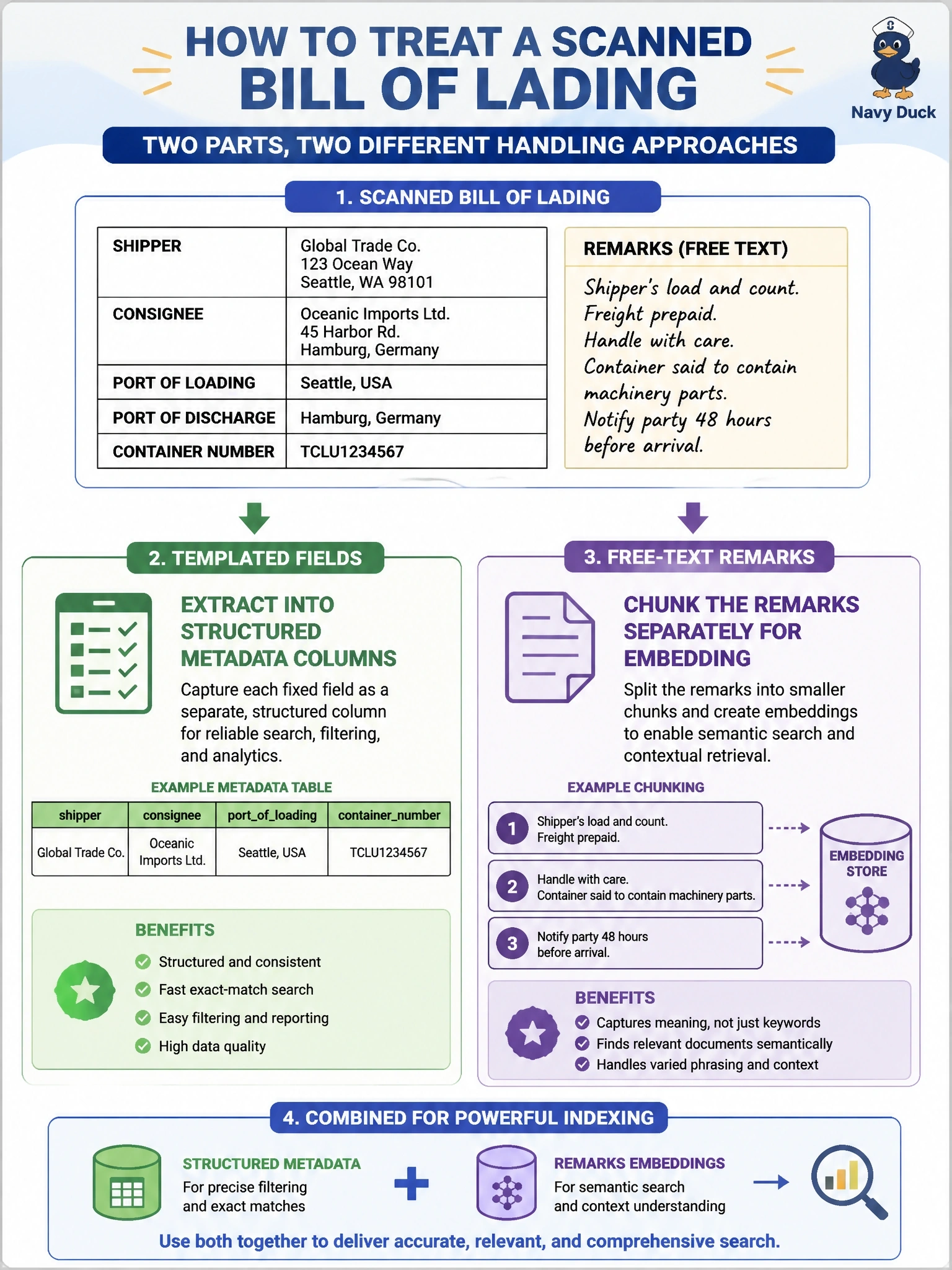
Short Explanation
Even with clause-boundary chunking, an unusually long clause can still need a further split - and that's exactly the case overlap is for: a shared window of text at the seam so a sentence straddling the cut doesn't lose its meaning in either half.
Full Explanation
Preserving a shared window of context across the split is correct because that is precisely the purpose of chunk overlap: when a single semantic unit - here, one long clause - must still be divided into two chunks, a modest overlap ensures that text near the split point appears in both chunks, reducing the risk that a sentence or reference straddling the boundary is rendered incomplete or ambiguous in either resulting chunk. Claiming overlap guarantees a clause will never need to be split again is wrong because overlap is a mitigation for the consequences of a necessary split, not a mechanism that changes whether a future split is needed - an unusually long clause can still require splitting regardless of overlap configuration. Claiming overlap automatically merges chunks back into one at query time is wrong because overlap is a preparation-time parameter that shapes what is stored, not a query-time reconstruction mechanism - the two chunks remain two separate stored and separately retrievable units. Claiming overlap reduces the total chunk count for the clause to one directly contradicts the premise of the question, which states the clause is already being split into two chunks; overlap adds shared context to both of those chunks, it does not reduce their number back down to one. This question specifically tests the finer point that even structure-aware, clause-boundary chunking can still require overlap when an individual structural unit itself exceeds a usable chunk size.