
A data engineer is finalizing the chunk-size setting for the charter-contract corpus and checks the embedding model's maximum input length. Why does that maximum matter when choosing a chunk size?
Select an answer to reveal the explanation.
Short Explanation
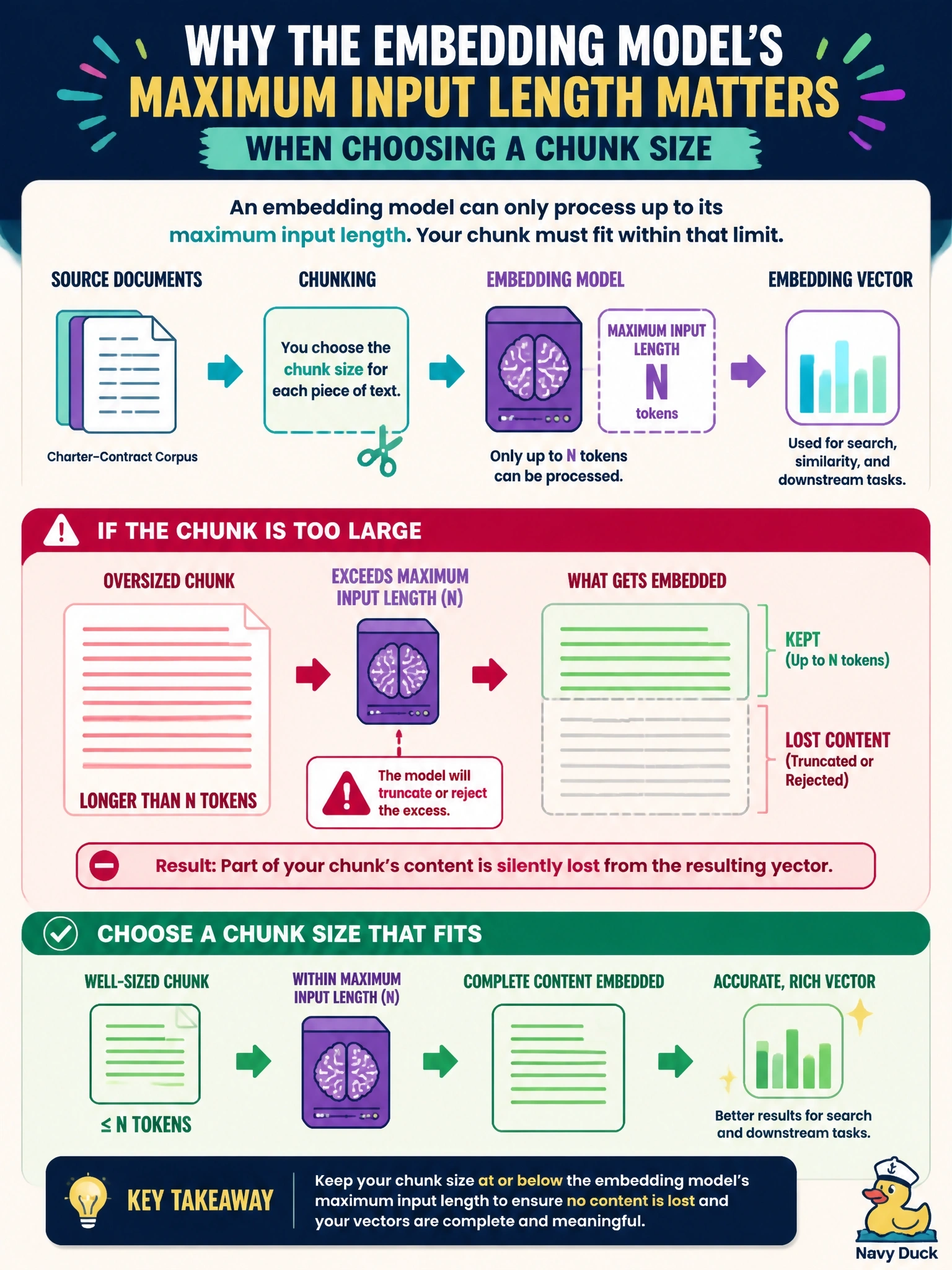
Every embedding model has a ceiling on how much text it will actually look at - blow past it with an oversized chunk, and whatever falls outside that ceiling just gets truncated or rejected, so the vector you end up indexing doesn't represent the whole chunk you thought it did.
Full Explanation
A chunk exceeding the embedding model's maximum input length being truncated or rejected is correct because embedding models, like other language models, have a fixed maximum input length, and text beyond that limit is either cut off (truncation) or causes an error, depending on the specific API - either way, a chunk sized without regard to this limit risks silently losing content from the vector actually indexed, which is a real and easy-to-miss data-preparation mistake. Claiming embedding models accept input of any length with no consequence is wrong and is the exact misconception this question tests - every production embedding model publishes a maximum input length, and ignoring it produces silently degraded vectors rather than an obvious error in many implementations. Claiming the maximum input length only affects the generation model at query time is wrong because embedding models are themselves subject to their own maximum input length at index time, entirely independent of whatever generation model is used later to answer a query - these are two separate model calls with two separate limits. Claiming an oversized chunk is automatically re-chunked by the embedding model is wrong because embedding models are not chunking tools - they accept whatever input they are given up to their limit and return a vector; automatic re-chunking is not a behavior embedding APIs provide, so this responsibility remains entirely with the data-preparation pipeline. The exam-relevant point is that chunk-size decisions must respect the target embedding model's input-length ceiling, not just retrieval-quality considerations alone.