
Meridian's charterparty contracts are issued as digitally generated PDFs (not scans) with a normal embedded text layer. Which extraction approach is most appropriate and efficient?
Select an answer to reveal the explanation.
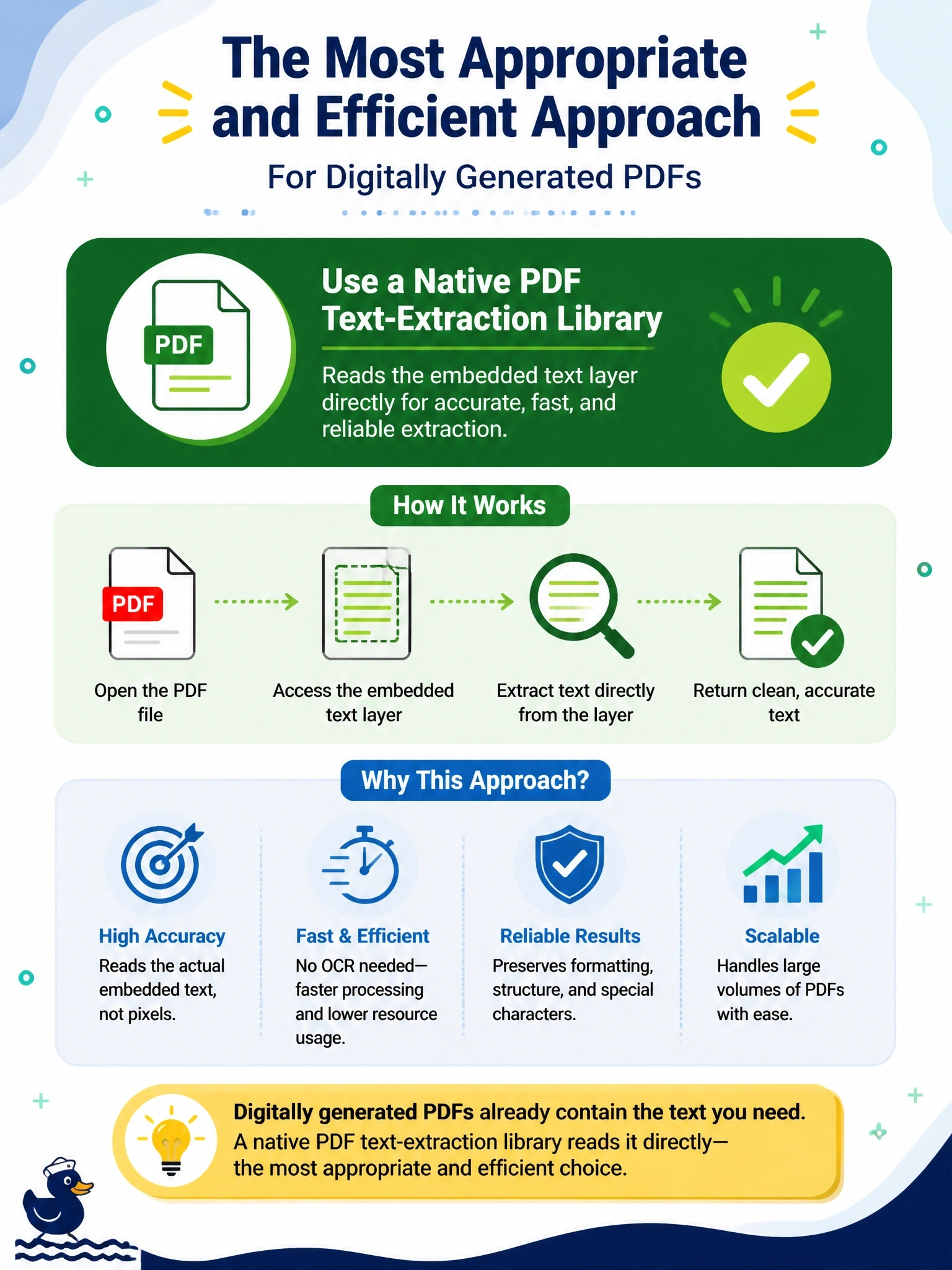
Short Explanation
There's already a text layer sitting right there in the file - reading it directly is both faster and more accurate than running OCR on something that was never an image to begin with.
Full Explanation
A native PDF text-extraction library is correct and most efficient because the file already has a digitally embedded text layer, so a library built to read that layer can pull exact, high-fidelity text directly without any image-recognition step. Defaulting to OCR for every shipping document regardless of source type is wrong and specifically contradicted by the scenario, which states this PDF is digitally generated with an embedded text layer - OCR is the right tool for the scanned bill-of-lading case elsewhere in this domain, but applying it here adds unnecessary recognition error and computational cost when perfect text is already extractable directly. Manual re-typing is wrong because it does not scale to a production data-preparation pipeline processing potentially thousands of contracts, and it introduces human transcription error where an automated extraction library would be both faster and more accurate. A speech-to-text model is wrong because charterparty contracts are written legal text, not audio recordings - there is no spoken-language input for a speech-to-text model to transcribe, making this option a category mismatch with the source format entirely. The exam-relevant skill tested here is recognizing that not every PDF needs OCR - the correct choice depends on whether the specific file has an embedded text layer or is an image, and this question is the deliberate contrast case to the scanned-bill-of-lading item.