
Before building the customs-compliance agent's retrieval index, a data engineer audits the corpus and discovers that HS-code tariff schedules for two of the five jurisdictions Meridian operates in are missing entirely. What data-preparation step does this call for?
Select an answer to reveal the explanation.
Short Explanation
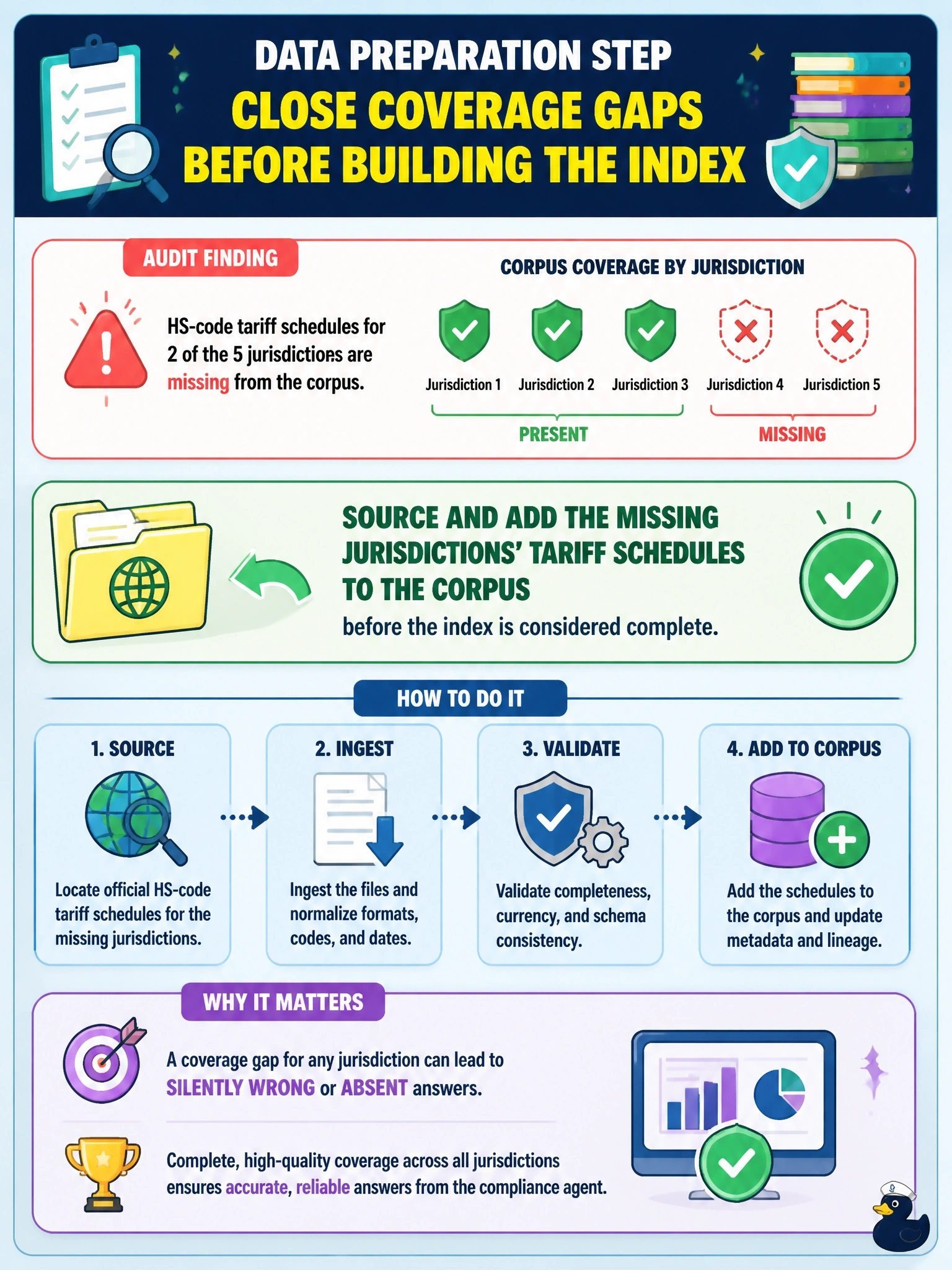
You’ve found a coverage gap: the missing tariff schedules are absent from the corpus, not just hard to retrieve. Add the schedules before treating the index as complete; retrieval settings can’t supply data that isn’t there.
Full Explanation
Source and add the missing jurisdictions’ tariff schedules before considering the index complete. Data preparation includes checking source coverage, and the agent can answer reliably only from material represented in its corpus; without those schedules, it may return no answer, retrieve irrelevant information from another jurisdiction, or generate unsupported guidance. For customs compliance, those outcomes can have serious consequences. Assuming the agent can infer the missing rules from the three represented jurisdictions is unsafe: tariff schedules contain jurisdiction-specific legal and regulatory requirements that do not reliably generalize. Silently reducing the jurisdictions the agent is scoped to answer about also fails conceptually; it hides a known limitation from stakeholders rather than repairing or transparently disclosing the coverage gap. Increasing the embedding model’s context window addresses how much text can be processed in a call, not whether missing source documents or facts exist, so it cannot fill the gap. A useful exam caveat is that retrieval tuning may help when relevant data is present but poorly retrieved; it cannot replace absent data. In practice, check a jurisdiction-by-jurisdiction coverage inventory against the intended scope, then verify that the missing schedules are sourced, added, and searchable before release.