
After extracting and chunking Meridian's customs declarations, where should the resulting text chunks and their metadata land before a Vector Search index is built over them?
Select an answer to reveal the explanation.
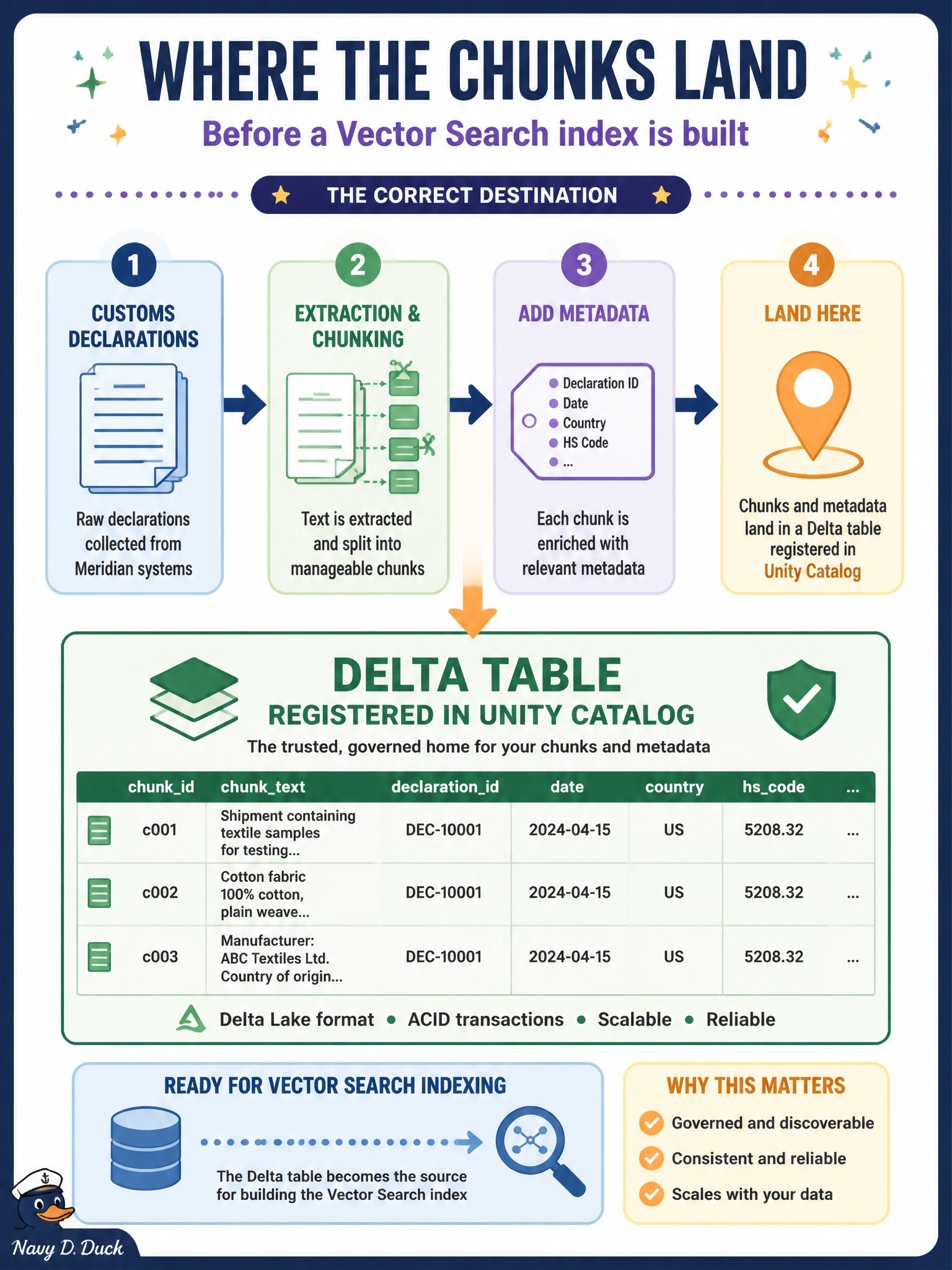
Short Explanation
This is the Databricks house rule: prepared text and its metadata land in a Delta table inside Unity Catalog, because that's the governed, durable source Vector Search actually syncs from - not a laptop file, not a folder buried in someone's home directory.
Full Explanation
A Delta table registered in Unity Catalog is correct because Databricks' Vector Search indexing is built to sync from governed Delta tables, and landing prepared text chunks and their metadata there gives the pipeline durability, access control, lineage tracking, and a supported sync source for the index - this is the documented, exam-relevant pattern for getting prepared source data ready to index. A local CSV file on an individual's laptop is wrong because it is neither durable, shared, nor governed - it sits outside Unity Catalog entirely, so no permission model, lineage, or Vector Search sync can reach it, and it disappears the moment the laptop does. An in-memory Python list discarded at the end of a notebook session is wrong for an even more basic reason: the whole point of a data-preparation pipeline is to persist its output for later, repeated use by an index and by other consumers, and anything that vanishes when the session ends cannot serve that purpose. A plain-text file in a workspace home folder is wrong because, like the CSV on a laptop, it bypasses Unity Catalog's governance and lineage model and is not the structure Databricks Vector Search is built to sync against - workspace files are not a substitute for a governed Delta table as the system of record. The exam-relevant takeaway is that Unity Catalog Delta tables are the required landing zone for indexable content on Databricks.