
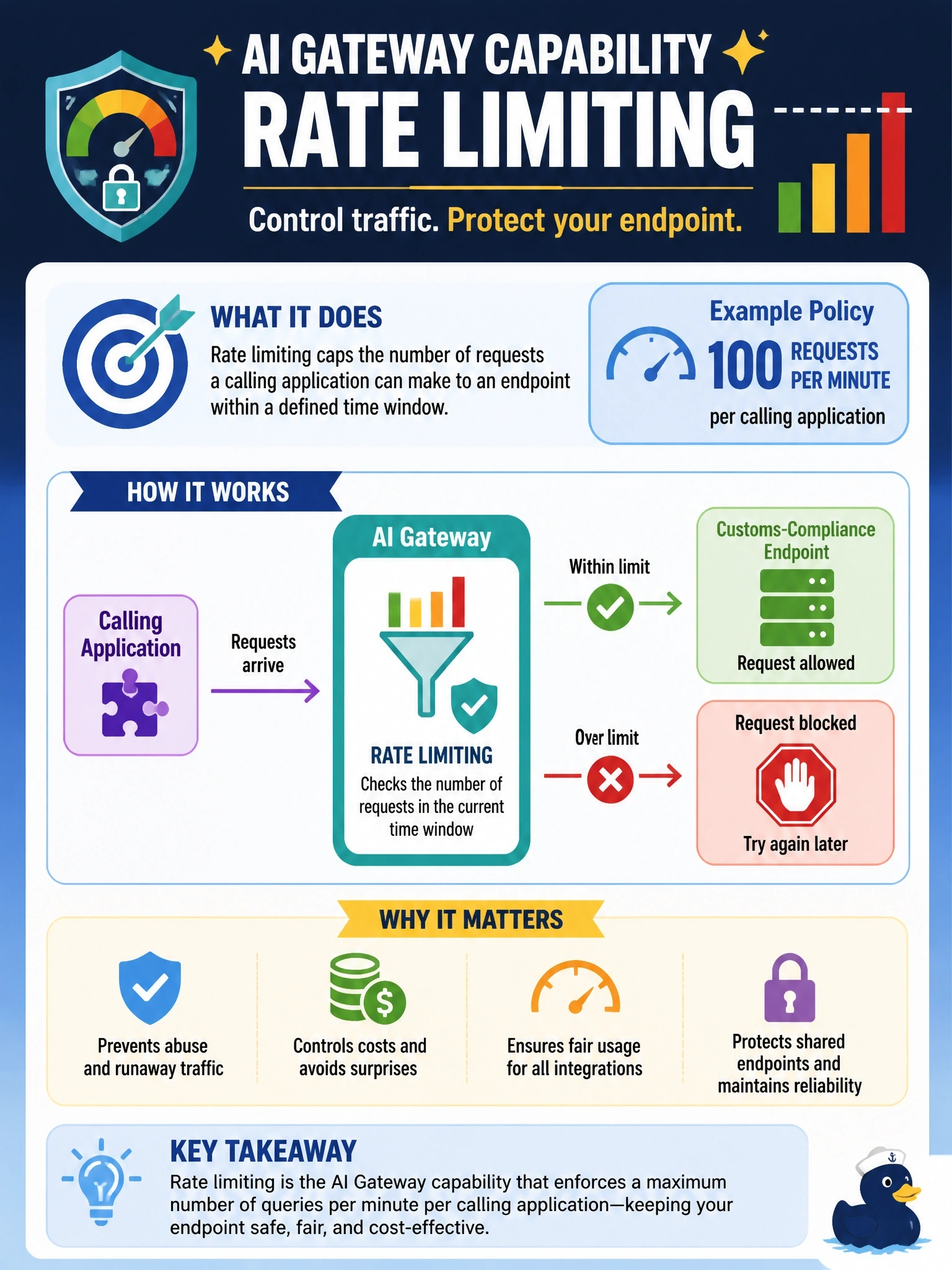
Meridian Line's platform team wants to cap the customs-compliance endpoint at a maximum number of queries per minute per calling application, so a misbehaving integration cannot overwhelm the shared endpoint or run up cost unexpectedly. Which AI Gateway capability directly provides this?
Select an answer to reveal the explanation.
Short Explanation
You want to keep one integration from flooding a shared endpoint or unexpectedly driving up costs. Rate limiting caps how many requests per minute a caller can make, so it’s the control you need.
Full Explanation
AI Gateway’s rate limiting feature lets an administrator cap the number of requests or tokens an endpoint will accept over a time window, optionally scoped per calling application or user. That directly addresses the goal of preventing one integration from overwhelming a shared endpoint or driving unexpected cost. Payload logging records request and response content for audit, debugging, or compliance purposes; it observes traffic but does not constrain its volume, so it cannot stop a runaway caller. Model version aliasing is a Unity Catalog / Model Serving mechanism for repointing which model version an alias such as “champion” resolves to; it does not throttle request volume. Delta Sync index refresh scheduling controls how often a Vector Search index re-reads its source Delta table, so it concerns a different part of the stack from endpoint request governance. For the exam, distinguish rate limiting, which caps volume, from usage tracking, which measures and attributes consumption, and payload logging, which captures content: they answer different questions. In practice, check that the limit is scoped to the intended calling application and set to the desired requests-per-minute threshold.