
A compliance auditor asks Meridian Line to produce a record of every prompt sent to and every response returned by the customs-compliance agent's serving endpoint over the last quarter, for regulatory review. Which AI Gateway capability, enabled ahead of time, would make this possible?
Select an answer to reveal the explanation.
Short Explanation
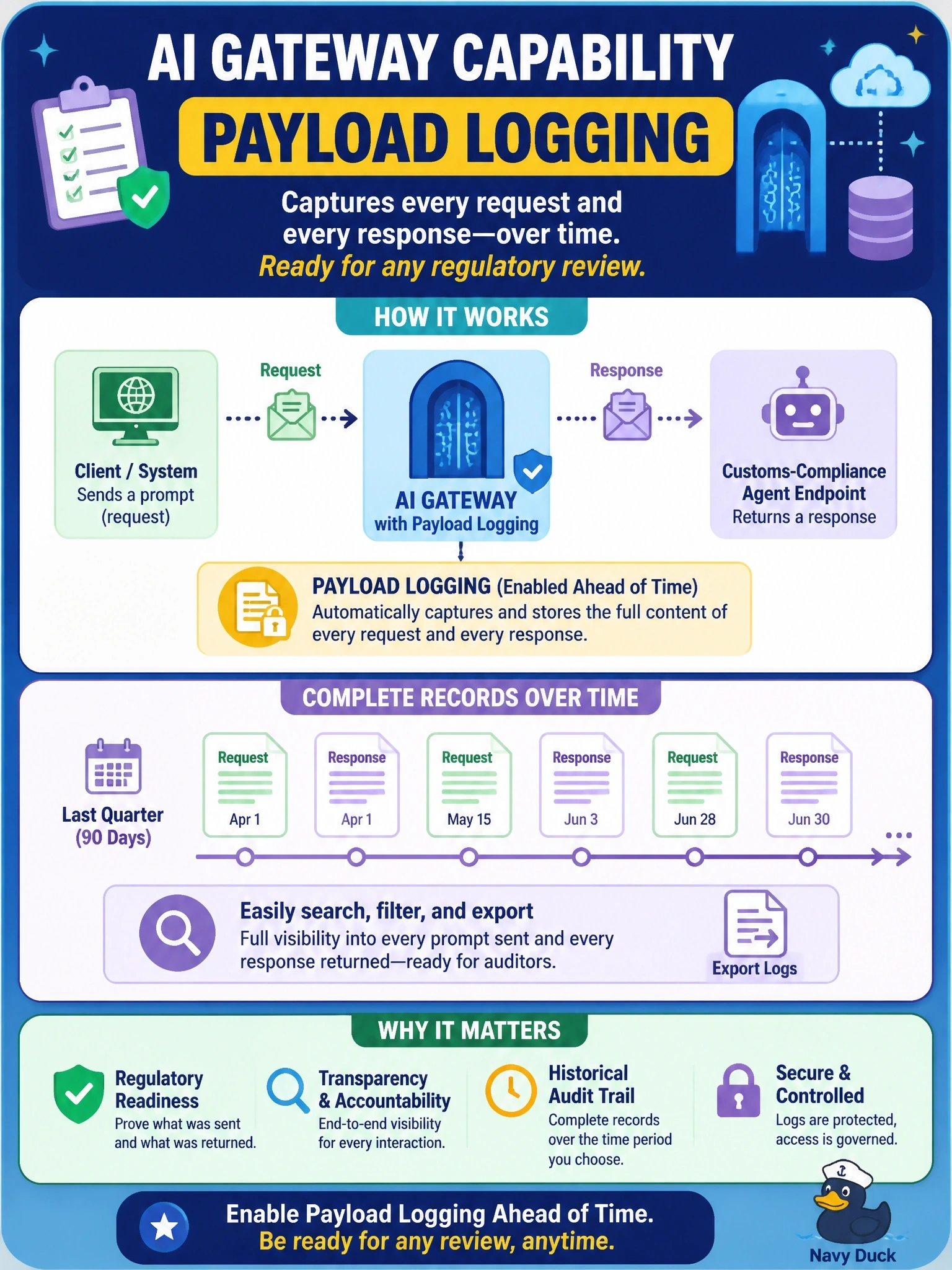
You can’t produce a transcript nobody recorded. Payload logging is the tape recorder that must already be running before the auditor asks for the tape; it captures request and response content over time.
Full Explanation
Payload logging records the content of requests sent to and responses returned by a serving endpoint over time, making it the capability that supports an after-the-fact audit or regulatory review. It must be enabled in advance: it cannot capture endpoint traffic retroactively. Traffic splitting sends selected portions of requests to different model versions for rollout comparisons, but does not create a content record. Scale-to-zero releases idle compute to save cost and does not capture requests or responses. A scheduled Direct Vector Access index sync is not a real control: Direct Vector Access indexes are updated through explicit API calls, not a sync schedule, and refreshing retrieval data does not retain endpoint exchanges. The exam caveat is that payload logging must be active before the period under review; enabling it when an auditor asks cannot recover earlier prompts or responses. As a practical check, confirm that payload logging is enabled for the serving endpoint and verify that the records cover the requested period and include both request and response content.