
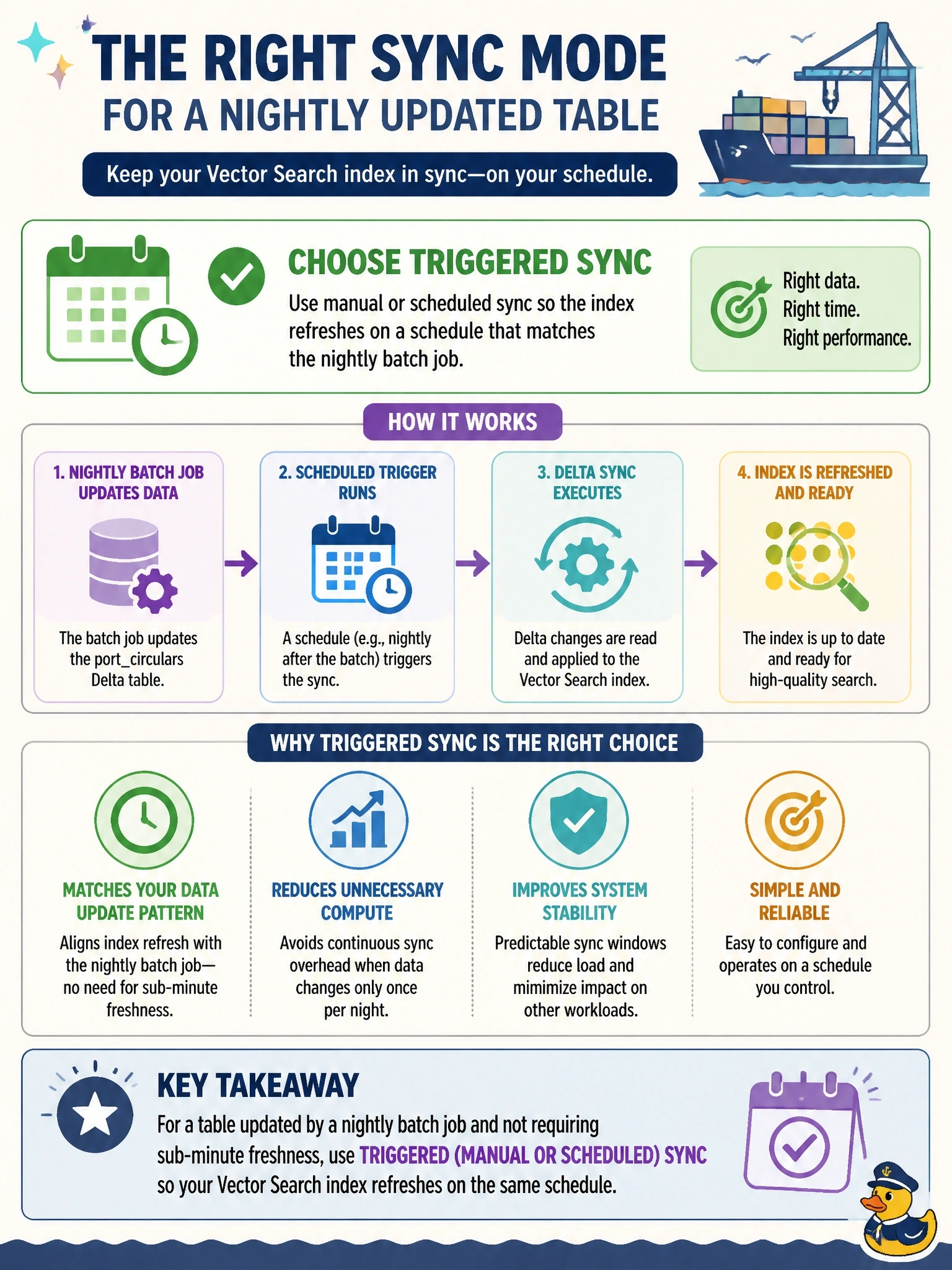
As part of deploying the port-operations copilot, an engineer is creating the Vector Search index over the port_circulars Delta table, which is updated by a nightly batch job and does not need sub-minute freshness. Which sync mode should the engineer choose for the Delta Sync index?
Select an answer to reveal the explanation.
Short Explanation
Don't run a live news ticker for something that only changes once a day. A triggered sync that refreshes on a schedule matching the nightly job gets the index current without paying for continuous compute the freshness requirement doesn't call for.
Full Explanation
Delta Sync indexes support different sync cadences, and the choice should match how often the source data actually changes and how fresh the index needs to be. Here, the source table updates once nightly and sub-minute freshness is explicitly not required, so a triggered sync — refreshed on a schedule or manually, aligned with the nightly job — is the appropriate, more cost-efficient choice over continuously reprocessing changes that mostly aren't happening. Continuous sync is the closest-looking trap: it is a real and valid Delta Sync mode, but it is designed for sources that change frequently and need near-real-time reflection in the index, which is the opposite of this scenario's stated requirement, and it costs more to run continuously than to trigger on a schedule. Claiming no sync mode is needed is false — Delta Sync indexes require an explicit sync mode selection, they do not silently default to instant updates. Direct Vector Access is a different index type entirely, not a sync mode of Delta Sync, and choosing it would mean giving up the whole benefit of syncing automatically from the governed Delta table in the first place. For the exam, match sync mode to source update frequency and freshness requirement: continuous for frequently-changing, latency-sensitive sources, triggered for periodic or batch-updated sources.