
Meridian Line wants one entry point that can answer a charter-clause question, a customs-compliance question, or a maintenance-triage question, each of which needs a different retrieval index and a different specialized prompt. Which architecture avoids building one enormous prompt that tries to do all three at once?
Select an answer to reveal the explanation.
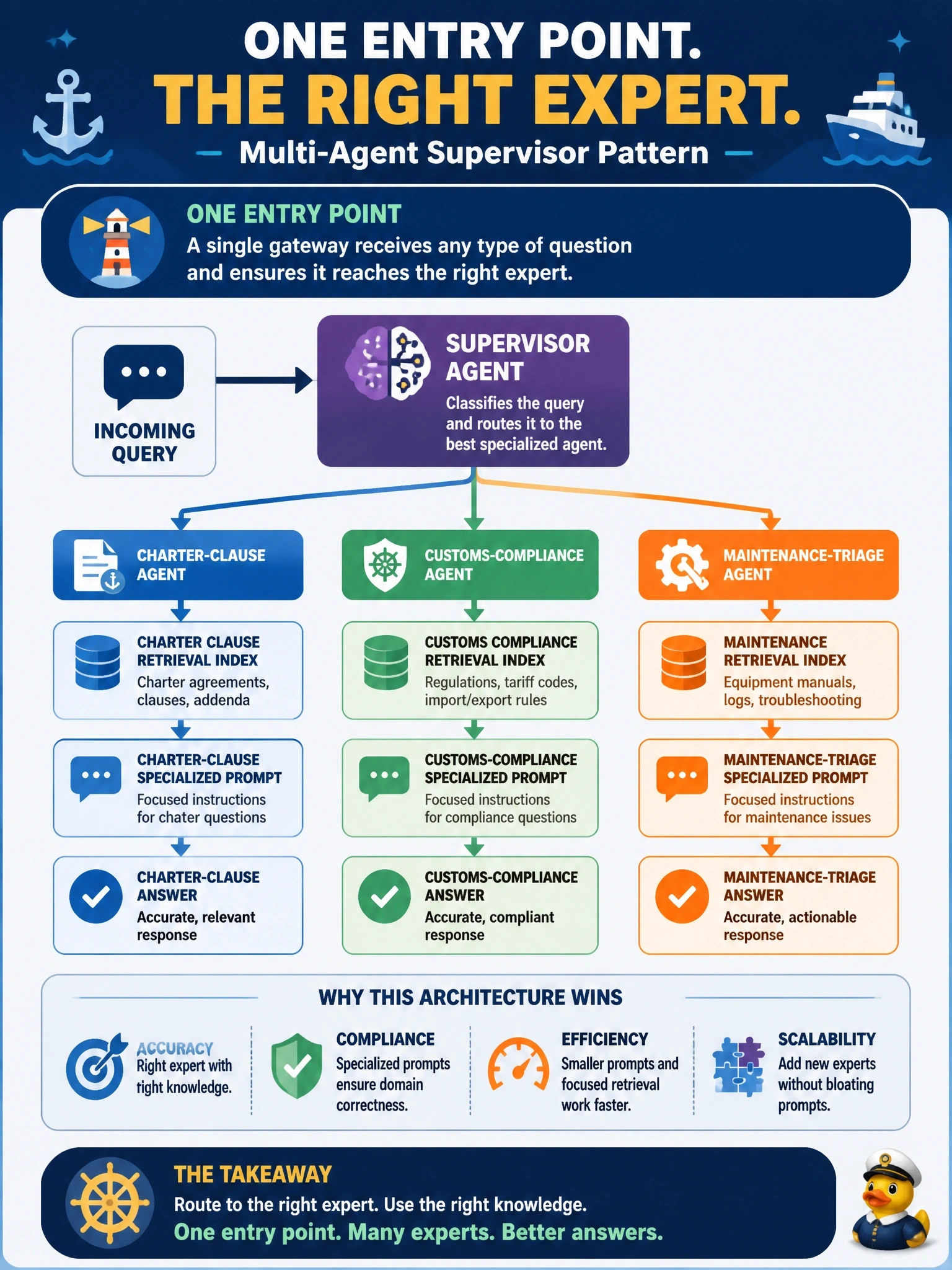
Short Explanation
Don't build one assistant that tries to be a contracts lawyer, a customs broker, and a mechanic at the same time. Put a router in front and hand the question to the specialist -- that's the whole idea behind a supervisor pattern.
Full Explanation
A Multi-Agent Supervisor architecture puts a routing layer in front of specialized sub-agents: the supervisor classifies the incoming query and dispatches it to the sub-agent built for that domain, each with its own retrieval index, tools, and prompt tuned to its narrower task, which keeps every individual prompt focused and every retrieval scoped to the right corpus while still presenting one entry point to the user. A single agent with one giant prompt spanning all three domains forces the model to juggle unrelated context and instructions on every call, degrading both prompt clarity and, per the earlier tool-proliferation lesson, tool and retrieval selection accuracy. Three fully separate applications with no shared entry point solves the prompt-bloat problem but reintroduces the very requirement the question rules out -- a single entry point -- by pushing the routing decision onto the user instead of the system. Merging all three corpora into one index was already established elsewhere in this bank as the wrong call when domains, metadata schemas, and audiences differ; it also does nothing about prompt specialization, since a merged index still feeds into whatever single prompt is asking it a question. Exam framing: determining when to reach for a Multi-Agent Supervisor pattern is a named Agent Bricks objective, and composing that routing with the underlying chains is Application Development work.