
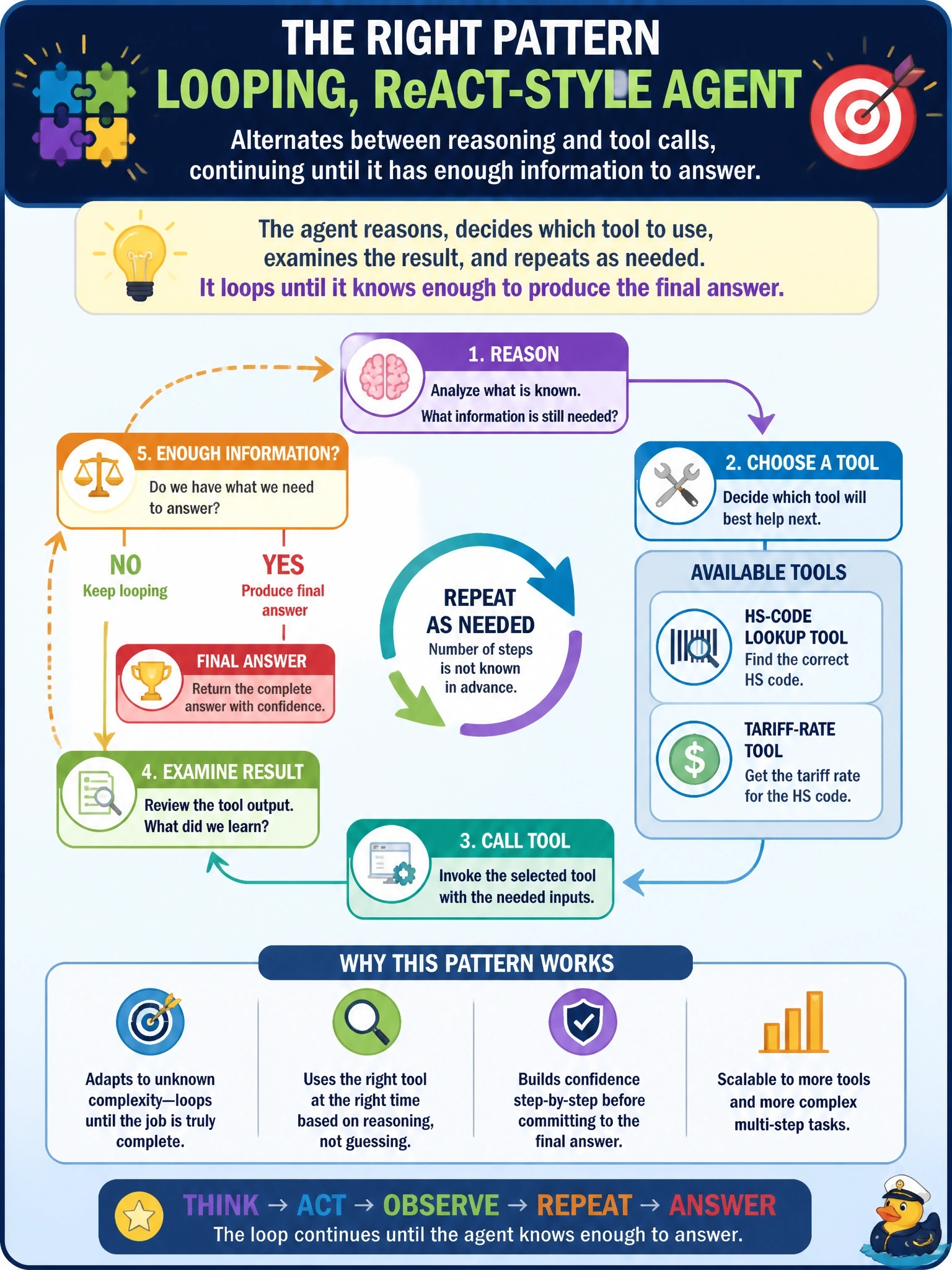
The customs-compliance agent must sometimes call the HS-code lookup tool, examine its result, decide it needs to also call the tariff-rate tool, examine that result, and only then produce a final answer -- the number of steps is not known in advance. Which agent execution pattern supports this?
Select an answer to reveal the explanation.
Short Explanation
When you don't know ahead of time how many tool calls a question needs, you can't hardcode the steps -- you need a loop: reason, act, look at what came back, decide whether to go again. That's the ReAct pattern in one sentence.
Full Explanation
A looping reasoning-and-acting agent -- the ReAct-style pattern the Mosaic AI Agent Framework supports -- repeatedly interleaves a reasoning step with a tool call, inspects the tool's output, and decides whether another tool call is needed or the information gathered is sufficient to answer, which is exactly what an open-ended, variable-length multi-stage task like chained HS-code and tariff-rate lookups requires. A single-shot, one-tool-call design cannot handle a case where the second tool call's necessity is only apparent after seeing the first tool's result -- it has no mechanism to loop back. A fixed two-step pipeline hardcodes an order that happens to match this example but breaks the moment a query needs a different sequence, zero tool calls, or three; it is not the general pattern being tested, it is a special case that got lucky. Pre-computing every combination overnight is not agentic reasoning at all, and it does not scale -- HS codes and tariff rates combine combinatorially and change over time, so a static precomputed table would go stale and still would not handle novel queries at inference time. Exam framing: defining and ordering tools for multi-stage reasoning explicitly describes a variable-length reasoning loop, which is the behavior a ReAct-style agent implementation provides.