
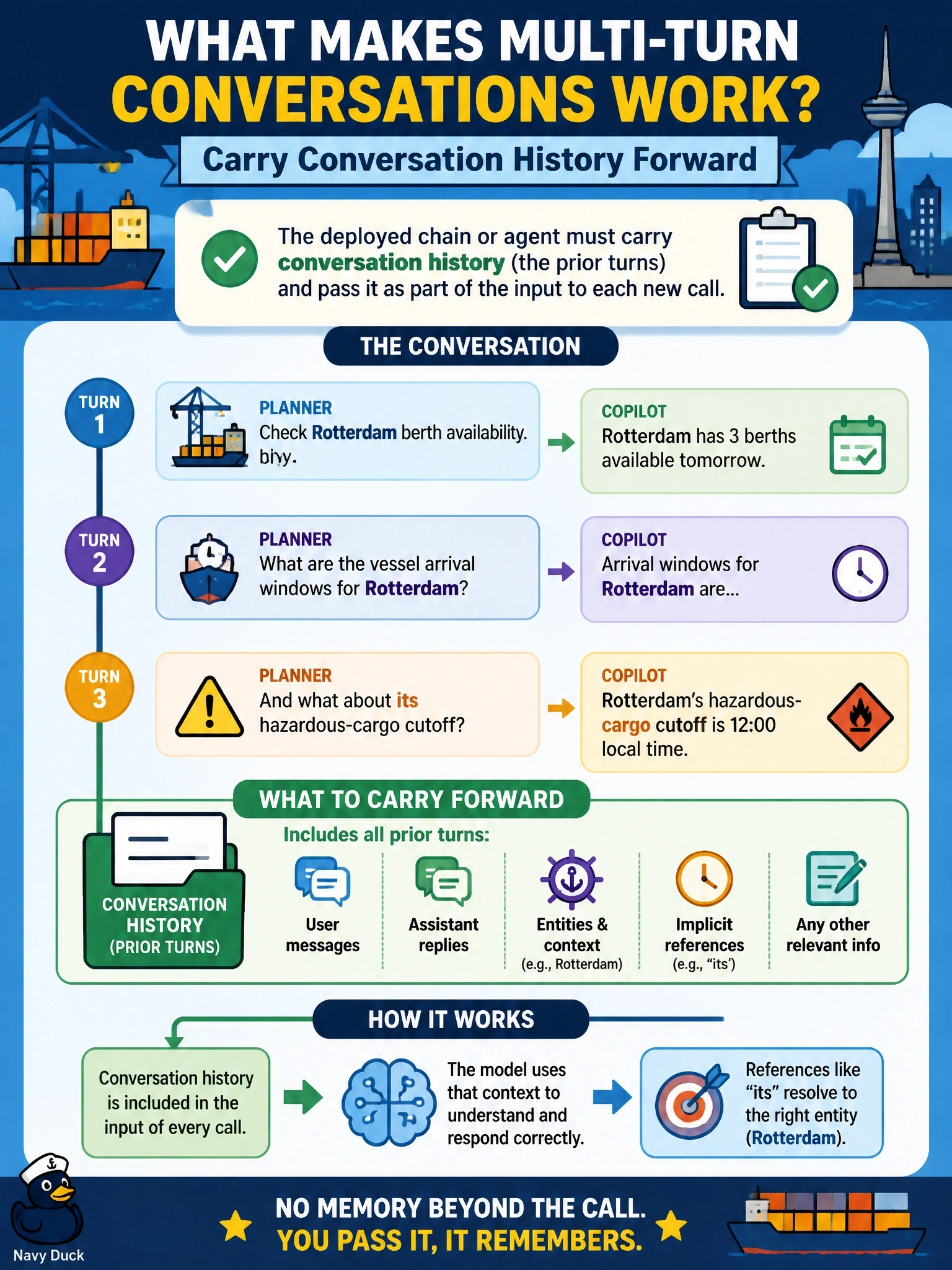
A planner asks the port-operations copilot about Rotterdam berth availability, then two turns later asks 'and what about its hazardous-cargo cutoff', expecting the agent to remember 'it' means Rotterdam. What must the deployed chain or agent implementation carry across turns for this to work?
Select an answer to reveal the explanation.
Short Explanation
The model doesn't remember your last question -- your application does, and it has to hand that history back in with the next call. No history in the prompt, no 'it' resolving to Rotterdam.
Full Explanation
A large language model is stateless between calls: it only 'knows' what is present in the context passed to it on a given invocation, so multi-turn coreference like resolving 'its' to Rotterdam requires the application layer to include the relevant prior turns as part of each new request's input, which is exactly what the ChatAgent interface's multi-turn support is designed to carry. Assuming the model infers this without being given the history is wrong -- without prior turns in context, 'it' is genuinely ambiguous to the model and it will either guess or ask for clarification. Fine-tuning a model on one planner's conversation history is a wildly disproportionate and impractical solution to short-term conversational memory, and it would need to be redone continuously as new conversations happen, which is not how conversation state is handled. Querying a Vector Search index in place of directly passing recent turns is a mismatch of tools: Vector Search is for retrieving relevant documents from a large corpus by semantic similarity, not for reconstructing the literal, ordered, recent turn-by-turn history a coreference resolution needs -- recent turns should simply be passed as context, not retrieved probabilistically. Exam framing: composing chains and agents that behave correctly across a conversation is Application Development work, and understanding that state must be explicitly carried, not assumed, is the core idea.