
During a patient education session, a patient asks why dental X-rays require safety precautions like collimation and ALARA exposure limits, whereas the operatory exam light does not. Which physical property distinguishes ionizing X-ray radiation from visible light?
Select an answer to reveal the explanation.
Short Explanation
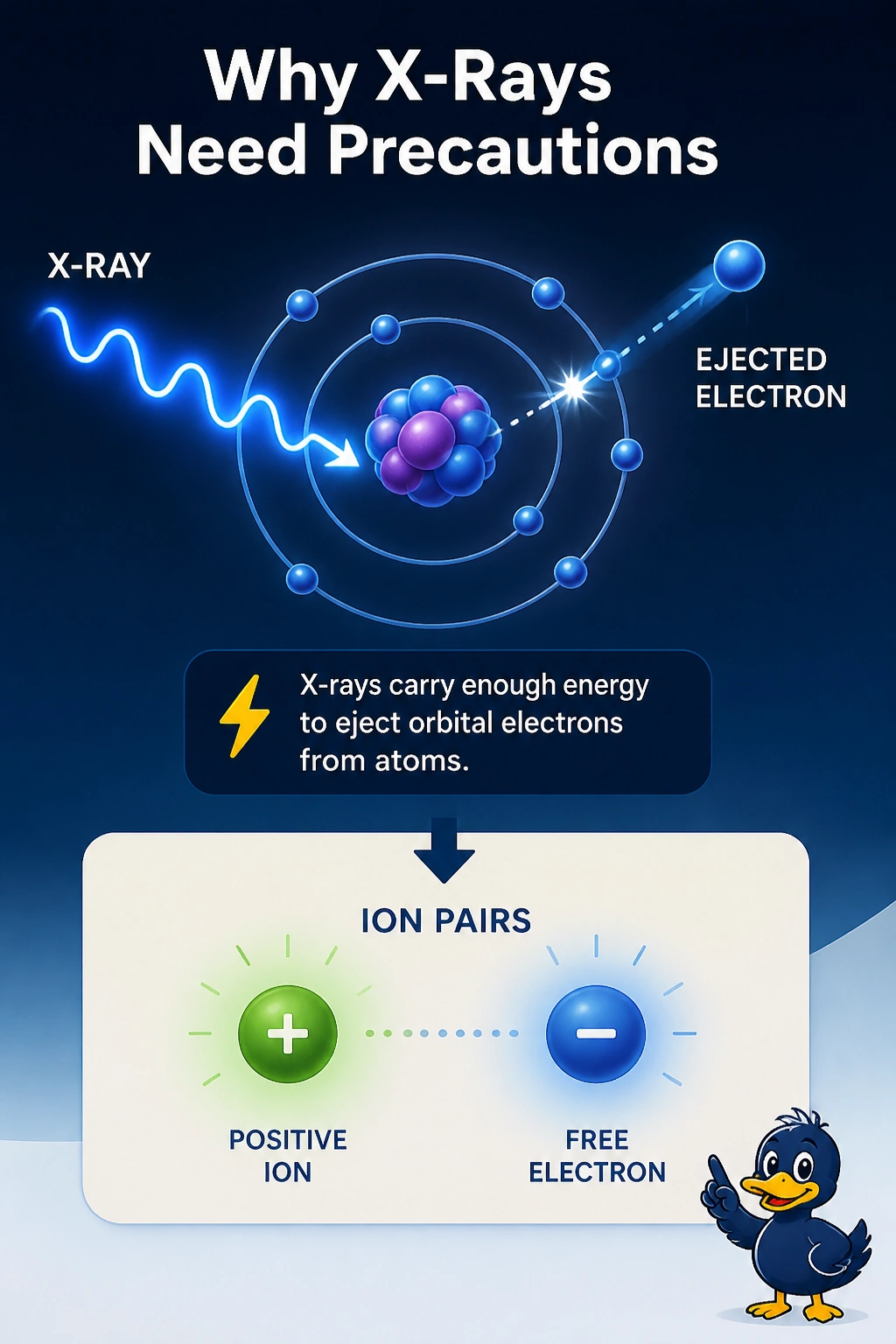
Think of visible light as a gentle tap you feel on your skin, while an X-ray photon packs enough punch to knock an electron out of its orbit. That ability to eject orbital electrons and create ion pairs is what makes X-rays ionizing for you to respect with ALARA and collimation. Don't fall for speed or surface-heat traps — photon energy is what sets them apart.
Full Explanation
The fundamental difference between diagnostic X-rays and visible light is that X-rays carry enough energy to eject orbital electrons from atoms and form ion pairs. This process, called ionization, disrupts chemical bonds in water and biological macromolecules such as DNA, which is why radiation protection protocols like ALARA, collimation, and filtration are required. The claim that X-rays travel faster than visible light in air and penetrate metal shielding effortlessly is false because all electromagnetic radiation travels at the speed of light in air, and high-atomic-number metals such as lead effectively attenuate diagnostic X-ray beams. The claim that X-rays deposit all of their energy as heat in the first millimeter of skin, like infrared lamps is incorrect because diagnostic X-rays are highly penetrating and deposit energy along deep tracks by ionization, not by superficial thermal heating like infrared radiation. The claim that X-rays have longer wavelengths than visible light and warm superficial skin layers reverses the electromagnetic spectrum: X-rays have vastly shorter wavelengths and higher frequencies than visible light, with energy that ionizes rather than gently warms tissue. As a caveat, even though dental X-rays are ionizing, diagnostic doses are very low when modern digital sensors and proper exposure parameters are used. As an operational check, confirm rectangular collimation and patient-specific exposure presets are selected before every exposure.
Prefer to study offline? Printable PDF study book + test engine ($7.50, unofficial). These questions stay free here.