
During a radiation safety review, a dental assistant asks why federal regulations set a numerical annual dose limit for dental staff but not for patients receiving diagnostic digital radiographs. Which principle explains this regulatory distinction?
Select an answer to reveal the explanation.
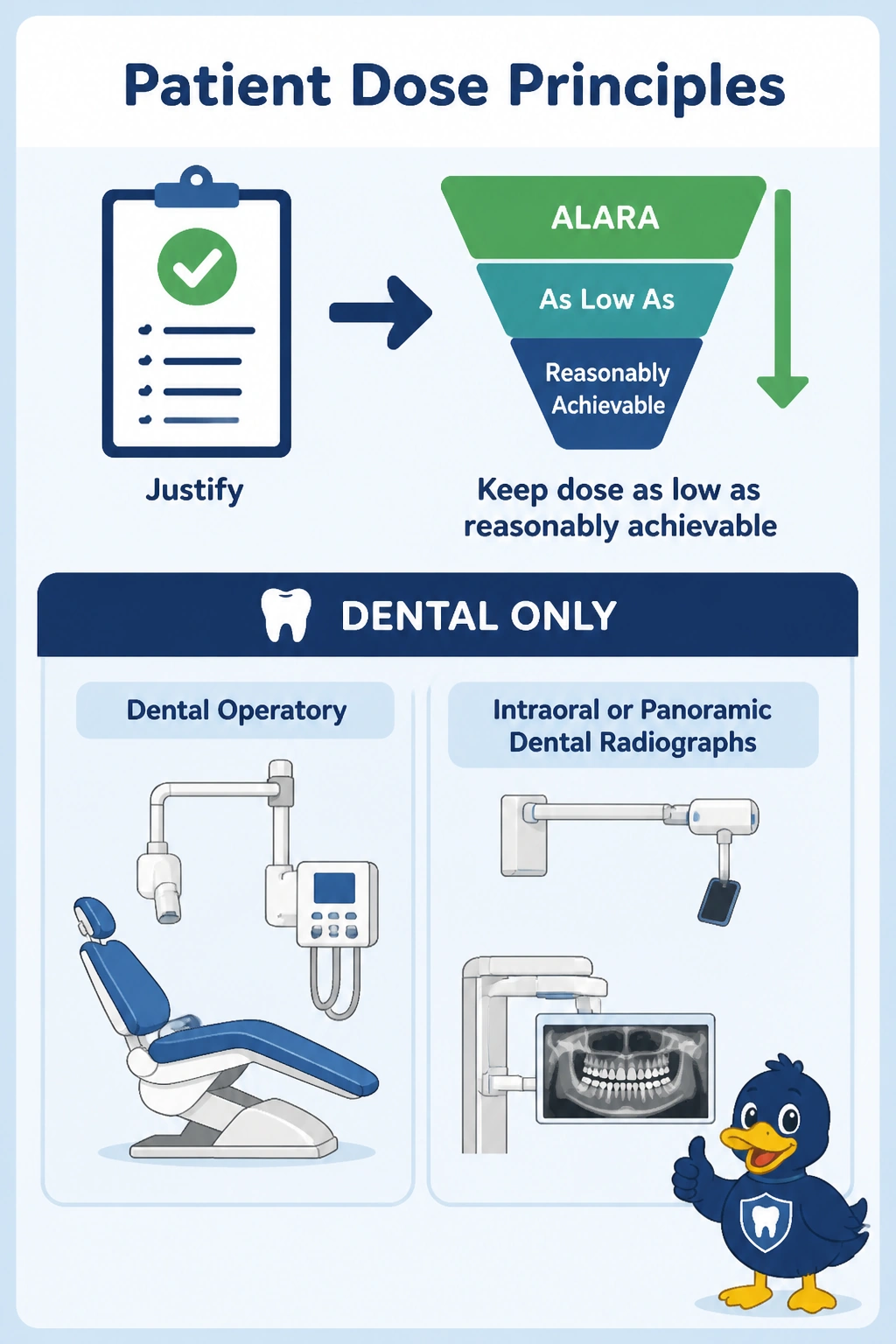
Short Explanation
You can think of occupational dose limits as a speed limit for daily commuters, while patient imaging is an emergency-only trip taken when its benefit outweighs its risk. Remember that dental X-rays are ionizing, not harmless or non-ionizing; patient exposure follows clinical justification and ALARA rather than a yearly numerical cap.
Full Explanation
Under federal and national radiation protection frameworks, patient exposures rely on clinical justification and ALARA rather than fixed numerical limits because each diagnostic radiograph must provide a net clinical benefit to the individual patient, with exposure optimized to the lowest dose needed for diagnostic quality. Diagnostic dental X-rays are ionizing radiation, capable of ejecting orbital electrons and causing cumulative cellular injury; they are not non-ionizing photons with zero biological effects. Diagnostic reference levels for dental exams are optimization tools to identify unusually high doses for review, not legal per-patient annual dose limits that forbid indicated imaging. Patient doses are medical exposures, not part of the dentist's annual occupational radiation limit; staff and patient exposures are tracked separately. One exam caveat is that regulatory dose limits apply to radiation workers and the general public, not to restricting medically necessary patient care. As a practical check, verify that each radiographic order follows a clinical examination and documented diagnostic need, then select the lowest effective exposure preset.
Prefer to study offline? Printable PDF study book + test engine ($7.50, unofficial). These questions stay free here.