
During a radiation biology review, a dental assistant asks how the less common direct effect of ionizing radiation differs from the indirect effect during diagnostic dental exposures. Which mechanism describes this direct effect?
Select an answer to reveal the explanation.
Short Explanation
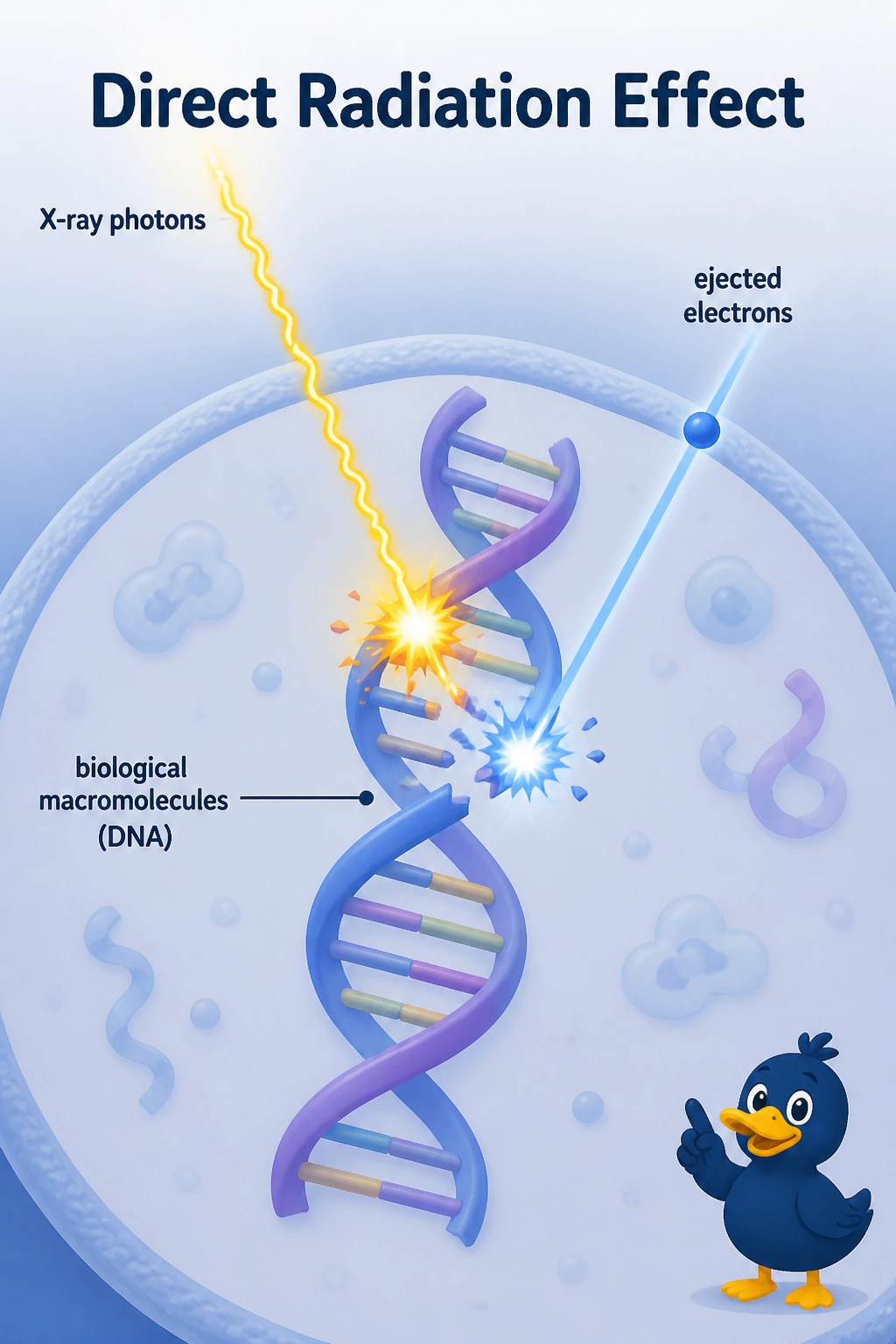
Imagine hitting a target directly with a dart instead of tossing a rock into a pond to make splashes—that is the direct effect in a nutshell. In direct radiation damage, X-ray photons or secondary electrons strike DNA or other vital macromolecules head-on to break chemical bonds. The trap is picking water radiolysis, which describes the more common indirect effect you see in tissue.
Full Explanation
In radiation biology, the direct effect occurs when X-ray photons or ejected electrons strike biological macromolecules like DNA directly and break bonds. Because human cells are composed mostly of water, direct hits on critical macromolecules are statistically less frequent than indirect hits, yet they can still cause single- or double-strand DNA breaks and cellular dysfunction. By contrast, when X-ray photons split cellular water molecules into free radicals that diffuse and damage nearby DNA, that describes the indirect effect via radiolysis of water, which accounts for the majority of diagnostic radiation injury. The statement that Low-energy photons vibrate outer-shell electrons and re-emit identical photons without causing ionization describes coherent scattering, a physical interaction that transfers no energy to break molecular bonds. Finally, High-speed cathode electrons strike the tungsten anode target and emit continuous braking radiation describes bremsstrahlung X-ray production inside the tubehead rather than biological tissue damage. As a caveat, both direct and indirect cellular injuries can often be repaired by cellular enzymes, especially at low diagnostic doses, though irreparable DNA damage remains possible. For an operational check, always apply ALARA principles—such as rectangular collimation and appropriate pediatric or adult presets—to minimize total photon interactions with patient DNA.
Prefer to study offline? Printable PDF study book + test engine ($7.50, unofficial). These questions stay free here.