
A dental clinic performs routine quality-assurance testing on its digital intraoral X-ray unit by exposing an aluminum step-wedge phantom under standardized settings and comparing the resulting grayscale steps over time. What is the primary radiation-protection purpose of this test?
Select an answer to reveal the explanation.
Short Explanation
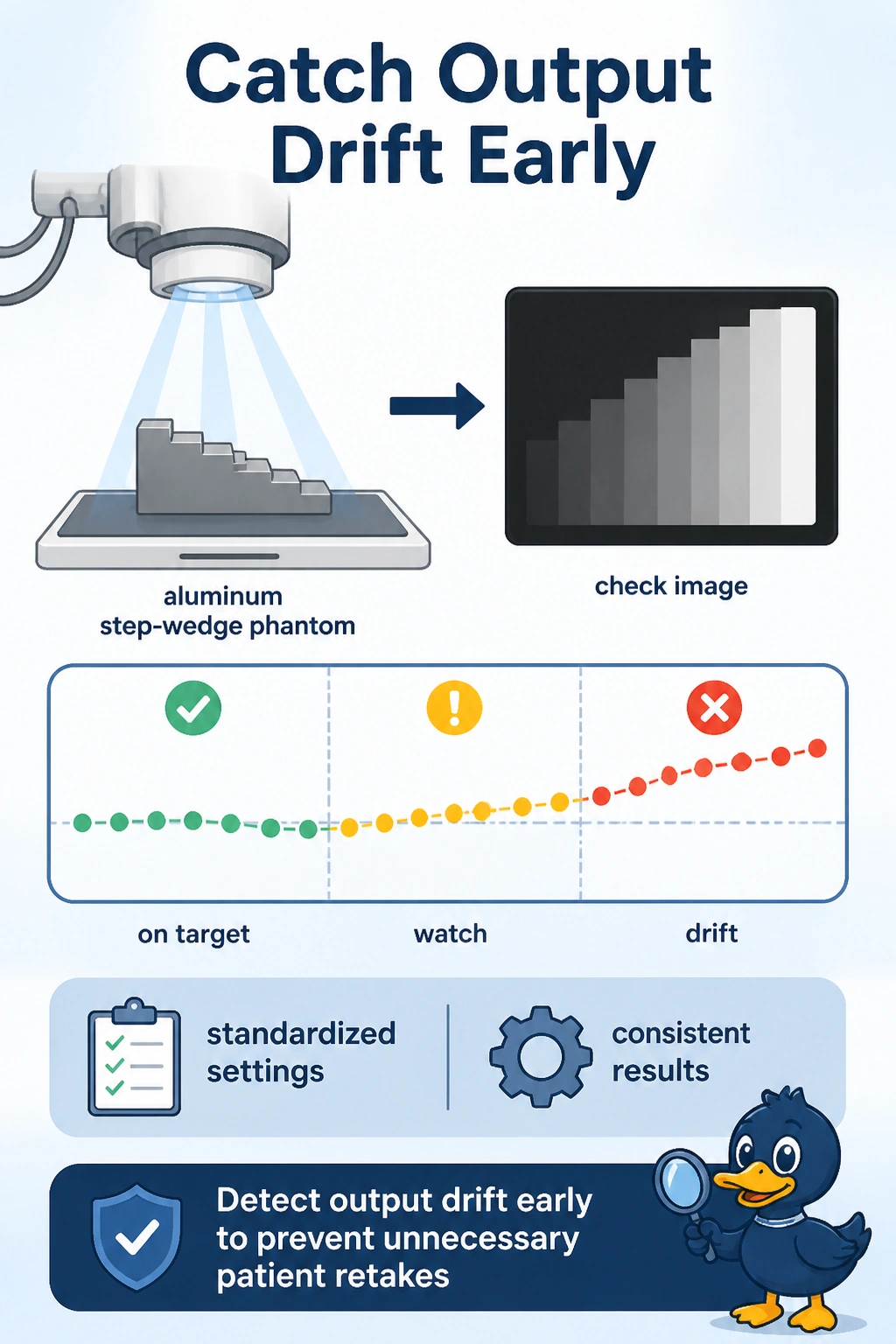
Think of a step-wedge test as tuning a guitar before the concert so you do not hit sour notes mid-song. Catching X-ray output drift on a test phantom keeps you from discovering poor image quality on a live patient who would then need a retake.
Full Explanation
The primary radiation-protection purpose of routine step-wedge phantom testing is "To detect generator output drift early and prevent unnecessary patient retakes." By exposing an aluminum step-wedge under standardized kVp, mA, time, and distance settings and comparing the resulting grayscale densities against a baseline reference image, the dental team can spot subtle shifts in X-ray tube output or timer accuracy before diagnostic quality degrades on live patients and forces repeat exposures. It is not used "To measure the exact effective dose in sieverts absorbed by the patient's thyroid gland," because effective dose requires radiation-weighting and tissue-weighting calculations rather than a simple aluminum step image. Nor is it performed "To calibrate the computer monitor's pixel resolution for detecting incipient caries," as monitor display performance is checked with dedicated test patterns on the workstation rather than X-ray exposures. It is also not used "To verify that added aluminum filtration equals 2.5 mm at 70 kVp," because filtration compliance is verified by half-value layer measurement with calibrated dosimetry, not by visual comparison of step-wedge densities. One caveat is that automatic exposure compensation in digital imaging software can mask mild generator drift if you rely solely on clinical images. As a concrete operational check, expose the step-wedge with identical baseline parameters and compare each grayscale step side by side against your reference image.
Prefer to study offline? Printable PDF study book + test engine ($7.50, unofficial). These questions stay free here.