
A dental clinic tracks every discarded or repeated digital intraoral exposure in a monthly quality-assurance retake log, recording the reason each image was rejected. What is the primary radiation-protection purpose of this reject-analysis log?
Select an answer to reveal the explanation.
Short Explanation
Every retake doubles the radiation dose for that tooth, so tracking why images fail is your best defense under ALARA. Do not confuse a retake log with dosimetry math—its real job is fixing the root cause so errors stop happening.
Full Explanation
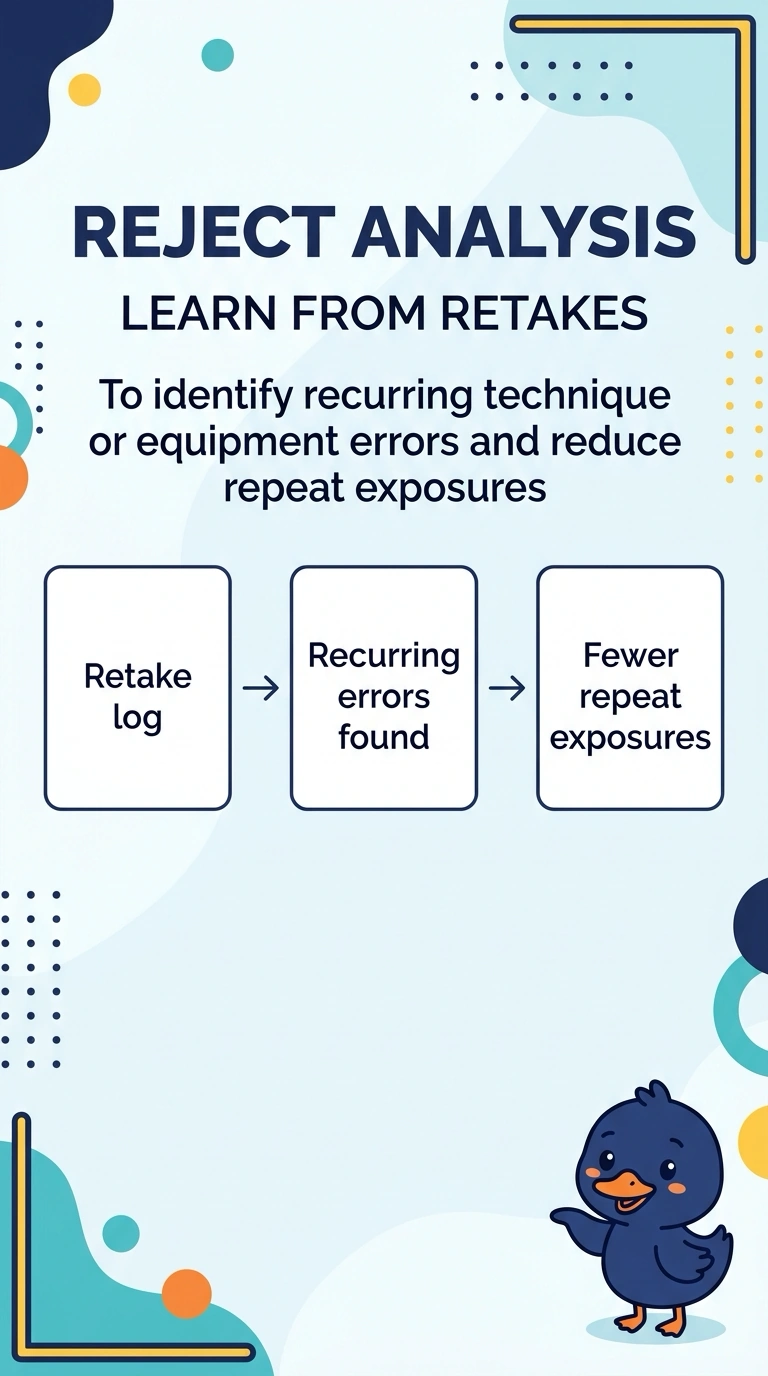
Under ALARA principles, the goal of reject analysis is To identify recurring technique or equipment errors and reduce repeat exposures by spotting patterns such as frequent cone-cuts, horizontal overlap, or drifting tubehead arms. A retake log does not have the physics measurements needed To calculate the exact cumulative effective dose received by each patient, which depends on specific exposure factors, collimation, and tissue weighting. It also cannot be used To verify that the X-ray unit meets the federal 7 cm primary beam diameter limit, which requires physically measuring the collimated beam at the end of the position-indicating device during equipment quality assurance. Likewise, a clinical retake log does not function To determine whether the personal radiation dosimeter control badge was exposed, as the control badge is stored in a radiation-free area and evaluated by the dosimetry laboratory. Caveat: a retake log only works if staff record every rejected exposure honestly rather than deleting failed images silently from the software. Operational check: review the reject-analysis log monthly and schedule targeted positioning coaching or equipment service whenever one error type spikes.
Prefer to study offline? Printable PDF study book + test engine ($7.50, unofficial). These questions stay free here.