
While comparing two intraoral X-ray beam spectra during a radiation physics review, a dental assistant notes that one beam consists of photons with shorter wavelengths and higher frequencies than the other. How does this difference affect the beam's physical properties?
Select an answer to reveal the explanation.
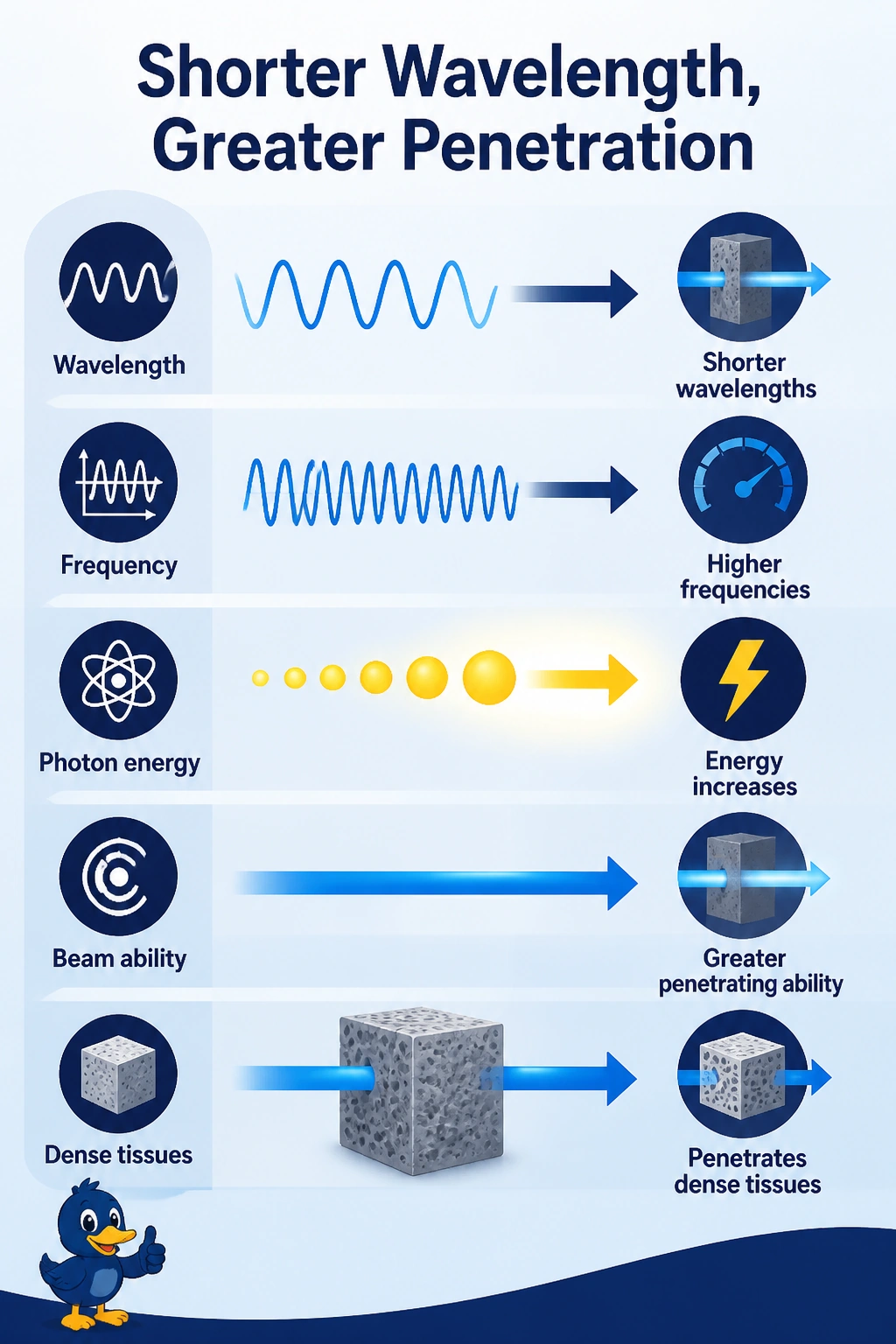
Short Explanation
Think of X-ray waves like ocean waves you watch from shore—tighter, faster crests pack a stronger punch. Higher frequency and shorter wavelength mean higher photon energy, allowing the beam to pass through dense enamel and bone. The trap is confusing photon energy with beam speed or quantity, which are separate properties.
Full Explanation
Photon energy is directly proportional to frequency and inversely proportional to wavelength, so It increases photon energy and gives the beam greater ability to penetrate dense tissues. When higher kilovoltage accelerates electrons faster toward the tungsten target, the resulting X-ray photons carry more energy, have shorter wavelengths, and travel with higher frequency to pass through enamel and cortical bone to reach the digital sensor. By contrast, It lowers individual photon energy and increases absorption within superficial gingival tissues describes low-energy, long-wavelength photons that are filtered out by aluminum because they add skin dose without aiding diagnosis. The claim that It slows photon travel speed in a vacuum and widens the primary X-ray beam divergence angle is incorrect because all electromagnetic waves travel at the constant speed of light in a vacuum, and divergence is governed by collimation and distance. Similarly, It reduces beam frequency and increases the total number of electrons striking the target confuses wave energy with tube current, which controls electron quantity rather than photon wavelength. As a caveat, higher-energy beams also shift digital image contrast toward a wider range of gray shades. For a quick operational check, verify the kilovoltage peak setting on the control panel matches the exposure chart for the patient's tissue thickness before pressing the exposure switch.
Prefer to study offline? Printable PDF study book + test engine ($7.50, unofficial). These questions stay free here.