
During a radiation biology review, a patient asks whether small diagnostic dental X-ray doses disappear completely from the body or leave lasting cellular risk over a lifetime. Which statement best describes the cumulative effect of ionizing radiation?
Select an answer to reveal the explanation.
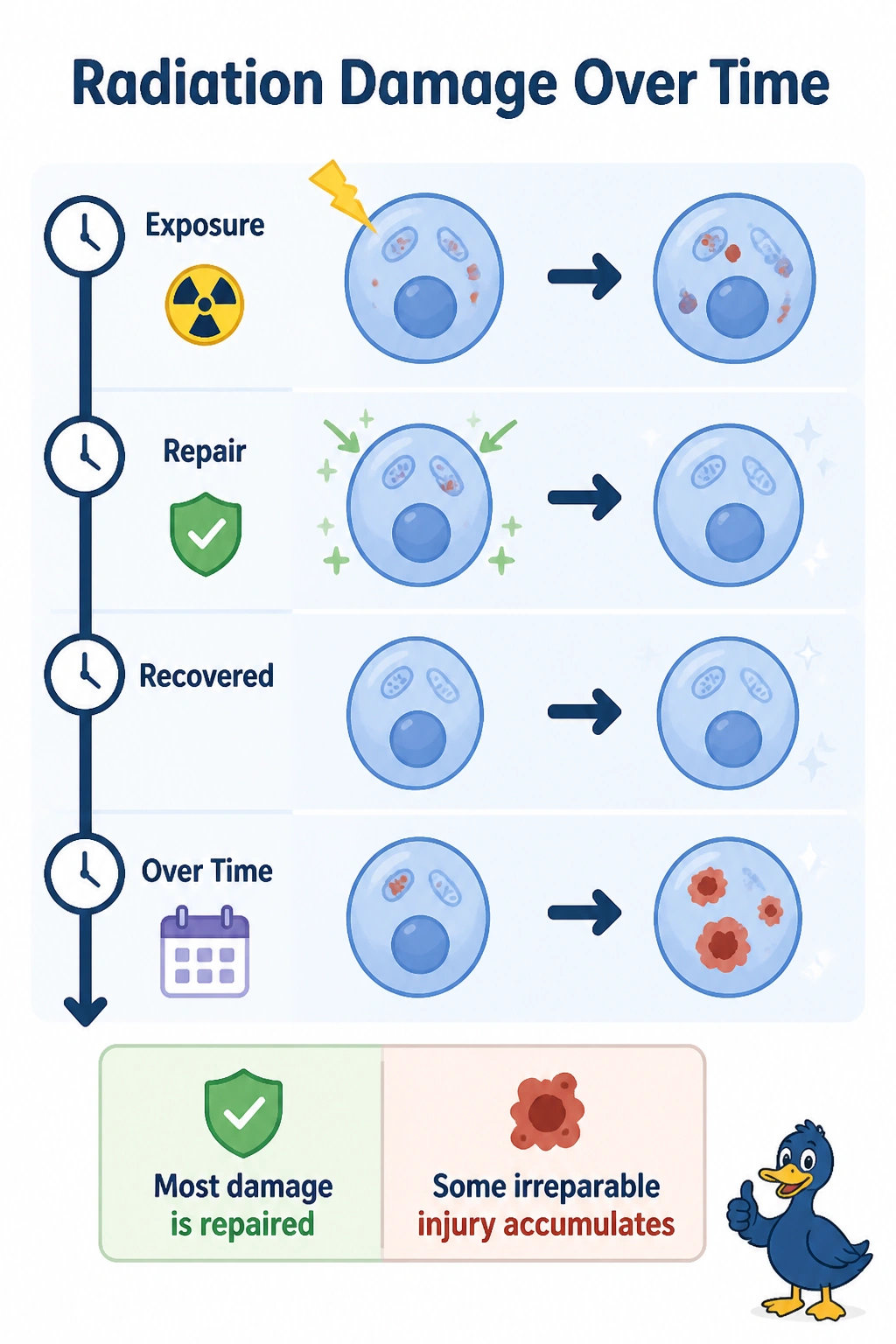
Short Explanation
Think of your body's cellular repair crew as fast and capable, though a few scratches on the blueprint never quite buff out. Most sublethal radiation injury is repaired between appointments, yet a small fraction of irreparable damage adds up over time. The trap is swinging to either extreme—assuming zero risk or zero repair.
Full Explanation
In radiation biology, Most cellular damage is repaired, but some irreparable injury accumulates over a person's lifetime. Normal cellular mechanisms repair most sublethal breaks caused by low-dose diagnostic dental X-rays, especially when exposures are spaced apart, but a small fraction of chromosomal or DNA damage remains unrepaired and adds to prior exposure history. Claiming that Every diagnostic X-ray exposure is completely repaired with zero lasting effect ignores stochastic risk and the rationale behind ALARA dose reduction. Stating that All radiation damage is permanent, and human cells cannot repair any injury overlooks the body's substantial DNA-repair capacity that allows fractionated or spaced diagnostic imaging. Believing that Only exposures received during childhood contribute to cumulative tissue risk is inaccurate because adult tissues remain susceptible throughout life, even though children are more radiosensitive. As a caveat, cumulative risk from properly prescribed digital dental radiographs is extremely small compared with the diagnostic benefit of detecting disease. For an operational check, review prior radiographs and prescribe new exposures only when clinically justified by examination findings.
Prefer to study offline? Printable PDF study book + test engine ($7.50, unofficial). These questions stay free here.