
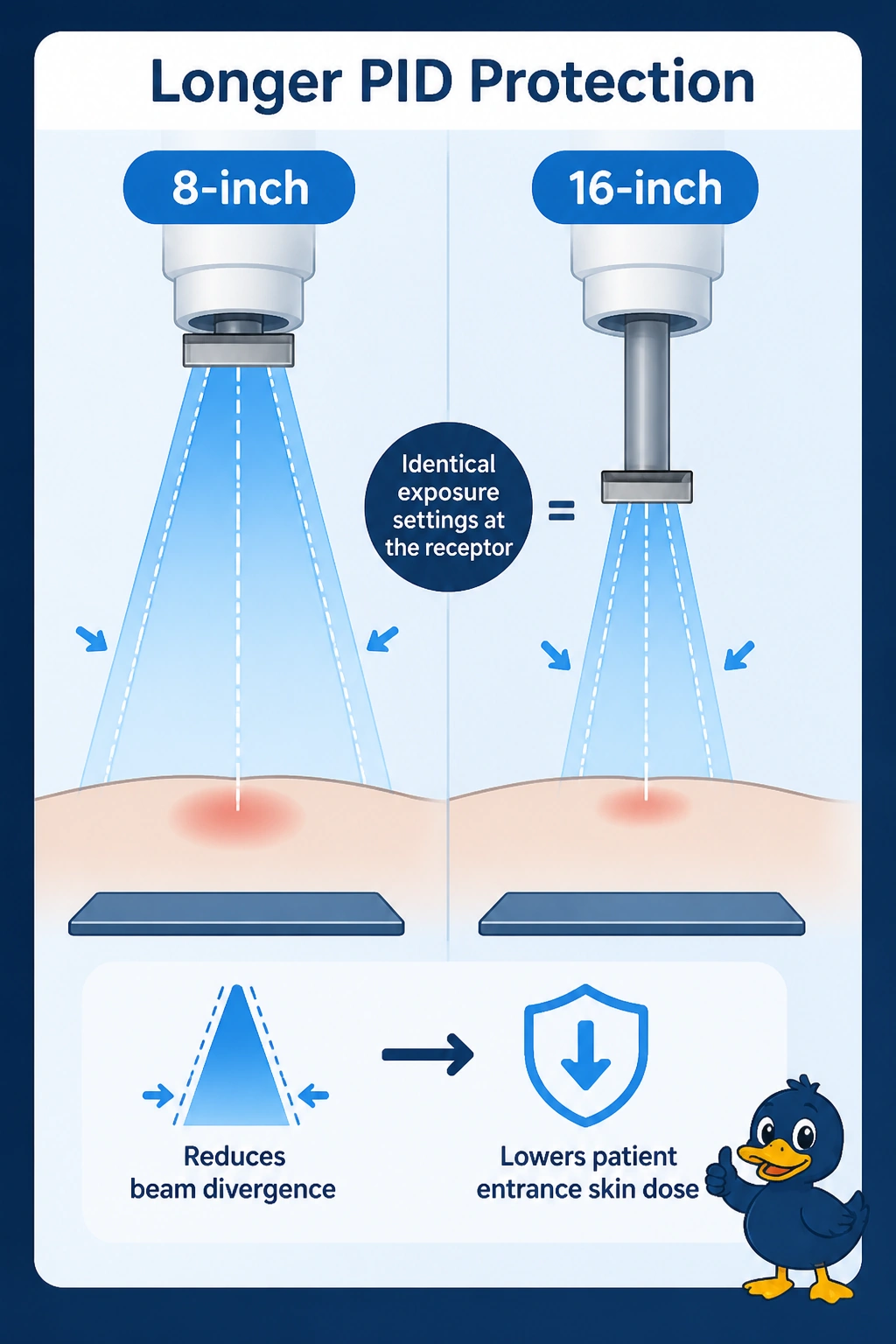
A dental clinic compares an older short 8-inch position-indicating device (PID) with a longer 16-inch PID at identical exposure settings at the receptor. How does increasing the source-to-skin distance with the longer PID affect patient radiation protection?
Select an answer to reveal the explanation.
Short Explanation
Think of a flashlight beam—the closer you hold it to a wall, the faster the cone spreads out and concentrates light at the entry point. A longer PID gives you a more parallel beam that exposes a smaller volume of tissue and lowers skin dose.
Full Explanation
Increasing the source-to-skin distance with a longer PID is beneficial because It reduces beam divergence and lowers patient entrance skin dose. When the X-ray source is farther from the skin, the photons reaching the patient travel in more nearly parallel paths, which reduces the volume of tissue irradiated beyond the receptor and decreases the entrance-to-exit dose ratio. It does not mean that It eliminates the need for a lead-lined collimator inside the tubehead, because collimation is still legally required to restrict the primary beam diameter to no more than 7 cm (2.75 inches) at the skin surface. Nor is it true that It increases X-ray beam divergence so more facial tissue is irradiated; a longer distance actually decreases divergence rather than widening it. Furthermore, changing PID length does not alter tube voltage, so It lowers the photon energy (kVp) of the primary beam before it exits is incorrect—kVp is controlled by the autotransformer and step-up transformer, not PID length. One caveat is that doubling the source-to-receptor distance requires adjusting exposure factors per the inverse square law to maintain receptor exposure. As an operational check, verify the PID is positioned close to the patient's cheek without gaps while keeping the exposure settings matched to the unit's PID length chart.
Prefer to study offline? Printable PDF study book + test engine ($7.50, unofficial). These questions stay free here.