
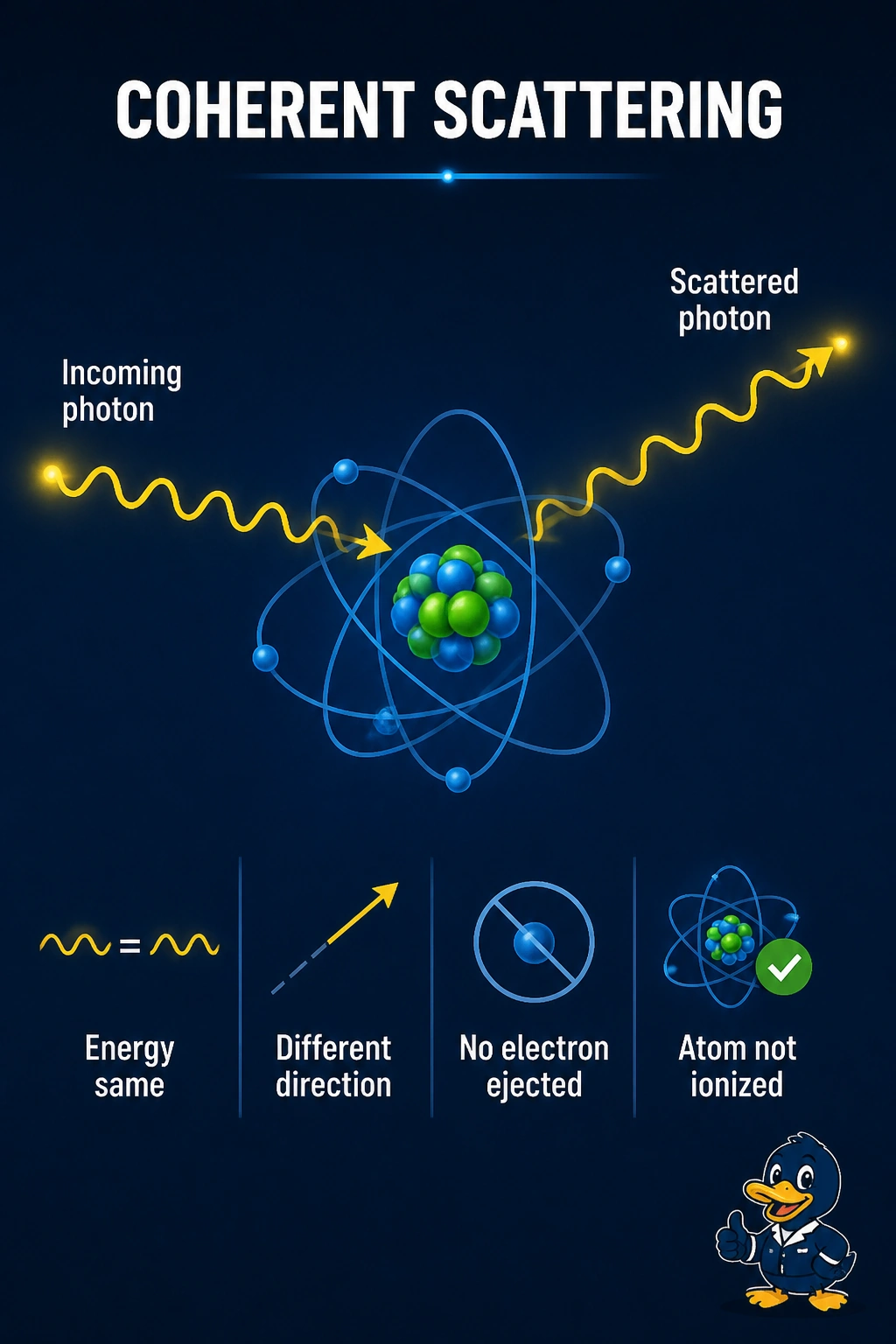
During a diagnostic dental X-ray exposure, a low-energy X-ray photon interacts with a whole atom in the patient's cheek, causing its electrons to vibrate momentarily and re-emit a photon of the exact same energy in a different direction without ejecting an electron. Which radiation interaction does this describe?
Select an answer to reveal the explanation.
Short Explanation
Think of coherent scattering like a billiard ball bouncing cleanly off a heavy bumper without chipping it. The trap is confusing it with Compton scattering or photoelectric absorption, both of which knock electrons loose and ionize the atom. Because no electron is ejected here, you get a change in photon direction without ionization.
Full Explanation
In diagnostic dental radiography, Coherent scattering without ionization of the target atom occurs when a low-energy incident X-ray photon interacts with an entire atom, momentarily exciting its electrons and immediately releasing a scattered photon of identical energy at a different angle. Because the photon energy is too low to overcome electron binding energy, no ionization takes place. Choosing Photoelectric absorption with inner-shell electron ejection is incorrect because photoelectric interactions completely absorb the incident photon and eject a tightly bound inner-shell electron, ionizing the atom and creating radiographic contrast. Selecting Compton scattering with outer-shell electron recoil fails because Compton scattering ionizes the atom by ejecting a loosely bound outer-shell electron and deflecting a lower-energy photon. Opting for Bremsstrahlung radiation produced at the tungsten target describes how primary X-ray photons are generated inside the X-ray tube when high-speed electrons decelerate near tungsten nuclei, rather than an interaction inside patient tissue. As a radiation-protection caveat, although coherent scattering does not ionize patient tissue, the redirected photon can still contribute slightly to image fog if it reaches the digital receptor. For an operational check, use proper beam collimation and recommended kilovoltage peak settings so unnecessary low-energy scatter reaching the sensor is minimized.
Prefer to study offline? Printable PDF study book + test engine ($7.50, unofficial). These questions stay free here.