
Inside a dental X-ray tube, the tungsten target on the anode is angled steeply relative to the electron beam from the cathode. What is the primary imaging and thermal advantage of this angled target design, known as the line-focus principle?
Select an answer to reveal the explanation.
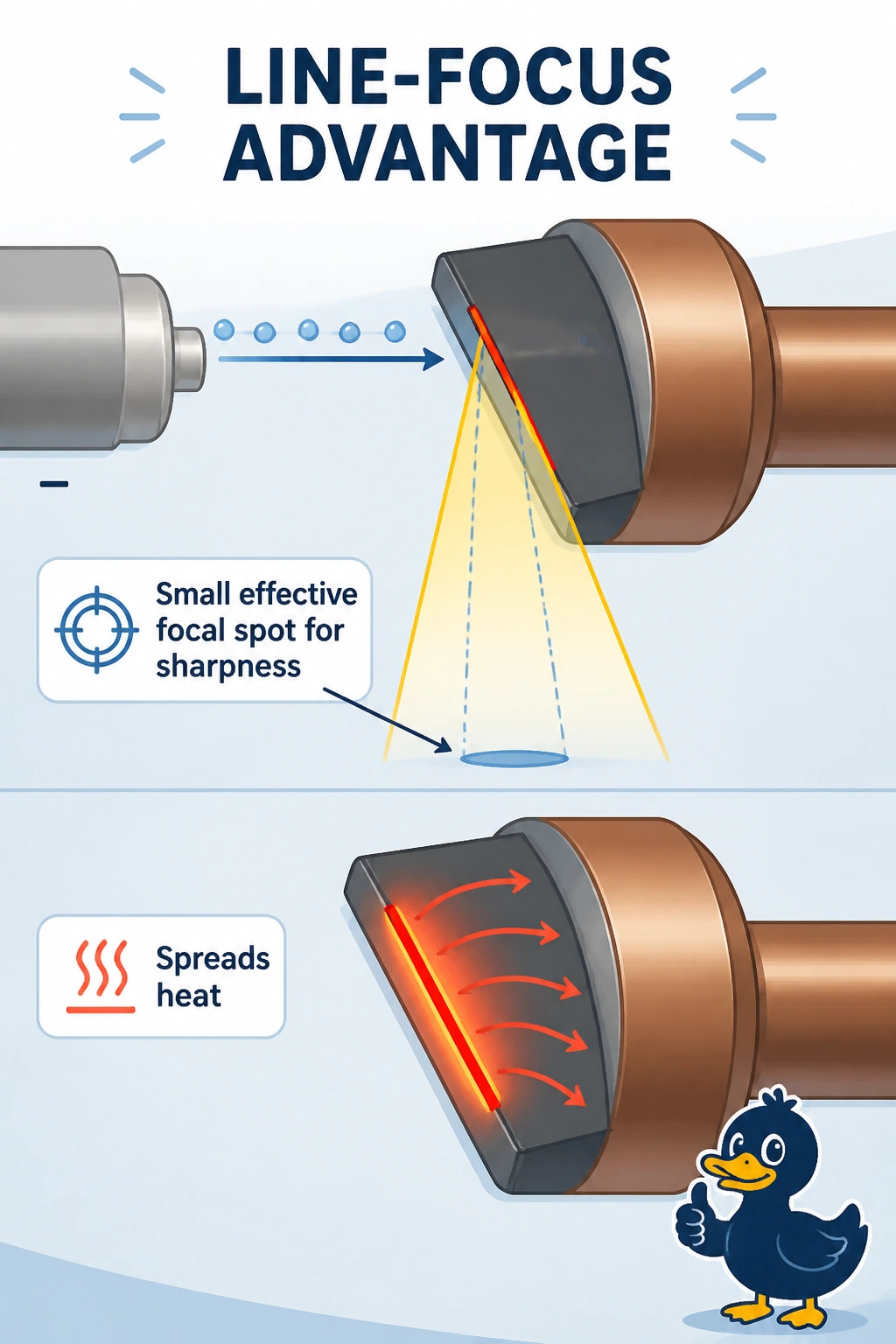
Short Explanation
The line-focus principle is like shining a flashlight at an angle onto a wall—you spread the heat over a wide patch while the beam looks narrow from the front. That angled tungsten target gives you a tiny effective focal spot for crisp image sharpness without melting the anode. Don't fall for the idea that angling the target changes photon wavelength or blocks characteristic radiation.
Full Explanation
Because nearly all kinetic energy of electrons striking the tungsten target converts into heat, a dental X-ray tube must dissipate thermal energy without sacrificing image detail. By angling the target face steeply, the line-focus principle allows electrons to strike a relatively large actual focal spot area—spreading heat safely—while the projected beam exiting downward sees a much smaller apparent source: It yields a small effective focal spot for sharpness while spreading heat, which reduces geometric unsharpness (penumbra) on digital images. It eliminates all characteristic X-ray photon production at the anode target is incorrect because characteristic radiation depends on tube kilovoltage exceeding the tungsten K-shell binding energy, not target angle. It increases primary beam wavelength to boost radiographic image contrast is false because wavelength and beam quality are governed by kVp and filtration rather than target geometry. It directs scattered photons backward toward the cathode focusing cup is wrong because the focusing cup shapes the incoming electron stream before impact, not X-ray scatter afterward. Caveat: if an X-ray tube anode pits or overheats from rapid consecutive exposures without cooling intervals, the effective focal spot degrades and image sharpness suffers. Operational check: follow the manufacturer's duty-cycle cooling intervals during multi-exposure full-mouth series.
Prefer to study offline? Printable PDF study book + test engine ($7.50, unofficial). These questions stay free here.