
During an equipment orientation, a dental assistant learns that the glass envelope of an intraoral X-ray tube is completely evacuated of air. What is the primary functional purpose of maintaining this vacuum during X-ray production?
Select an answer to reveal the explanation.
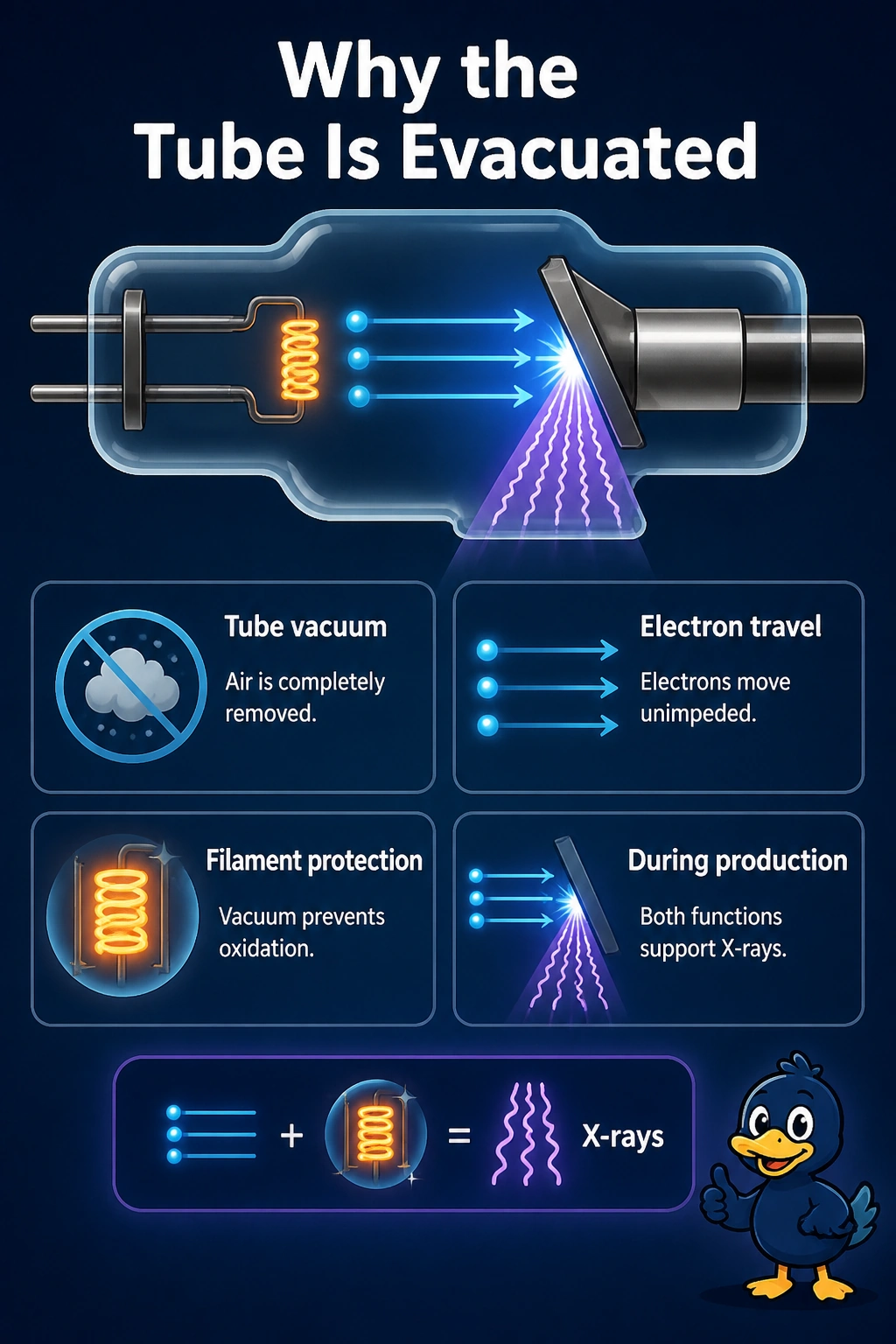
Short Explanation
Think of the X-ray tube vacuum as an oxygen-free highway: your electrons need an empty lane to hit full speed, and the hot tungsten filament would burn out in air. The trap is mixing up the vacuum with the focusing cup, copper stem, or aluminum filter.
Full Explanation
Allow electrons to travel unimpeded and prevent filament oxidation is the primary reason the glass X-ray tube is evacuated of air, ensuring high-speed electrons reach the tungsten target without colliding with gas molecules and preventing the heated cathode filament from burning out. Focus the electron stream onto a small focal spot on the tungsten target is the role of the negatively charged molybdenum focusing cup surrounding the filament, not the vacuum itself. Dissipate extreme heat generated when electrons strike the anode target is accomplished by the copper anode stem and surrounding insulating oil inside the tubehead housing. Filter out low-energy photons before the beam exits the tubehead is performed by inherent glass-and-oil filtration together with added aluminum disks placed across the tubehead port. One caveat is that any crack in the glass envelope breaks the vacuum and immediately renders the X-ray tube inoperable. If an X-ray unit suddenly fails to produce radiation or shows arcing noises during an exposure check, take the unit out of service for qualified technician inspection.
Prefer to study offline? Printable PDF study book + test engine ($7.50, unofficial). These questions stay free here.