
A dental operatory is equipped with a lead-lined partition wall containing a leaded glass viewing window adjacent to the exposure switch. How should the dental assistant position themselves during an intraoral digital exposure?
Select an answer to reveal the explanation.
Short Explanation
Whenever your operatory gives you a shielded wall and viewing window, step behind it—nothing beats solid structural shielding. The trap is relying on open-room distance rules when a dedicated barrier is already mounted right next to the exposure switch.
Full Explanation
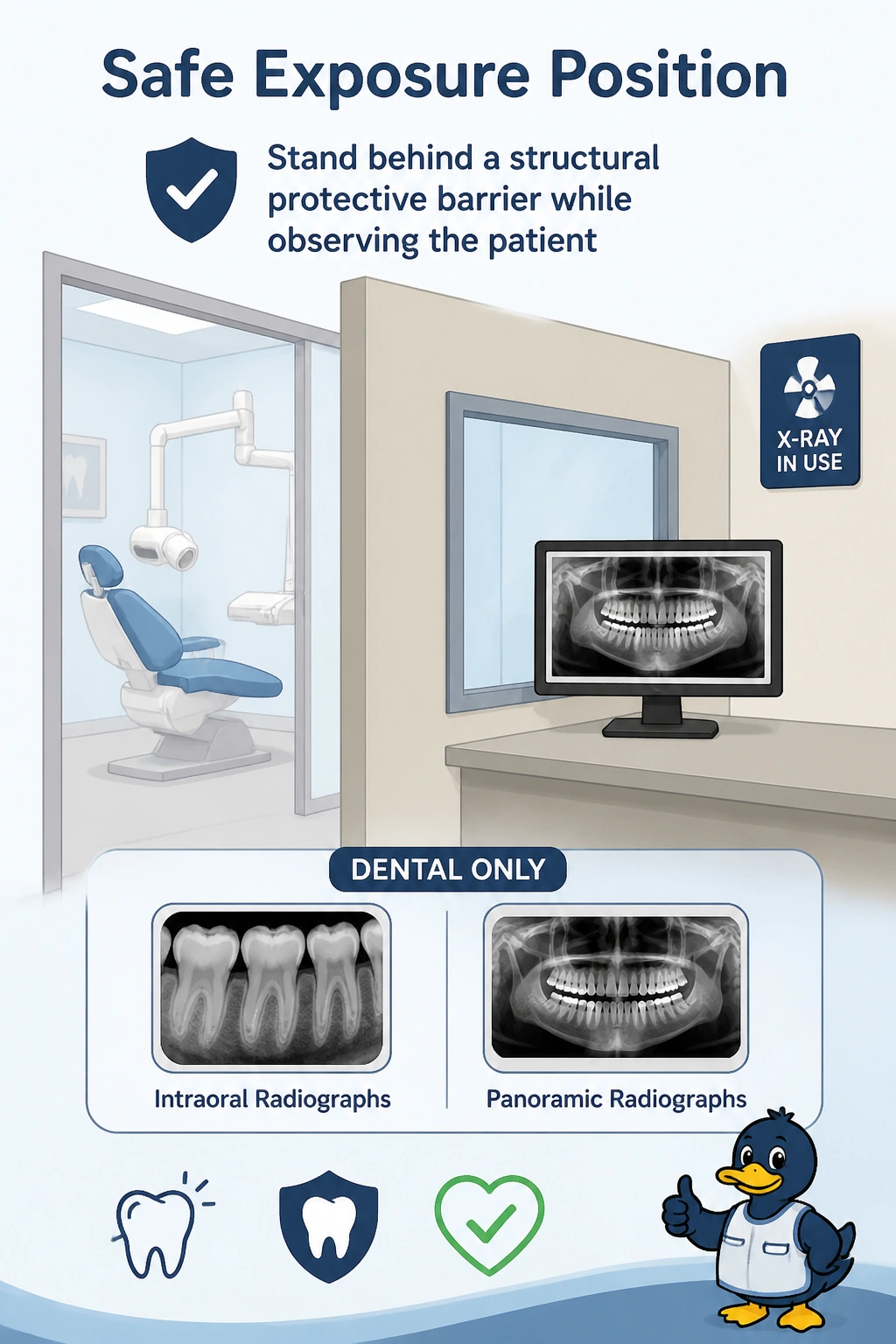
Stand behind a structural protective barrier while observing the patient provides the highest level of occupational radiation protection by attenuating scatter radiation from the patient while allowing the operator to monitor patient stillness through the leaded glass window. Stand four feet behind the patient at a forty-five degree angle to the beam fails both the distance and angle guidelines for rooms without barriers and leaves the operator unnecessarily exposed to scatter when a shielded wall is available. Hold the X-ray tubehead steady from the side opposite the primary X-ray beam is strictly prohibited because operators must never hold the tubehead or position-indicating device during an exposure due to leakage and scatter risks. Stand directly behind the tubehead two feet from the patient's chair places the operator far too close to the patient scatter source and bypasses the protective partition. One caveat is that you must keep your entire body, including your arms and head, behind the barrier while the exposure switch is depressed. Before pressing the button, step fully behind the partition and maintain visual contact with the patient through the viewing window.
Prefer to study offline? Printable PDF study book + test engine ($7.50, unofficial). These questions stay free here.