
A dental assistant increases the exposure time setting on an intraoral digital X-ray unit while keeping kilovoltage peak (kVp) and milliamperage (mA) unchanged. How does this adjustment alter the primary X-ray beam?
Select an answer to reveal the explanation.
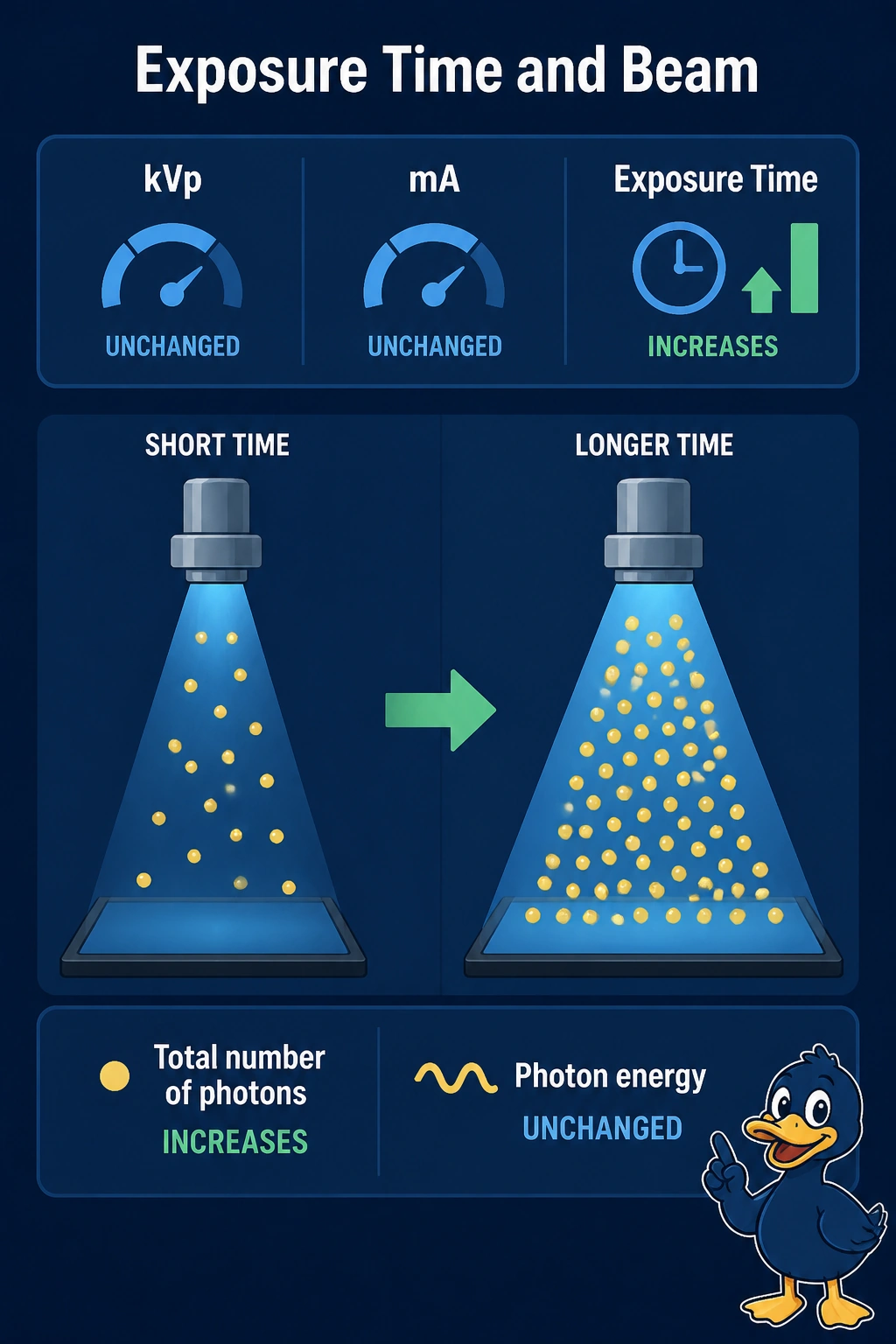
Short Explanation
Exposure time works just like leaving a garden hose running longer—you get more water, not higher water pressure. The trap is thinking extra seconds make the X-ray beam more penetrating, when only kVp controls photon energy.
Full Explanation
It increases the total number of photons without changing their energy because exposure time simply controls how long high-speed electrons strike the tungsten target at the same accelerating voltage. Raising time increases beam quantity proportionally—just like raising milliamperage—while beam quality remains fixed by the kVp setting. It increases both the total number of X-ray photons and their average penetrating energy is incorrect because photon energy depends on peak voltage across the tube, not exposure duration. It increases the average photon energy while leaving the total photon count unchanged describes raising kVp alone rather than lengthening exposure time. It decreases the wavelength of the primary beam to improve tissue penetration also refers to increasing kVp, which shifts the spectrum toward shorter, higher-energy wavelengths. Keep in mind as a caveat that longer exposure times increase patient radiation dose and the risk of motion unsharpness. As an operational check, confirm the anatomical region and patient size on the unit's exposure chart before adjusting timer settings so dose stays within ALARA limits.
Prefer to study offline? Printable PDF study book + test engine ($7.50, unofficial). These questions stay free here.