
A dental practice is replacing an older alternating-current (AC) intraoral X-ray unit with a direct-current (DC) constant-potential generator. How does the DC generator reduce unnecessary patient skin dose during digital exposures?
Select an answer to reveal the explanation.
Short Explanation
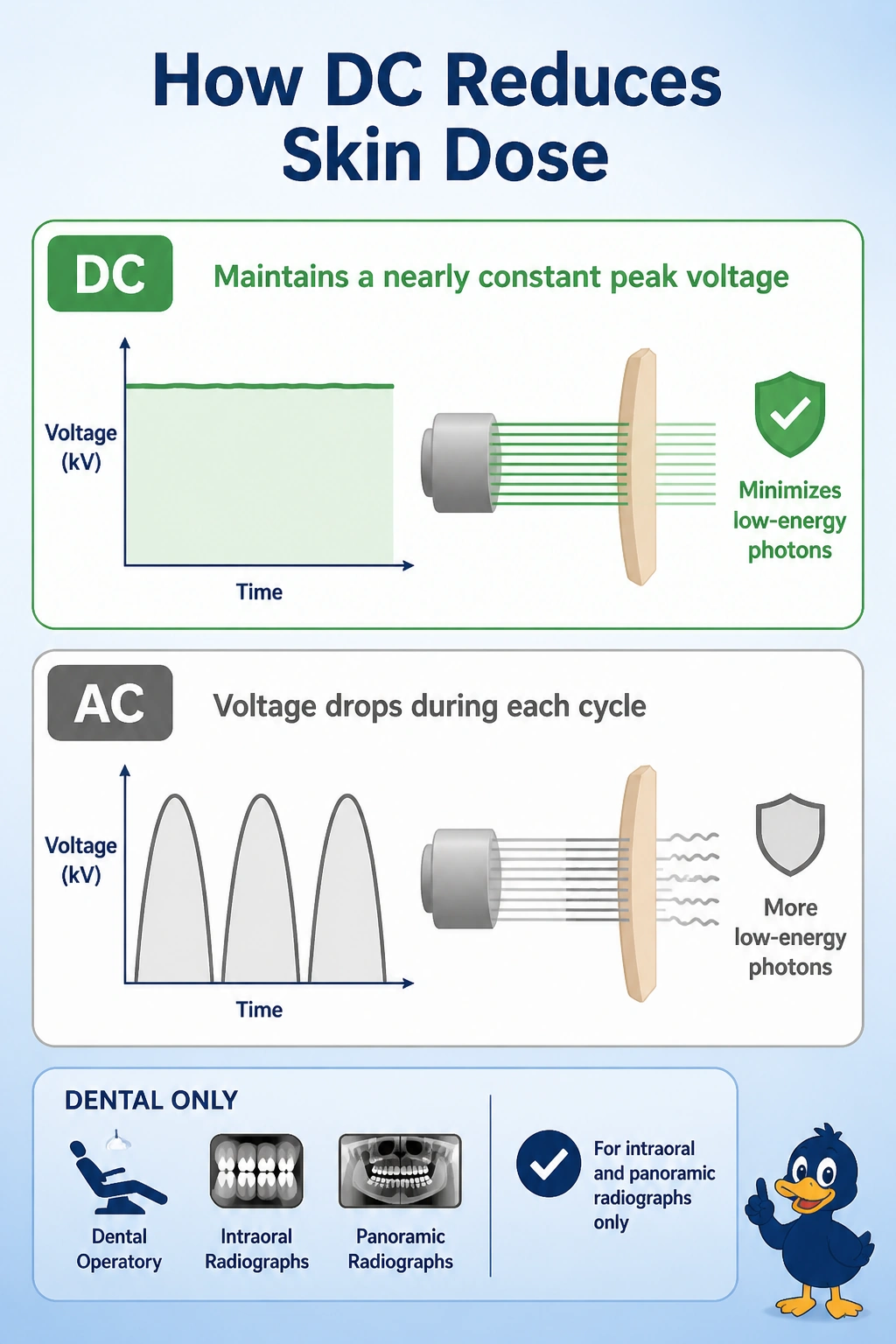
An older AC generator lets voltage rise and fall like a roller coaster, throwing weak X-rays at the patient's cheek on every swing. A DC unit keeps voltage steady at the top of the hill so you get diagnostic penetration without wasting soft photons on skin.
Full Explanation
It maintains a nearly constant peak voltage, minimizing low-energy photons because a high-frequency direct-current (DC) generator converts alternating line power into a steady potential across the X-ray tube. Without the repeated voltage dips of an AC waveform, fewer weak, long-wavelength photons are produced that would otherwise be absorbed superficially by the patient's skin without reaching the digital sensor. It eliminates the need for aluminum filtration in the tubehead is false because added aluminum filtration is still required to remove remaining low-energy photons from the primary beam. It restricts X-ray emission to only the negative half of the cycle describes self-rectified AC operation, where no X-rays are produced during the inverse half-cycle rather than constant-potential DC output. It replaces tungsten with a copper target to lower photon energy is incorrect because tungsten remains the target material for X-ray production while copper serves as the heat-dissipating stem. As a physics caveat, DC units produce a higher mean beam energy at the same nominal kVp setting, so exposure times are typically shorter. For a concrete operational check, verify that the practice's digital sensor exposure chart is calibrated specifically for the DC generator's output rather than copied from the legacy AC unit.
Prefer to study offline? Printable PDF study book + test engine ($7.50, unofficial). These questions stay free here.