
Inside an intraoral dental X-ray machine, an autotransformer sits between the incoming alternating-current power line and the high-voltage step-up transformer. What is the primary electrical function of this autotransformer during an exposure?
Select an answer to reveal the explanation.
Short Explanation
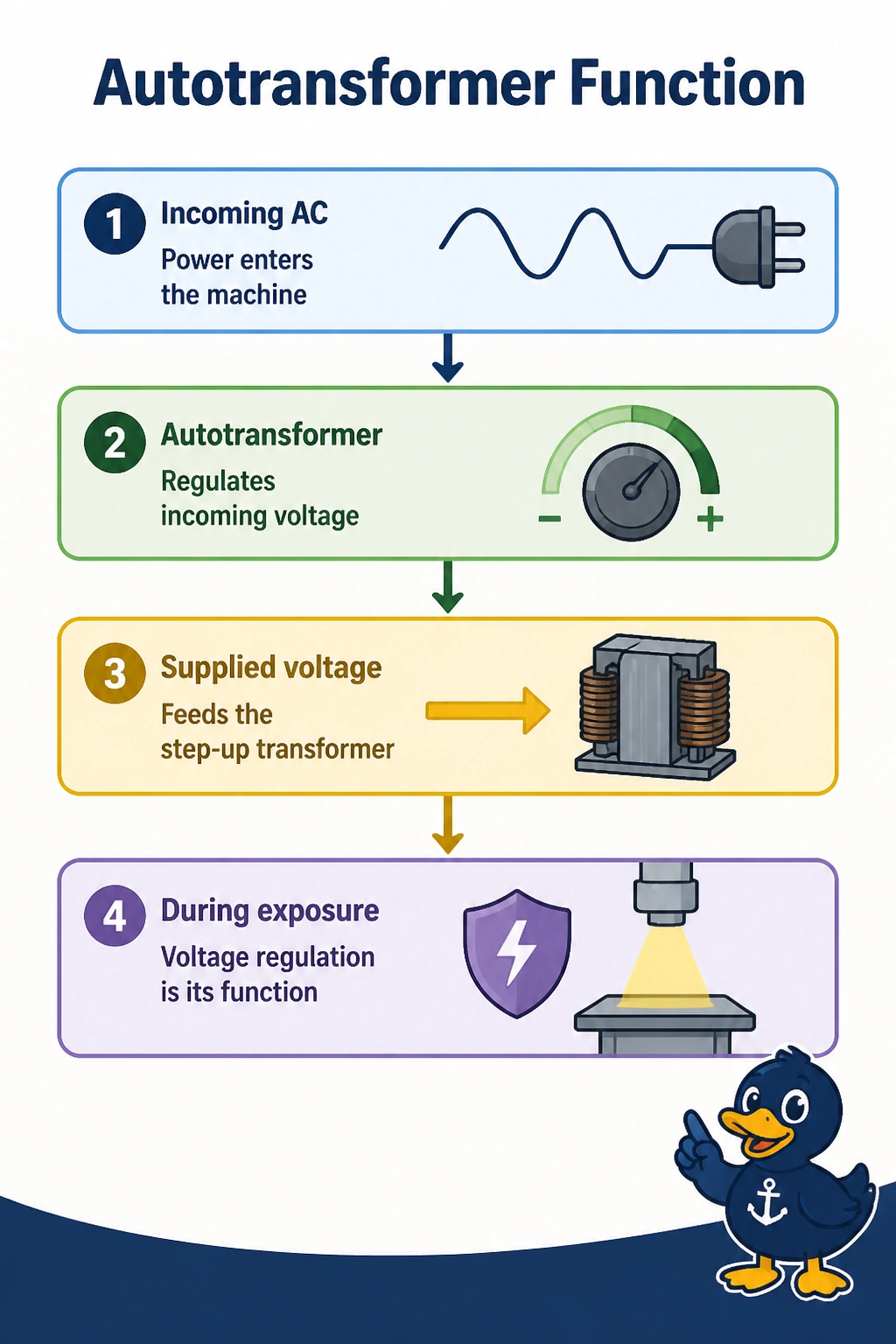
Think of the autotransformer as a dimmer switch that dials in just the right voltage before the big power boost happens. You rely on it to adjust the line voltage fed into the step-up transformer, which sets the beam's penetrating energy. The trap is confusing it with the step-down transformer that heats the filament or the aluminum filter that trims weak photons.
Full Explanation
During an intraoral exposure, the autotransformer's primary role is that It regulates the incoming voltage supplied to the step-up transformer, allowing the operator or preset control to select the desired kilovoltage peak (kVp). By tapping different windings on a single coil, the autotransformer compensates for minor line-voltage fluctuations and delivers a precise voltage to the high-voltage circuit. By contrast, It converts alternating current into direct current before photons are generated describes rectification circuitry in constant-potential generators rather than the autotransformer. Meanwhile, It heats the tungsten cathode filament to release free electrons by thermionic emission is the job of the low-voltage step-down transformer in the filament circuit. Lastly, It absorbs low-energy photons from the primary beam before they exit the tubehead describes aluminum filtration rather than an electrical transformer. As a caveat, many modern digital units lock kVp at a fixed setting, so the autotransformer operates automatically behind the scenes. For an operational check, inspect the control-panel kVp indicator before exposure to confirm the selected penetrating power matches the diagnostic task.
Prefer to study offline? Printable PDF study book + test engine ($7.50, unofficial). These questions stay free here.