
During an office equipment review, a dental assistant asks why modern intraoral X-ray units use an open-ended, lead-lined position-indicating device (PID) rather than an older pointed, closed-end plastic cone. What is the primary radiation-protection reason for this design?
Select an answer to reveal the explanation.
Short Explanation
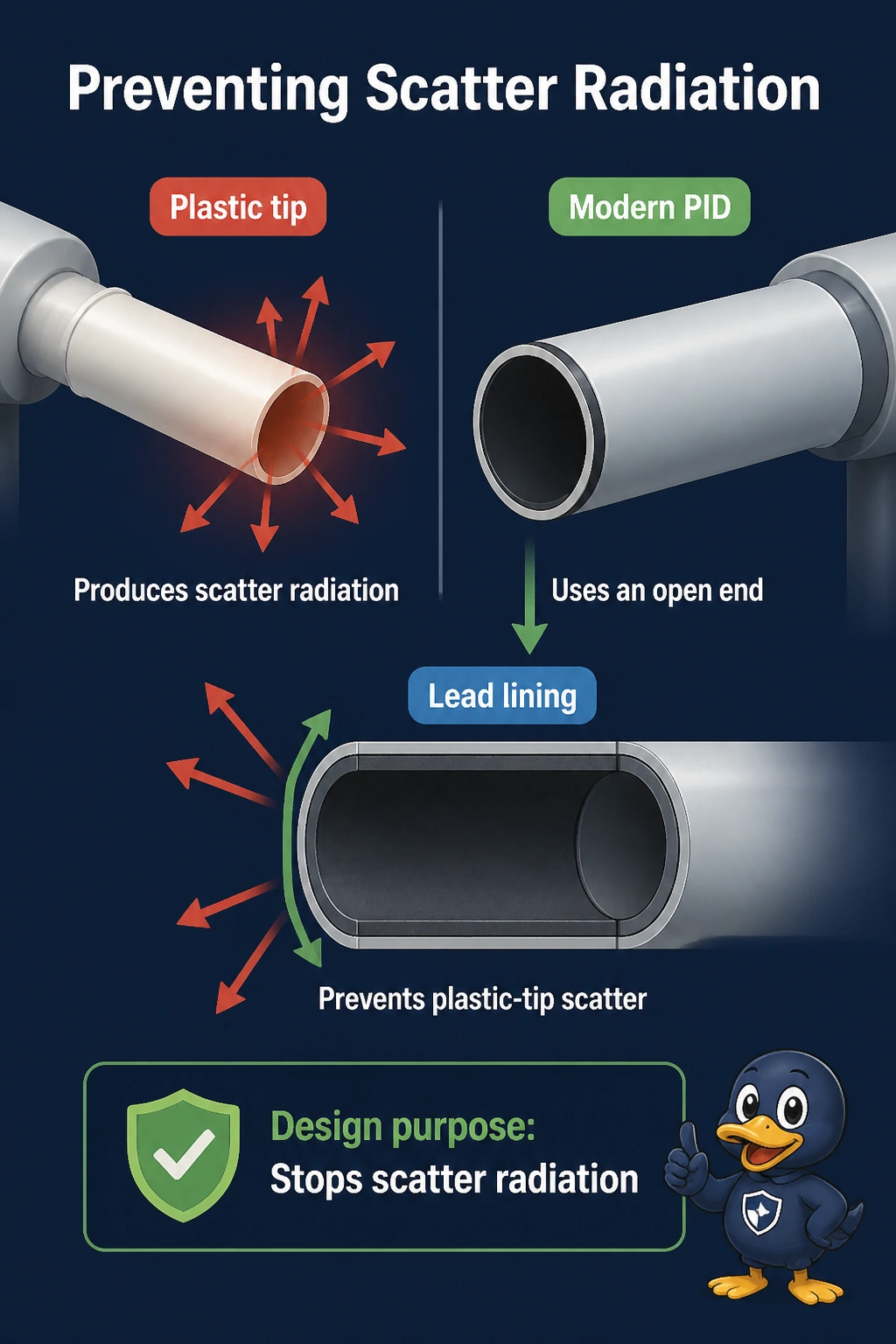
An open-ended, lead-lined PID keeps the X-ray beam clean by not giving photons a plastic tip to bounce off on their way to your patient. The trap is thinking the open tube changes beam energy or replaces aluminum filtration, when its real job is stopping extra scatter.
Full Explanation
It prevents scatter radiation produced by a plastic tip because an open-ended cylinder or rectangle lets the primary X-ray beam pass through air while its internal lead lining absorbs off-axis photons, whereas a pointed closed-end plastic cone causes photons to interact with the plastic and generate unnecessary secondary scatter toward the patient's face. It increases the kilovoltage peak of the primary beam is incorrect because beam energy and penetration are controlled by the high-voltage transformer and kVp selector, not the PID shape or lining. It removes the need for a lead collimator at the tubehead port is incorrect because a lead diaphragm at the port is still required to define beam size, while the PID lining only absorbs divergent photons along its length. It eliminates the need for added aluminum filtration is false because aluminum disks inside the tubehead are still required to remove low-energy photons from the primary beam. As a caveat, even with an open-ended lead-lined PID, scatter still originates from the patient's tissues during exposure, so operators must maintain proper distance and shielding. Perform an operational check by inspecting the PID for cracks or loose attachment and using rectangular collimation whenever compatible with the receptor holder.
Prefer to study offline? Printable PDF study book + test engine ($7.50, unofficial). These questions stay free here.