
A clinician is reviewing a cone-beam computed tomography (CBCT) scan to evaluate the anterior-posterior dimension of the upper airway and the labiolingual inclination of a maxillary central incisor. Which multiplanar viewing plane provides this lateral profile?
Select an answer to reveal the explanation.
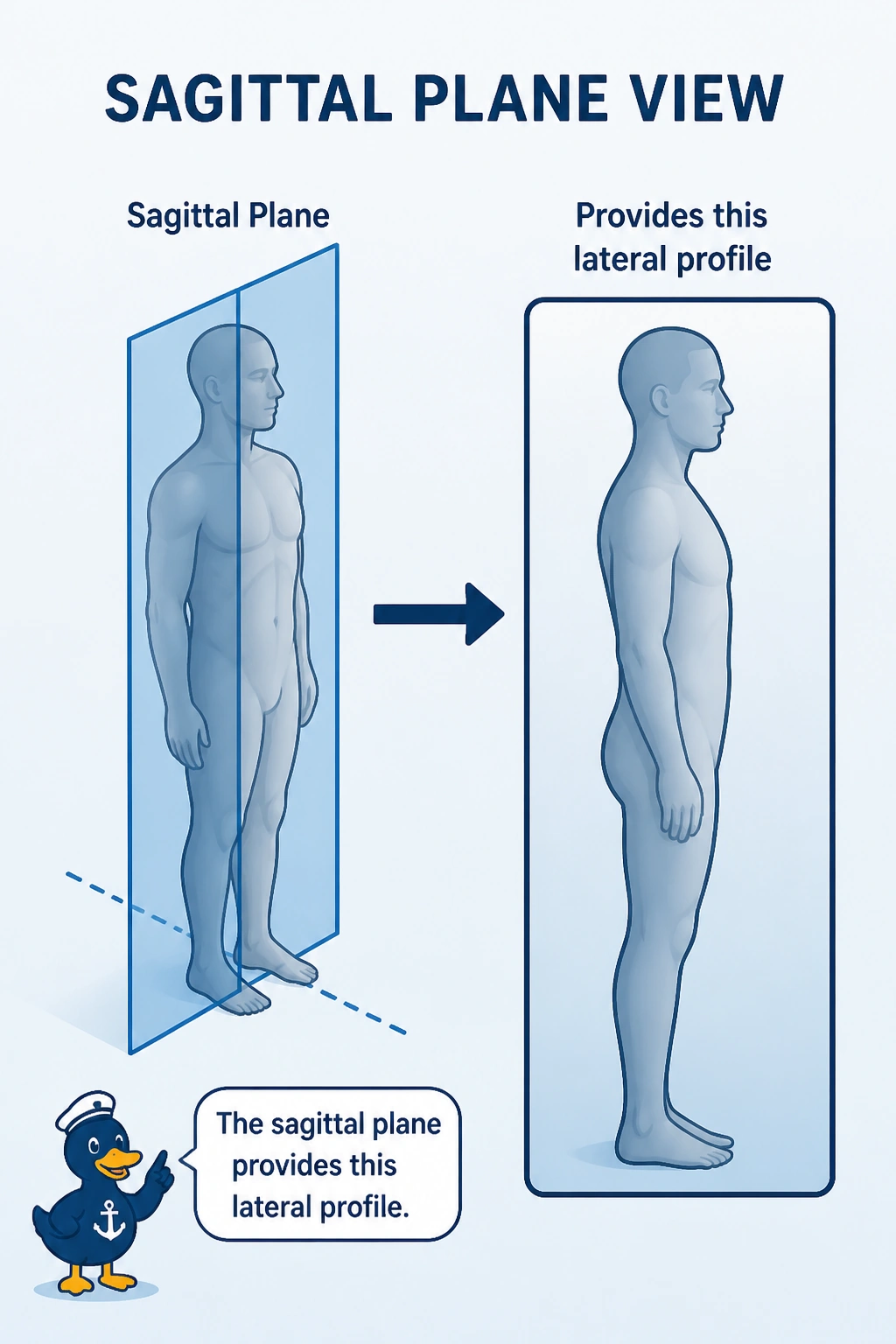
Short Explanation
Picture looking straight at the side of your patient’s face to trace how far forward an incisor tilts or how wide the airway runs front to back. That side-profile view is exactly what the sagittal plane delivers on a CBCT scan. The coronal plane is the tempting alternative, but it gives you a face-on view rather than a side profile.
Full Explanation
Multiplanar reconstruction in cone-beam computed tomography (CBCT) displays three-dimensional volume data in three orthogonal planes. The sagittal plane divides the body into left and right sections, providing a lateral profile that reveals anterior-posterior airway dimensions and the labiolingual inclination of anterior teeth. By contrast, the coronal plane divides the body into anterior and posterior sections, showing a facial view or buccolingual cross-sections of posterior teeth rather than an anterior-posterior profile. The axial plane divides the body into superior and inferior sections, producing a top-down horizontal slice suited to viewing arch form or root canal orifices. The panoramic (curved) reconstruction plane follows the curve of the dental arch to create an unrolled panoramic view, so it distorts true anterior-posterior relationships rather than providing an orthogonal lateral profile. As an exam caveat, in a curved dental arch, a standard orthogonal sagittal slice aligns cleanly only with midline structures such as central incisors; posterior teeth require a custom oblique or parasagittal slice. For a practical check, verify that the vertical reference line passes through the long axis of the maxillary central incisor in both the axial and coronal windows before measuring inclination.
Prefer to study offline? Printable PDF study book + test engine ($7.50, unofficial). These questions stay free here.