
When positioning a patient in a digital panoramic unit, why must the dental assistant carefully align the patient's dental arches within the machine's three-dimensional focal trough?
Select an answer to reveal the explanation.
Short Explanation
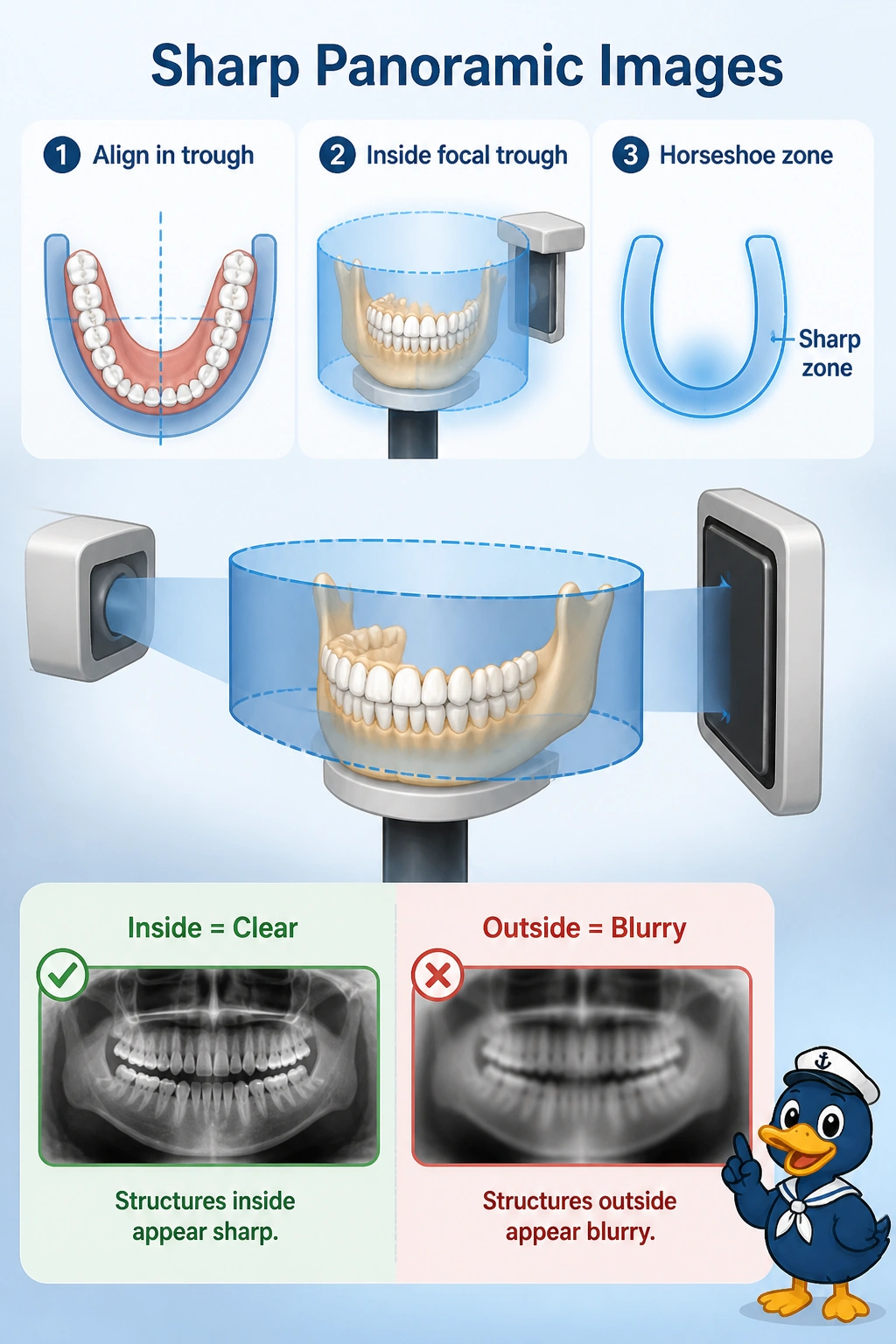
Think of the panoramic focal trough as a narrow, horseshoe-shaped spotlight where your patient's teeth must sit to stay in focus. Structures inside that curved zone record sharply, while teeth placed too far forward or back blur out. The trap is thinking focal trough alignment prevents metallic ghost images or lets a thyroid collar be worn safely.
Full Explanation
A digital panoramic unit uses rotational tomography, moving the X-ray source and receptor simultaneously around the patient's head so that only anatomy within a curved three-dimensional focal trough remains in focus. Aligning the dental arches within this zone is necessary To ensure structures inside the horseshoe-shaped zone appear sharp and clear, because objects anterior or posterior to the focal trough are intentionally blurred by the rotational motion. Alignment does not serve To keep the tubehead from rotating past the shoulders, which is managed by upright posture and lowering the shoulders. Positioning inside the focal trough also cannot function To eliminate all ghost images from metallic fillings, because dense metal outside the trough—such as earrings or jewelry—still casts contralateral ghost shadows. Nor does it work To allow a thyroid collar to be worn without artifact, as a thyroid collar sits in the primary beam path and still creates a dense midline radiopacity. As a caveat, the focal trough is narrowest in the anterior region, making incisor sharpness especially sensitive to small bite-stick errors. For an operational check, confirm the patient's incisors rest in the notched bite-stick groove and the lateral laser aligns with the canine or specified landmark.
Prefer to study offline? Printable PDF study book + test engine ($7.50, unofficial). These questions stay free here.